Introduction
Getting shortlisted for a first software development job can be challenging, especially when candidates have limited professional experience. Many fresh graduates understand programming concepts and complete academic assignments, but they may struggle to present their abilities in a way that helps recruiters evaluate their readiness for an entry-level role.
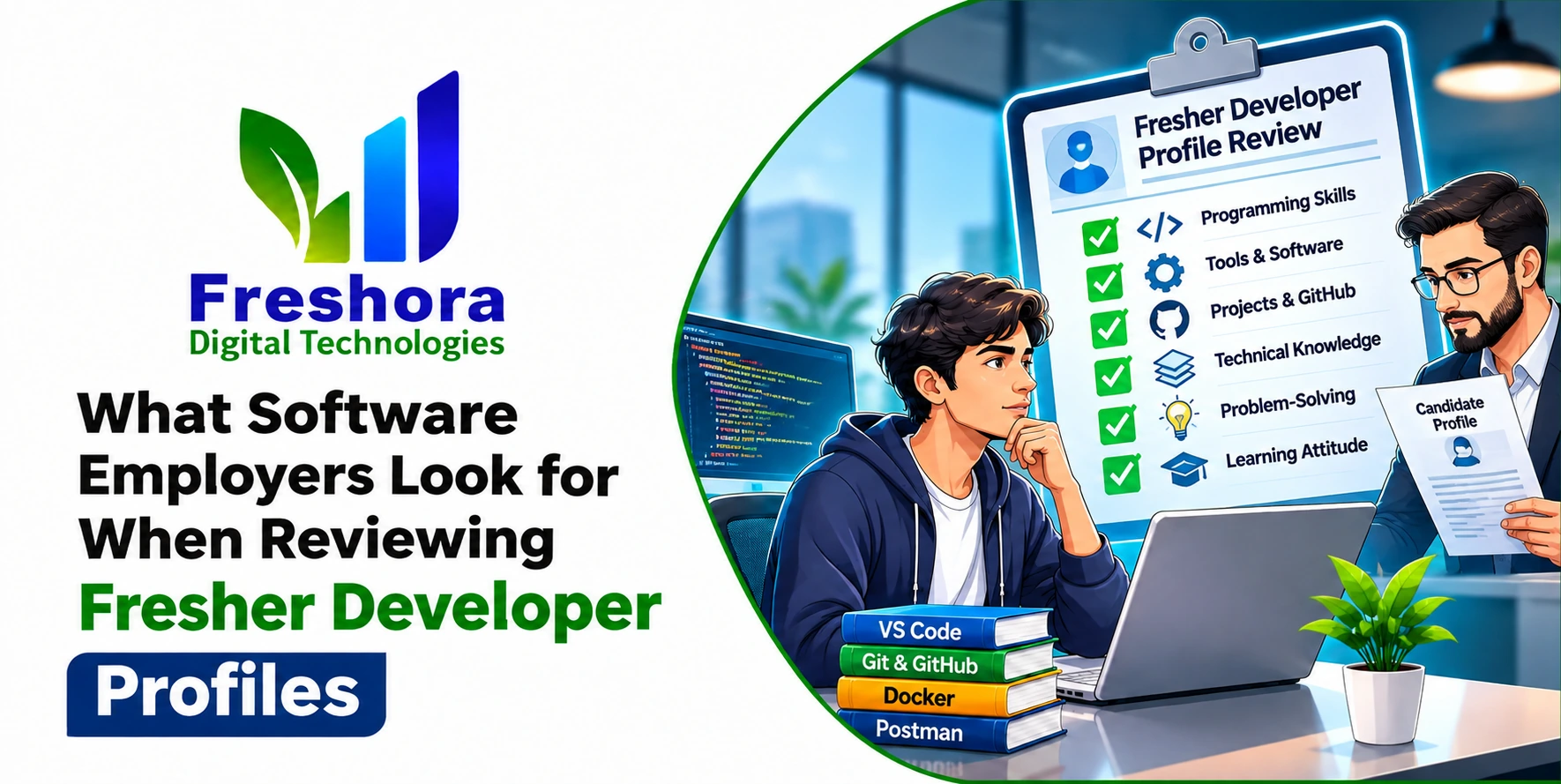
Employers reviewing fresher developer profiles generally look beyond degree details and lists of programming languages. They want to understand what a candidate knows, how they apply technical concepts, whether they can solve practical problems and how clearly they communicate their work.
A well-prepared developer profile helps recruiters identify relevant skills without having to guess what a candidate can actually do. Understanding what employers look for in fresher developer profiles can help graduates organise their resumes, projects, portfolios and technical information more effectively.
1. Clear Technical Skills Relevant to the Job Role
One of the first areas employers review is the candidate's technical skill set. However, listing several programming languages does not automatically demonstrate development ability.
The skills mentioned in a profile should match the responsibilities of the position. For example, a junior front-end developer profile may include HTML, CSS, JavaScript and responsive design. A candidate applying for a Python developer position may highlight Python fundamentals, object-oriented programming, SQL and basic application development.
Employers may also look for familiarity with development tools, databases, version control and debugging practices, depending on the role.
Freshers should prioritise skills they can explain and demonstrate. A shorter, accurate skills section is often more useful than a long list of technologies with which the candidate has limited experience.
2. Practical Projects That Demonstrate Development Ability
Projects help employers understand how candidates apply their knowledge outside theoretical learning. They provide evidence of practical involvement and can create useful discussion points during technical interviews.
A fresher developer profile can include academic projects, personal applications, internship assignments or independently developed solutions.
For each project, candidates should explain:
-
Project Objective: What problem does the project address?
-
Technology Stack: Which programming languages, frameworks, databases or tools were used?
-
Personal Contribution: Which features or components did the candidate develop?
-
Implementation: How does the application work?
-
Challenges: What technical issues occurred and how were they handled?
-
Outcome: What was completed, tested or improved?
For example, a candidate who developed a student management application could describe its login functionality, student record operations, database structure and validation process.
The purpose is not to make every project appear complex. Employers benefit more from understanding the candidate's actual contribution than from reading exaggerated project descriptions.
3. A Functional Portfolio and Accessible Project Links
A portfolio can help freshers demonstrate their development work beyond the information available in a resume. It gives recruiters an opportunity to review actual project interfaces, source code and implementation decisions.
Depending on the role, a portfolio may contain responsive websites, web applications, programming projects, APIs or database-driven applications.
Candidates should ensure that shared project links work correctly. A portfolio should not contain unfinished pages, broken navigation or inaccessible demonstrations. If a project is hosted on GitHub, the repository should have a meaningful description and clear setup instructions.
A useful portfolio also explains the purpose of each project, the technologies involved and the candidate's contribution. This makes it easier for employers to evaluate the work without spending unnecessary time understanding its background.
4. Problem-Solving and Programming Fundamentals
Technical knowledge is not limited to remembering programming syntax. Software developers regularly need to understand requirements, break problems into smaller steps, identify errors and develop workable solutions.
Employers may evaluate fresher candidates through coding exercises, technical questions or discussions about their projects.
Important fundamentals can include variables, data types, conditions, loops, functions, arrays, objects, data structures and basic algorithms. The expected depth depends on the job role and employer.
Candidates should practise explaining how their code works rather than memorising solutions. They should also be comfortable identifying logical errors and describing alternative approaches when a solution does not work as expected.
A profile that demonstrates practical problem-solving through projects can provide a stronger foundation for technical discussions.
5. Understanding of Databases and Application Development
Many entry-level software development roles involve working with data. Employers may therefore look for basic database knowledge and an understanding of how applications store, retrieve and process information.
Candidates interested in web or software development can demonstrate familiarity with SQL, relational database concepts, tables, primary keys, relationships and basic queries.
For application development roles, understanding how the front end communicates with a back end can also be useful. Depending on the position, candidates may be expected to know about APIs, server-side logic, authentication and data validation.
Freshers do not need to claim expertise in every part of a software architecture. They should clearly communicate what they have implemented and identify the areas they are still learning.
6. GitHub Activity and Code Quality
For many development roles, a GitHub profile provides another way to review a candidate's technical work. It can show project organisation, source code, documentation and development activity.
However, simply sharing a GitHub link is not enough. The repositories should contain meaningful projects that are easy to understand.
Candidates should pay attention to:
-
Clear repository names and descriptions.
-
Readable code and consistent file organisation.
-
Useful README documentation.
-
Relevant commit messages.
-
Instructions for running the project.
-
Screenshots or demonstrations where appropriate.
-
No exposed passwords, API keys or confidential information.
Employers may not review every line of code, but a well-organised repository makes a candidate's work easier to evaluate and discuss.
7. Resume Quality and Professional Presentation
A fresher's resume should make important information easy to find. Recruiters reviewing several applications need to identify a candidate's qualifications, skills and relevant work without searching through unnecessary details.
A clear developer resume generally includes contact information, educational qualifications, technical skills, projects, internships, certifications and relevant achievements.
Project descriptions should focus on what was built and which technologies were used. Statements such as "Developed a responsive website using HTML, CSS and JavaScript" are more informative than generic descriptions such as "Worked on a web project."
Candidates should also check spelling, formatting, dates and contact information before submitting applications. The resume should be tailored to the job role instead of using the same generic version for every position.
8. Communication and Ability to Explain Technical Work
Software development involves collaboration with other developers, testers, designers, project managers and business teams. Therefore, communication is relevant even for candidates applying to technical positions.
Employers may assess whether freshers can explain their projects, understand instructions, ask appropriate questions and communicate technical challenges.
During an interview, candidates should be prepared to describe why they selected a particular technology, how they approached a problem and what they would improve if they developed the project again.
Clear communication does not require complicated technical language. Explaining a solution accurately and logically is more valuable than using unfamiliar terminology without understanding it.
9. Learning Ability and Adaptability
Technology changes continuously, and entry-level developers are often expected to learn new tools, frameworks and development practices after joining an organisation.
Employers may therefore look for evidence that candidates can learn independently, accept feedback and improve their work.
Examples include completing a project using an unfamiliar technology, learning a new framework for an academic assignment or improving an existing application after identifying its limitations.
Candidates can include relevant certifications and learning activities in their profiles, but they should also be ready to explain what they learned and how they applied it.
A willingness to learn becomes more convincing when supported by practical examples.
10. How Freshers Can Improve Their Developer Profiles Before Applying
Building a strong profile requires more than adding additional skills or certificates. Candidates should organise their preparation around the type of software role they want to pursue.
A practical improvement process can include the following steps.
Step 1 – Select a Target Role: Choose a specific direction such as front-end development, back-end development, full-stack development, Python development or software testing.
Step 2 – Review Job Descriptions: Identify recurring technical requirements and compare them with current knowledge and experience.
Step 3 – Improve Technical Fundamentals: Strengthen programming concepts, databases, debugging and the tools relevant to the selected role.
Step 4 – Complete Practical Projects: Build projects that demonstrate the ability to implement useful features and solve identifiable problems.
Step 5 – Organise GitHub Repositories: Add meaningful descriptions, documentation and working project instructions.
Step 6 – Prepare a Role-Specific Resume: Highlight relevant technical skills, project contributions and practical experience.
Step 7 – Practise Technical Explanations: Prepare to discuss project architecture, code decisions, challenges and possible improvements.
This process helps candidates present a more consistent profile across resumes, portfolios, professional networking platforms and job applications.
11. Finding Suitable Entry-Level Software Development Opportunities
Once a developer profile is ready, candidates can begin exploring relevant entry-level vacancies. Searching with specific job titles can help identify opportunities that match their current abilities.
Common search terms include junior software developer, graduate software engineer, trainee programmer, junior web developer, front-end developer trainee and Python developer trainee.
Candidates can also explore recruitment platforms, company career pages and professional networking channels. When comparing opportunities, they should review experience requirements, technical expectations, location, employment type and application instructions.
Fresh graduates who want to understand how recruitment platforms differ can refer to this guide: Top Entry-Level IT Job Portals for Freshers in India: Roles, Filters and Application Features Compared. It explains different job discovery platforms and the features candidates can use when searching for entry-level IT opportunities.
The most suitable vacancy is not necessarily the one with the most attractive job title. Candidates should prioritise roles where the responsibilities and technical requirements align with their current preparation and career direction.
12. Common Profile Mistakes That Can Affect Shortlisting
Even candidates with good technical knowledge may weaken their applications through avoidable profile issues.
Some common mistakes include listing programming languages without practical knowledge, describing projects without explaining personal contributions, sharing broken portfolio links and submitting resumes with outdated information.
Another issue is using the same project description for different job roles. A front-end developer application should emphasise relevant interface and browser-side work, while a back-end developer application may need more detail about APIs, databases and server-side implementation.
Candidates should also avoid copying project descriptions or exaggerating their responsibilities. Recruiters may ask detailed questions about the work, making inaccurate claims difficult to defend.
A consistent, honest and clearly organised profile gives employers a more reliable understanding of a fresher's capabilities.
Conclusion
Employers reviewing fresher developer profiles generally want to understand more than academic qualifications. Technical skills, practical projects, programming fundamentals, code organisation, communication and learning ability can all contribute to how a candidate is evaluated.
Fresh graduates can improve their profiles by choosing a target role, developing relevant skills, completing demonstrable projects and presenting their work through a clear resume and portfolio. They should also ensure that every technical claim is accurate and supported by practical knowledge.
For businesses and technology teams, a well-structured fresher profile makes it easier to identify relevant capabilities during early recruitment stages. For candidates, thoughtful profile preparation creates a stronger starting point for technical discussions and entry-level software development opportunities.