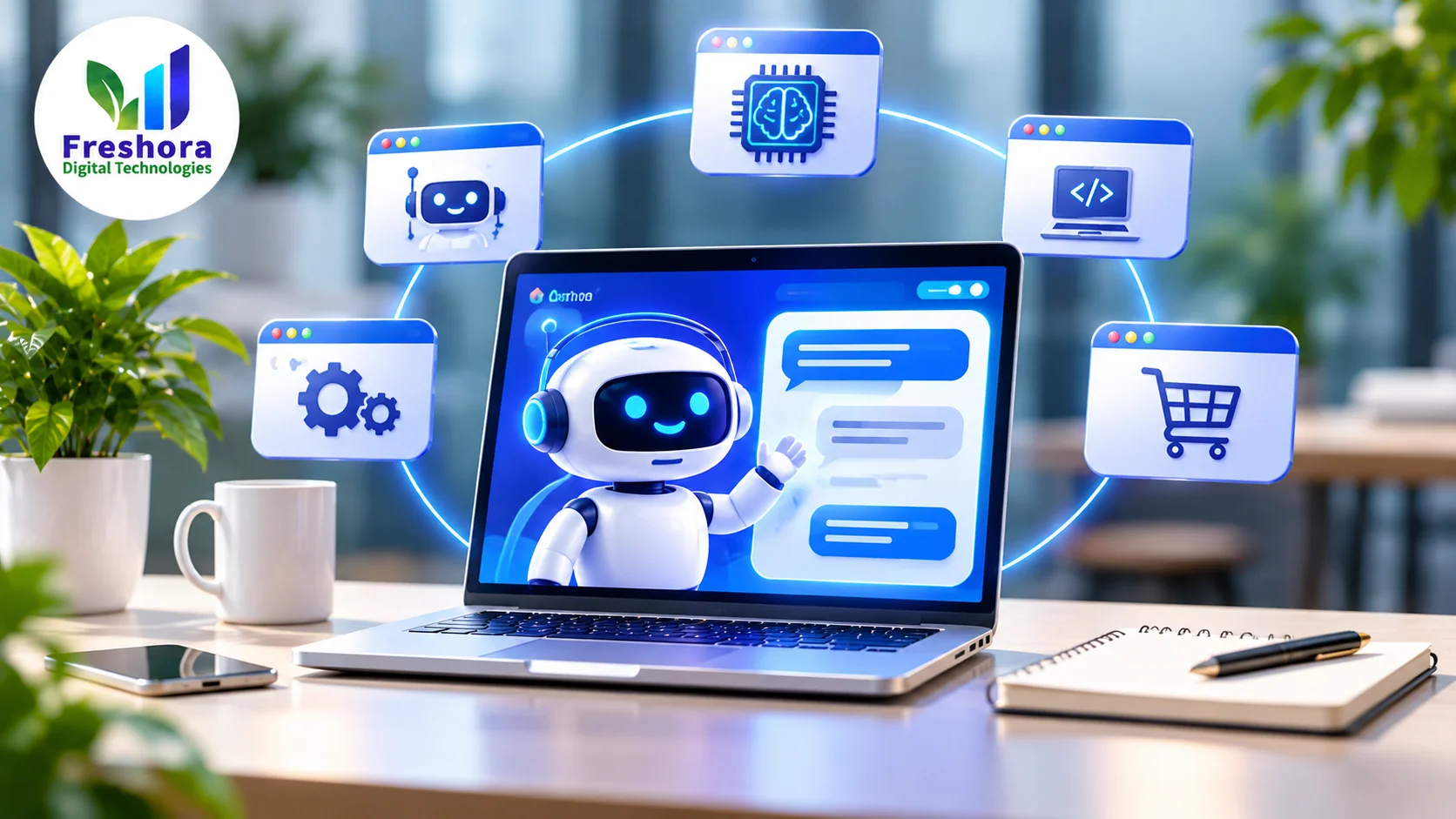
Create useful AI-powered conversations that support customers, assist shoppers and connect enquiries with your team.
Customers often expect quick answers when they visit a website, browse products or look for support. An AI chatbot can make that experience more accessible by helping visitors find information, understand available options and move towards an appropriate next step.
Freshora is an AI Chatbot Development Company in Trichy, building conversational experiences around real business requirements. Our AI Chatbot Development Services can cover website assistants, e-commerce conversations, customer support workflows and lead qualification.
We plan each chatbot around its intended audience, approved knowledge sources, conversation boundaries and the systems it needs to work with. Where required, AI Chatbot Integration Services can connect the experience with selected business platforms and APIs.
The goal is not to add a chatbot simply for appearance. It is to create a practical digital assistant with useful responses, clear limitations and a reliable route to human support when a conversation needs personal attention.

A useful chatbot starts with a defined purpose. Freshora can shape the conversation, knowledge and integration requirements around the workflows that matter to your organisation.
Help visitors explore services, understand key information and find the right page or enquiry channel through a guided website conversation.
Support product discovery, product questions, delivery information and common shopping queries. Order-specific features depend on secure commerce integration.
Respond to recurring support questions using approved help content, guide users through defined steps and offer escalation when an issue needs a person.
Ask relevant qualifying questions, collect enquiry details with appropriate notice and route potential opportunities to the correct sales contact.
Connect the chatbot with selected websites, CRM platforms, helpdesks, catalogues or internal APIs where access and integration options are available.
Organise approved business information so the chatbot can retrieve relevant answers and stay within the topics and sources defined for it.
An e-commerce chatbot can help visitors navigate a large catalogue by responding to product questions, explaining categories and directing shoppers to relevant items. It can also make store information easier to find, including shipping, returns, payment methods and customer service options.
For a more connected experience, the chatbot may use approved product data or connect with store services. Features such as live stock availability, personalised recommendations, customer account details and order tracking require the appropriate platform integration, permissions and testing.
Freshora designs e-commerce conversations around the store’s catalogue, customer journey and operational rules. Responses should reflect current information and avoid making promises about stock, delivery or refunds unless those details are available from a trusted source.
The chatbot can also provide a clear route to a human agent for complex product questions, payment issues or situations that need individual review.
Support teams often receive repeated questions about services, account processes, booking steps, product usage and business policies. An AI customer support chatbot can handle suitable first-level questions using approved help articles and structured answers, allowing customers to find information without searching through multiple pages.
The chatbot should be configured with clear topic boundaries and a defined response when it cannot find reliable information. It should not invent policy details, expose private records or present uncertain answers as confirmed facts. Sensitive or account-specific requests should use secure verification and approved system workflows.
Human handoff is an important part of the design. When a customer is dissatisfied, asks for an exception or raises a complex issue, the chatbot should explain how to reach the support team and pass along relevant conversation context where the system allows it.
For more context on conversational support, explore our article about how AI chatbots improve customer service.
A lead generation chatbot can ask visitors what they are looking for, identify the service or product they are interested in and collect relevant details for a follow-up. Instead of presenting a long form at the beginning, a conversational flow can gather information in smaller, understandable steps.
Qualification questions should be relevant and proportionate. Depending on the business, they may cover the type of requirement, location, preferred timeline or project context. Contact details should be requested transparently, with appropriate consent and privacy information.
With a suitable integration, qualified enquiries can be routed to a CRM, email workflow or sales team. The exact fields, assignment rules and notifications should be mapped before development so that the chatbot supports the existing sales process rather than creating disconnected records.
Read our guide on how AI chatbots improve customer support efficiency for additional context on conversational automation.
A chatbot becomes more useful when it can work with reliable business information and approved processes. Integration planning identifies which systems the chatbot can access, what information it may use and which actions it is allowed to perform.
Embed the chatbot into the relevant website or application interface and align its behaviour with the user journey.
Send permitted enquiry details to supported CRM workflows, with agreed field mapping, validation and routing rules.
Create or route support requests where the selected helpdesk provides suitable APIs and secure access controls.
Use approved catalogues, FAQs and business documents as information sources, with a process to keep content current.
Connect defined endpoints for specific read or action workflows, subject to authentication, permissions and technical feasibility.
Route conversations or alerts to the relevant team through agreed channels and escalation conditions.
Integration options depend on platform documentation, API availability, security requirements and access granted by the system owner. Our related article on AI integration services for business automation in Trichy discusses the wider role of connected systems.
Understand the target users, business goals, common questions, required tasks and measures of a useful outcome.
Map conversation paths, tone, fallback responses, boundaries and situations that require human assistance.
Identify approved content sources, review information quality and define how updates will be maintained.
Build the chatbot experience and connect selected systems or APIs according to agreed permissions and workflows.
Test representative questions, unclear inputs, edge cases, data handling, integration behaviour and escalation paths.
Deploy the agreed experience, review real usage and refine content or conversation paths based on observed issues.
A chatbot should be designed with practical safeguards from the beginning. This includes limiting its knowledge to approved sources, avoiding unnecessary collection of personal information and making it clear when a user is interacting with an automated assistant.
Testing should include common questions as well as ambiguous requests, unsupported topics and attempts to obtain information the chatbot should not disclose. Where the assistant can trigger actions or retrieve records, authentication and permission checks must be handled by the connected systems rather than relying only on conversational instructions.
Use relevant, approved information and provide a fallback when the answer is not available.
Collect only necessary details and handle data according to the business’s privacy and security requirements.
Give users a clear path to a person for sensitive, complex or unresolved situations.
Review unanswered questions, incorrect responses and changing business information after launch.
Find answers to common questions about AI chatbot development, integrations and business use cases.
An AI chatbot development company plans, builds and integrates conversational systems that help users find information or complete defined tasks. This can include website chat, customer support, e-commerce assistance, lead qualification and connections to approved business systems.
AI chatbot development services can include requirement discovery, conversation design, knowledge preparation, model and platform selection, interface development, integrations, testing, deployment and ongoing improvement. The components depend on the use case, data sources and required workflows.
Yes. An AI chatbot for e-commerce can help shoppers explore product information, understand policies, get order-related assistance and reach the right support path. Features such as live inventory, order status or account-specific responses require secure integration with the relevant commerce and business systems.
AI chatbot integration services can connect a chatbot with a website and selected systems such as a CRM, helpdesk, product catalogue or internal API. Integration feasibility depends on the platform, available APIs, authentication methods, data permissions and the workflow requirements.
An AI customer support chatbot interprets a customer message and uses its configured knowledge sources and rules to provide a relevant response or guide the customer through a task. It should be designed to recognise uncertainty, protect personal information and hand conversations to a human when needed.
An AI lead generation chatbot can ask relevant questions, collect permitted contact details, identify a visitor’s needs and route qualified enquiries to a sales team. The questions, consent wording and CRM handoff should match the business process and applicable privacy requirements.
No chatbot can be expected to answer every question correctly. Accuracy depends on the quality and freshness of its knowledge, the clarity of its instructions, system integrations and testing. Important workflows should include clear limits, fallback responses and human escalation.
The timeline depends on the number of use cases, conversation paths, knowledge sources, integrations, security requirements and testing needs. A focused website assistant is usually less complex than a chatbot connected to multiple operational systems. Requirements should be reviewed before estimating delivery.
Whether you need an e-commerce assistant, a customer support chatbot, lead qualification or integration with existing business software, start with the workflow you want to improve.
Share your website, intended users, common questions and any systems the chatbot should connect with. Freshora can review the requirements and help define a practical development approach, including the necessary knowledge sources, integrations, testing and human handoff.
Get exclusive digital marketing tips, SEO insights, web & app updates, and job opportunities delivered straight to your inbox.
Join our WhatsApp channel for instant digital marketing tips, SEO insights, web & app updates, and latest job opportunities.
Join NowFreshora Digital Technologies proudly serves businesses across Tiruchirappalli (Trichy), including Cantonment, Puthur, Thillai Nagar, Palakarai, Subramaniyapuram, Mela Chinthamani, Woraiyur, KK Nagar, Karumandapam, Crawford, Edamalaipatti Pudur (EMP), Kattur, Airport Area, Ariyamangalam, Panjappur, Thuvakudi, Tiruverumbur, BHEL Township, Srirangam, Thiruvanaikaval, Samayapuram, No.1 Tollgate, Central Bus Stand Area, and Chathiram Bus Stand Area.
We also serve clients across Tamil Nadu, India, and globally in Singapore, the UAE, Saudi Arabia, Canada, Australia, the United Kingdom, and the United States, delivering innovative Website Development, Mobile App Development, Software Development, SEO, Google Business Profile Management, and Digital Marketing solutions that help businesses grow and succeed in the digital world.