
Listen to Ria Hi everyone, This is Ria... Ria's Message Hey everyone! I'm Ria... Your Business Dreams Every business has a dream... For Business Owners Hello business owners, naan Ria... Brand Building Hi enoda peru Ria! For Your Website Vanakkam everyone! Naan Ria... Start Your Digital Journey Hey everyone! Unga business-ku... Listen to Ria Hi everyone, This is Ria... Ria's Message Hey everyone! I'm Ria... Your Business Dreams Every business has a dream... For Business Owners Hello business owners, naan Ria... Brand Building Hi enoda peru Ria! For Your Website Vanakkam everyone! Naan Ria... Start Your Digital Journey Hey everyone! Unga business-ku...
FLUTTER APP DEVELOPMENT

Flutter App Development Company in Trichy

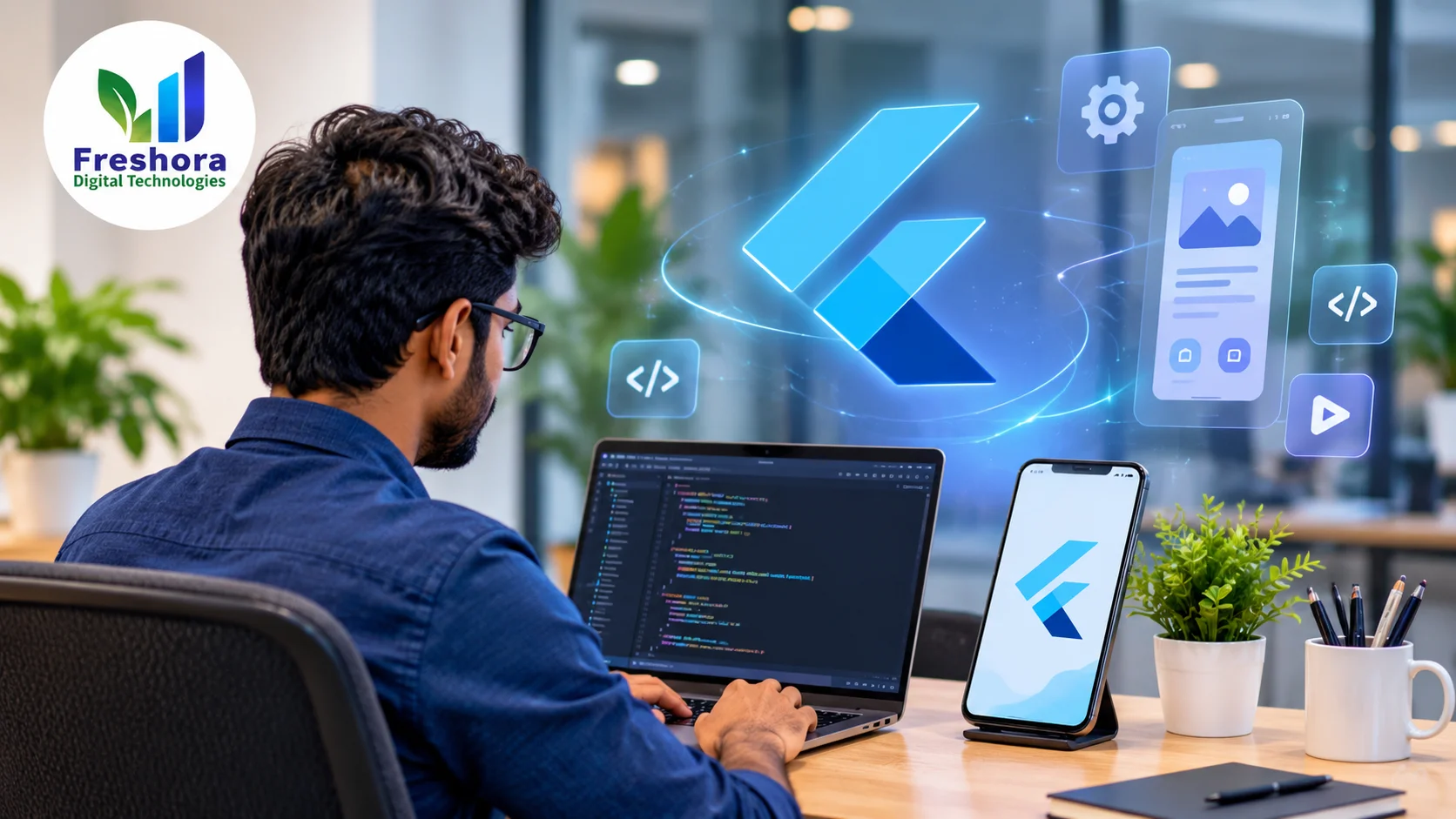
Looking for a Flutter app development company to turn your application idea into a functional digital product? Freshora helps businesses plan and develop applications using Flutter, Google's open-source UI framework, and Dart programming language.

Flutter allows developers to build applications for multiple platforms using a shared codebase. This approach can help businesses maintain a consistent user experience while managing development more efficiently. However, the right implementation depends on the application's features, technical requirements, integrations, and long-term objectives.

At Freshora, we approach Flutter application development by first understanding what the application needs to achieve. We consider its users, essential features, workflows, interface requirements, and backend dependencies before defining the development approach.

Whether you are planning a new business application, improving an existing digital product, or developing a custom solution for a specific operational need, our team can help you evaluate the requirements and plan the right Flutter development approach.

Let's Talk
Flutter App Development Company in Trichy

Flutter App Development Built Around Your Application

An application should do more than provide a collection of screens. It should help users complete tasks, access relevant information, and interact with your business without unnecessary complexity.

Flutter provides a flexible framework for developing applications with customised interfaces and interactive features. Its widget-based architecture allows developers to create reusable interface components and maintain consistent layouts across supported platforms.

Freshora approaches Flutter application development with attention to three important areas:

User experience: The interface should be easy to understand, with navigation and interactions that suit the intended users.

Application functionality: Features should support the actual purpose of the product, whether that involves managing information, processing requests, accessing dashboards, or completing business workflows.

Technical structure: The application should have an organised codebase, appropriate state management, and reliable communication with the required backend services.

The development approach is planned around the product rather than forcing every application into the same technical structure.

Flutter App Development Services

Freshora provides Flutter-focused development services for businesses that need applications designed around specific features, workflows, and user requirements.

01

Technical Planning & Requirement Analysis

A clear technical plan helps establish how an application should function before development begins.

We review the proposed features, user journeys, data requirements, external dependencies, and platform expectations. Based on this assessment, we define an appropriate application structure and identify the main components required for development.

This planning stage helps clarify the scope of the project and reduces uncertainty during implementation.

02

Flutter UI Development with Widgets

Flutter uses widgets to construct application interfaces. These components can be combined and reused to create layouts, navigation elements, forms, buttons, lists, and interactive screens.

We develop interfaces based on the application's purpose and expected user behaviour. The focus is on clear navigation, consistent visual elements, responsive layouts, and practical interactions.

Reusable widgets also help maintain consistency when the application contains multiple screens with similar interface elements.

03

State Management

State management determines how an application handles changing information and responds to user actions.

For example, an application may need to update a shopping cart, refresh dashboard information, validate a form, or display the latest status of a submitted request.

We consider the application's complexity and data flow when selecting an appropriate state-management approach. Application logic is organised to keep user interactions and data updates understandable and maintainable.

04

Backend & API Integration

Many applications depend on backend systems to retrieve information, authenticate users, save records, and process requests.

Flutter applications can communicate with backend services through APIs. Depending on the project, integration may involve authentication, database-backed information, third-party services, notifications, or other external systems.

We identify these dependencies during planning and structure the integration around the available backend capabilities and application requirements.

05

Custom Application Features

Every application has a different purpose. Some require user accounts and role-based access, while others depend on booking workflows, reporting interfaces, location-based features, or business-specific data processing.

Our development approach considers the functionality needed for the product rather than relying on a fixed set of standard features.

06

Testing & Release Preparation

Before an application is prepared for release, its main workflows and interactions need to be evaluated.

Testing considerations may include navigation, form validation, API responses, different screen sizes, error handling, and platform-specific behaviour.

The scope of testing depends on the application and its release requirements. This helps identify functional issues before the product is made available to its intended users.

Custom Flutter App Development

Custom Flutter app development is suitable when an organisation needs an application that supports workflows or features beyond a standard off-the-shelf solution.

Instead of adapting business operations to a generic application, a custom product can be planned around the way users and teams actually work.

Business Workflow Applications

Different businesses follow different processes. A service business may need request submission and status tracking, while an organisation may require internal task allocation and approval workflows.

We identify the main user activities and translate them into application workflows. This helps determine which screens, actions, permissions, and data connections are required.

Role-Based Access

Some applications serve multiple types of users. Administrators, employees, customers, and service providers may each require different levels of access.

Role-based functionality can help control which information and actions are available to each user. The access model should be planned alongside the application's authentication and backend permissions.

Data-Driven Interfaces

Applications may need to display information that is relevant to individual users or business operations.

Depending on the requirements, this could include activity summaries, transaction records, booking details, operational status, or reporting information.

The interface should present the relevant data clearly, with appropriate connections to the backend system that manages it.

Integration with Existing Systems

A new application may need to work alongside systems that a business already uses.

For example, it may need to exchange information with an existing website, backend application, database, or third-party platform.

Integration requirements should be assessed early to understand API availability, authentication methods, data formats, and any technical limitations.

Flutter Cross-Platform App Development

Flutter cross platform app development allows developers to create applications for multiple platforms using a shared codebase.

Instead of building every interface independently, developers can reuse much of the application logic and UI implementation. This can simplify development when the same core product needs to serve users across supported platforms.

However, a shared codebase does not mean every platform has identical requirements. Device capabilities, permissions, interface conventions, and platform-specific integrations still need to be considered.

Shared Codebase Benefits

A shared codebase can reduce duplicated implementation across platforms. Changes to common application features can often be managed within the same development structure.

This approach can also make it easier to maintain consistent interface components and application behaviour.

The actual development effort depends on the complexity of the product, the number of integrations, and the features required on each platform.

Reusable Interface Components

Flutter's widget system supports reusable interface elements. Developers can use these components to create consistent layouts, controls, and interactions.

This is useful when an application needs a recognisable experience across different devices while still accounting for variations in screen dimensions and platform behaviour.

Device & Platform Features

Some application features depend on the capabilities of the device or operating system.

Examples include camera access, location permissions, file handling, notifications, and other native integrations. These requirements need to be evaluated during technical planning.

Where necessary, Flutter applications can use platform-specific integrations to access supported device functionality.

When Flutter May Be Suitable

Flutter may be suitable when a business wants to develop a product for multiple platforms while sharing a significant portion of its codebase.

It can be considered for customer-facing applications, business tools, booking solutions, service platforms, and other products with common functionality across platforms.

The suitability of Flutter should be evaluated against the application's performance requirements, device integrations, user experience expectations, and technical constraints.

Flutter Software Development Approach

A well-organised Flutter project requires more than interface development. The application architecture, programming language, data flow, and integration strategy all influence how the product functions.

Our Flutter software development approach considers the following technical areas.

Flutter & Dart

Flutter is the UI framework used to build the application, while Dart is the programming language used to implement its functionality.

Dart supports the development of application logic, reusable components, and interactions within the Flutter environment.

The choice of framework and implementation structure should reflect the product's actual requirements rather than technology preference alone.

Widget Architecture

Flutter applications are built using widgets. These represent interface elements and can be organised into reusable components.

A well-planned widget structure makes it easier to manage screens, maintain consistent layouts, and update interface elements without unnecessarily duplicating code.

State & Data Handling

Applications frequently process information that changes as users interact with them.

The implementation needs to account for data loading, updates, validation, user actions, and responses from backend services.

The selected state-management approach should match the application's size, complexity, and data flow.

Backend Communication

Backend communication allows the application to retrieve and submit information.

Depending on the project, this may involve REST APIs or other supported integration methods. Authentication, response handling, data validation, and error management should be considered as part of the integration design.

Code Structure

A clear code structure helps developers understand how different application components relate to each other.

Separating responsibilities between interface components, application logic, and data-related functionality can make future changes easier to manage.

The exact architecture depends on the product's scope and expected development requirements.

Our Flutter App Development Process

Every Flutter project begins with an understanding of what needs to be built. The following stages provide a structured way to move from an initial idea to an application prepared for release.

01

Requirement Discovery

We begin by understanding the application idea, its intended users, and the problem it needs to solve.

This includes identifying essential features, user roles, key workflows, expected platforms, and any existing systems involved in the project.

The purpose is to establish a clear picture of the product before deciding how it should be implemented.

02

Technical Feasibility Review

The proposed features are reviewed to understand their technical requirements.

This may include assessing API availability, external integrations, device capabilities, data handling, authentication, and platform-specific dependencies.

If a requirement introduces technical limitations or additional complexity, it should be identified before development begins.

03

Feature Prioritisation & Estimation

Not every proposed feature needs to be included in the first release.

We consider which capabilities are essential to the application's main purpose and which can be planned for later development stages.

Project estimation takes into account the number of screens, feature complexity, integrations, interface requirements, and testing scope. This creates a more realistic basis for discussing the project timeline and development effort.

04

UI & Architecture Planning

Once the main requirements are understood, the application interface and technical structure can be planned.

This involves organising screens, navigation, reusable widgets, data flow, and the interactions required for the main user journeys.

The goal is to create an implementation plan that connects the user experience with the application's underlying functionality.

05

Development

The planned application components are implemented using Flutter and Dart.

This stage may include interface development, state management, application logic, API communication, authentication, and required third-party integrations.

Development follows the agreed scope and technical approach.

06

Testing & Release Preparation

The application is evaluated against its planned features and workflows.

Testing may cover navigation, user inputs, data handling, API communication, permissions, and supported device configurations.

Once the required checks have been addressed, the application can be prepared for the agreed release process.

Types of Flutter Applications

Flutter can support different types of digital products. The right solution depends on the features, users, and technical requirements of each application.

Customer-Facing Applications

Businesses can use customer-facing applications to provide information, manage user accounts, and make selected services accessible through a mobile interface.

Internal Business Applications

Internal applications can support task management, request handling, approval processes, and other operational activities.

Booking Applications

A booking application may allow users to view availability, submit appointment requests, manage reservations, and receive relevant updates.

Dashboard & Reporting Applications

Applications can present business information through dashboards, records, summaries, and reporting interfaces connected to the relevant backend systems.

Service-Based Applications

Service businesses may require applications that connect customers with services, support request submission, or provide access to account-specific information.

The features and integrations for each product should be determined by its intended purpose and user requirements.

Why Choose Freshora for Flutter App Development

Choosing a development partner involves more than selecting a technology. It also requires a clear understanding of the product, its users, and the technical decisions involved in building it.

Freshora approaches Flutter projects by connecting application requirements with an appropriate development plan.

Requirement-focused planning: We consider the purpose, users, features, and workflows before defining the application structure.

Flutter-specific implementation: The development approach considers Dart, widgets, state management, and the framework's cross-platform capabilities.

Integration planning: Backend connectivity and external dependencies are considered as part of the technical scope.

Feature-based estimation: Development effort is evaluated according to the actual screens, functionality, integrations, and testing requirements.

Clear development stages: A structured workflow helps establish what needs to be planned, implemented, and evaluated at each stage.

The aim is to develop an application that addresses the intended business requirements while maintaining a practical and organised technical foundation

Flutter App Development in Trichy, Tamil Nadu

Freshora is based in Trichy, Tamil Nadu, and works in the IT, software, and digital growth space.

Businesses in Trichy looking to develop a Flutter application can discuss their product ideas, functional requirements, and technical needs with Freshora. We can also discuss Flutter development projects with businesses located in other parts of India and beyond.

Whether the requirement involves a customer-facing product, an internal business application, or a specialised digital solution, the first step is to understand the application scope and determine whether Flutter is an appropriate technology for the project.

Frequently Asked Questions About Flutter App Development

Have an application idea that needs a clear technical direction?

Discuss your requirements with Freshora. Share the problem your application should solve, the features you have in mind, and the platforms you want to support.

We can help you evaluate the Flutter development approach, identify the main technical requirements, and plan the next steps towards building your application.

Contact Freshora to discuss your Flutter app development project.

Get a Free Consultation

Join Our WhatsApp Channel 💬

Join our WhatsApp channel for instant digital marketing tips, SEO insights, web & app updates, and latest job opportunities.

Join Now
Areas We Serve

Serving Businesses Across Trichy, India & Worldwide

Freshora Digital Technologies proudly serves businesses across Tiruchirappalli (Trichy), including Cantonment, Puthur, Thillai Nagar, Palakarai, Subramaniyapuram, Mela Chinthamani, Woraiyur, KK Nagar, Karumandapam, Crawford, Edamalaipatti Pudur (EMP), Kattur, Airport Area, Ariyamangalam, Panjappur, Thuvakudi, Tiruverumbur, BHEL Township, Srirangam, Thiruvanaikaval, Samayapuram, No.1 Tollgate, Central Bus Stand Area, and Chathiram Bus Stand Area.

We also serve clients across Tamil Nadu, India, and globally in Singapore, the UAE, Saudi Arabia, Canada, Australia, the United Kingdom, and the United States, delivering innovative Website Development, Mobile App Development, Software Development, SEO, Google Business Profile Management, and Digital Marketing solutions that help businesses grow and succeed in the digital world.

WhatsApp Chat Button Call Button

Website Audit Free

F
R
E
E

A
U
D
I
T

R
E
P
O
R
T