Existing Software Does Not Fit
The available platforms don't support your workflow properly.

Custom, Scalable & Business-Focused Web Applications for Modern Organisations
Freshora Digital Technologies provides professional Web Application Development in Trichy for businesses that need more than a conventional website.
A website primarily presents information.
A web application allows people to perform actions, manage information, process transactions, communicate with systems and complete business workflows through a browser.
From customer portals and booking platforms to ERP-connected applications, dashboards, e-commerce systems, SaaS platforms and custom business software, Freshora develops web applications around the actual requirements of the organisation.
Our approach combines:
Business Understanding + UI/UX + Application Architecture + Development + Database + API Integration + Security + Testing + Deployment + Maintenance
The objective is not simply to build a technically impressive application.
The objective is to build a web application that solves a real business problem, works reliably for its users and can evolve as the business grows.

If your business needs users to log in, submit information, manage accounts, make bookings, process orders, access dashboards, view reports, update records or interact with business systems, a conventional website may not be enough.
You may need a web application.
Freshora Digital Technologies develops web applications for businesses that need:
We begin with the business requirement rather than immediately choosing a technology stack.
A web application is a software application that users access through a web browser.
Unlike a simple informational website, a web application typically allows users to interact with data or complete tasks.
Examples include:
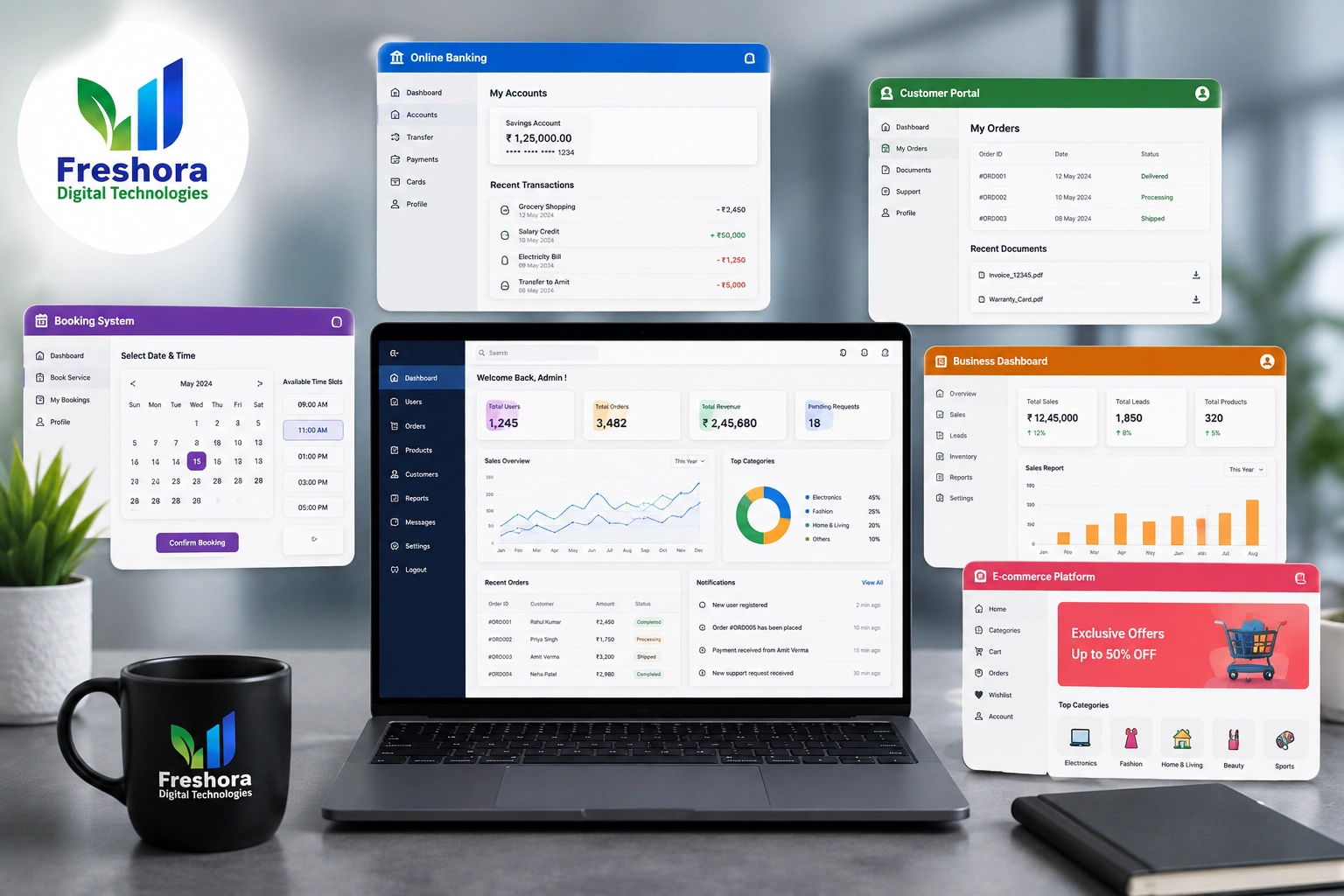
Users can log in, view transactions, transfer funds and manage accounts.
Customers can log in, view orders, download documents and submit requests.
Users can select a service, date and time and confirm an appointment.
Managers can log in and view sales, leads, inventory or operational information.
Customers can search products, add items to a cart, pay and track orders.
The browser becomes the user's interface, while the application logic, APIs and database operate behind the scenes.
This distinction is important when deciding what your business actually needs.
| Website | Web Application |
|---|---|
| Primarily provides information | Allows users to perform tasks |
| Mostly public content | Can contain private user areas |
| Pages and content | Business logic and workflows |
| Limited interaction | Complex interaction |
| Often CMS-driven | Often application-driven |
| Basic forms | Advanced data processing |
| Informational | Operational / transactional |
For example:
Business Website
"Here are our services and
contact details."
Web Application
"Log in, create a booking, make
payment, view your history and download your invoice."
The technology requirement is completely different.
Every business operates differently.
Off-the-shelf software may be sufficient for some organisations, but other businesses have processes that don't fit standard platforms.
This is where Custom Web Application Development in Trichy can provide value.
A custom application can be designed around:
Instead of forcing your business to change its process to match generic software, custom development allows the application to be built around the actual process.
Custom development may be worth considering when:
The available platforms don't support your workflow properly.
You need information to move between CRM, ERP, website and other platforms.
Employees repeatedly enter, copy or verify the same information.
The business requires functionality that generic platforms don't provide.
Your software itself is part of your competitive advantage.
Your current manual process cannot efficiently handle growing users, orders or data.
Custom development is not automatically better than an existing platform.
The correct question is:
What solution gives the business the best combination of functionality, reliability, cost and future scalability?
Freshora's Web Application Development Services in Trichy can cover the complete application lifecycle.
Understand the business problem.
Define what users and administrators need to do.
Design how the application will work technically.
Design the user interface and experience.
Build the front end, back end and database.
Connect APIs, CRM, ERP, payments or external systems.
Validate functionality, security, performance and usability.
Move the application into its production environment.
Continue improving and supporting the application.
This complete lifecycle helps reduce the risk of treating application development as only a coding project.
Choosing a Web Application Development Company in Trichy requires looking beyond design.
A professional application development partner should understand:
At Freshora Digital Technologies, web application development connects with our wider capabilities in:
This allows application projects to be approached as complete digital systems.
A business may need different teams for:
When these areas are handled independently, communication can become complicated.
Freshora's broader technology capability allows these disciplines to be considered together.
The result can be:
One Business Requirement → One Technical Architecture → One Coordinated Development Team → One Integrated Solution
Customers can log in to:
Employee-facing applications can support:
Useful for:
Features can include:
Custom applications can help businesses manage:
Dashboards can turn business data into a more usable visual interface.
Examples include:
The goal is to present the information the right user actually needs.
An advanced e-commerce platform may include:
Large or specialised online stores may require more application-level architecture than a simple brochure-style website.

E-commerce Web Application Development in Trichy can support businesses that need an online platform where customers can browse, compare and purchase products.
Depending on the business, the application can integrate with:
A connected e-commerce application can create a workflow such as:
Customer Order → Payment → Inventory Update → ERP → Shipping → Customer Notification
The exact architecture depends on the systems already used by the business.
A database-driven application stores, retrieves, updates and manages information dynamically.
This can include:
For example:
User → Login → Database → Retrieve account information → Display personalised dashboard
The quality of the database architecture can strongly influence application performance, reliability and scalability.
In a simple static website, content may remain largely the same for every visitor.
A database-driven application can deliver information based on:
This allows applications to become dynamic and personalised.
A web application may involve several layers:
Front End (What the user sees) → Application Layer (Business rules and logic) → API Layer (Communication between systems) → Database (Stores structured information) → External Services (Payments, messaging, maps, CRM, ERP and other systems)
Good architecture keeps these responsibilities organised.
Modern Web Application Development in Trichy is not simply about using the newest programming framework.
Modern development should focus on:
The latest technology is useful only when it provides a genuine advantage.
Large organisations may require applications that support:
Enterprise Web Application Development in Trichy therefore requires deeper planning than a simple business website.
An enterprise application may include:
User Management → Roles & Permissions → Workflow Engine → Database → API Layer → External Integrations → Reporting → Monitoring
The architecture should be designed around the organisation's actual operations.
Enterprise applications commonly have different users with different permissions.
For example:
System-wide access.
Department-level access.
Operational functionality.
Customer-specific information.
Restricted external access.
This is why authentication and authorisation are fundamental parts of enterprise application design.
Many applications don't exist in isolation.
A business application may need to communicate with:
Web Application Integration in Trichy connects these systems so information can move between them efficiently.
APIs often provide the communication layer between a web application and another service.
For example:
Web Application → API → CRM
Or:
Web Application → Payment API → Payment Gateway
Or:
Web Application → WhatsApp API → Customer Communication
This creates a connected application ecosystem.
Applications that contain private information need controlled access.
Authentication can involve:
The exact architecture depends on the application and security requirements.
Not every user should see everything.
A role-based access system can control:
For example:
can see sales reports.
can see assigned leads.
can see only their own account information.
This creates more controlled application environments.
Security must be considered throughout application development.
Potential areas include:
A secure application is not created by adding one security feature at the end.
Security needs to be considered throughout the architecture.
Applications frequently process sensitive business information.
Examples include:
Data should be handled according to the application's requirements and applicable legal, regulatory and privacy obligations.
Application performance is not just about page speed.
An application may also need to process:
Performance can therefore depend on multiple layers.
A typical performance investigation can examine:
Browser → Front End → API → Application Server → Database → External APIs
The bottleneck may exist at any of these points.
Poor database design can create slow applications.
Performance considerations can include:
For large applications, database performance can become increasingly important as data volume grows.
Applications that rely heavily on external APIs can experience delays when those services respond slowly.
API architecture can therefore consider:
The goal is to prevent one slow external system from making the entire application unusable.
Modern applications can be hosted using cloud infrastructure where appropriate.
Cloud architecture can support:
Cloud is not automatically better for every application.
The architecture should match the business requirements and budget.
A Progressive Web Application, or PWA, can combine aspects of websites and application-like experiences.
Depending on the project, PWAs may support features such as:
Whether a PWA is appropriate depends on the user requirements and product strategy.
PHP Web Application Development in Trichy can be appropriate for businesses that already use PHP-based systems or require a PHP-compatible application environment.
PHP can support:
The framework and architecture should be selected according to the project requirements rather than choosing PHP simply because it is familiar.
Building an application is only part of the work.
It also needs to be tested.
Web Application Testing Services in Trichy can evaluate:
Does each feature work as expected?
Do connected systems exchange information correctly?
Can users complete tasks without confusion?
Does the application work across supported browsers and devices?
Does it remain responsive under expected workloads?
Are common security weaknesses identified and addressed appropriately?
Do new updates break existing functionality?
Imagine a booking application where:
The customer selects a date.
The booking appears successful.
But the database fails to save it.
The customer thinks the appointment is confirmed.
The business never receives it.
Testing helps identify these scenarios before the system is depended on by real users.
A web application requires ongoing attention after launch.
Web Application Maintenance Services in Trichy can include:
Maintenance requirements depend on the application and technology environment.
An application should not be treated as complete simply because it works at launch.
After deployment, monitoring can identify:
Monitoring allows problems to be detected earlier.
A new application may begin with:
100 users → and later need to support: 10,000 users or more.
Similarly:
1,000 records → may become: 1 million records
Architecture should therefore consider reasonable future growth.
Scalability can involve:
The appropriate approach depends on expected demand.
Freshora follows a structured development journey.
Understand the business problem.
Define user roles, features, workflows and priorities.
Design architecture, integrations and database requirements.
Create the interface and user journey.
Build front-end, back-end and database components.
Connect APIs and external platforms.
Test functionality, usability, security and performance.
Launch in the production environment.
Observe system behaviour after launch.
Continue improving the application.
One of the most common questions businesses ask is:
How much does web application development cost in Trichy?
There is no responsible single price for every application.
A web application is not simply priced by the number of pages.
The cost depends on the complexity of the system being built.
Important factors can include:
A simple customer portal is different from an enterprise management system.
An application for 50 users has different infrastructure requirements from one serving thousands.
More workflows and functions generally mean more design, development and testing.
Multiple roles and permissions increase complexity.
Simple data storage differs significantly from a complex relational business database.
CRM, ERP, payment, WhatsApp, accounting and other integrations add development and testing requirements.
Highly interactive interfaces require additional design and development.
Applications handling sensitive information may require stronger security controls and testing.
High-traffic or data-heavy systems may require additional architecture.
Cloud resources, databases, storage and monitoring can contribute to ongoing costs.
Updates, support, security and future feature development create continuing requirements.
Could include:
Could include:
Could include:
These are fundamentally different projects, so their costs can vary significantly.
Giving every application a fixed package price can be misleading.
A business application is closer to a software product than a standard brochure website.
The right estimate should consider:
After understanding the requirement, Freshora can provide a project scope and estimate based on the actual application.
The cost of development should be considered alongside the value the application is expected to create.
For example, an application may help a company:
A higher development investment can make sense when the application solves a significant operational problem.
The right question is:
What measurable business problem will the application solve?
Technology projects involve real business consequences.
A poorly designed application can create:
That's why experience matters.
Freshora Digital Technologies combines web development, software development, API integration, UI/UX and broader technology capabilities, allowing application projects to be considered from several technical perspectives.
Our experience includes 5+ years in digital development, 125+ completed web projects and a team of 12+ developers and technology professionals.
Those figures should always be maintained against current company records as the business grows.
Strong E-E-A-T for a development company should not rely only on statements such as:
"We are experts."
It should demonstrate actual experience through:
For example:
Project Challenge
The client relied on spreadsheets to
manage customer information.
Solution
A centralised web application was developed with
role-based access and reporting.
Outcome
The business gained a central workflow for managing
customer information.
Only verified client outcomes should be published as measurable results.
Freshora Digital Technologies combines:
This creates a complete application-development ecosystem.
Our web application approach can be represented as:
Discover (Understand the business) → Define (Document users, requirements and workflows) → Design (Create the user experience) → Architect (Plan application, database and integrations) → Develop (Build the platform) → Integrate (Connect systems and APIs) → Test (Validate functionality, security and performance) → Deploy (Launch the application) → Monitor (Observe application behaviour) → Improve (Continue enhancing the platform)
The strongest applications don't simply contain features.
They reflect the way a business actually operates.
For example:
Lead Received → Sales Assignment → Follow-Up → Quotation → Approval → Order → Invoice → Payment → Customer Notification
A custom application can connect these stages into a more organised workflow when the business requirements justify it.
Freshora Digital Technologies is based in Trichy and develops web applications for businesses operating in:
A Trichy-based company can therefore use local development expertise while building software capable of supporting customers and operations beyond the city.
ERP-connected applications, dashboards, inventory and workflow systems.
Appointments, portals and business applications, subject to appropriate privacy and operational requirements.
Admission systems, student portals and management platforms.
eCommerce, product systems and customer platforms.
Booking and customer-management systems.
Property databases, enquiry platforms and dashboards.
Customer portals, booking systems and workflow applications.
SaaS products, APIs and customer platforms.
The application should be designed around the industry's actual requirements rather than an arbitrary template.
Web application development is the process of designing and building software applications that users access through web browsers.
A website primarily presents information, while a web application allows users to perform tasks, interact with data or complete business workflows.
They can include application planning, UI/UX design, front-end development, back-end development, database development, API integration, testing, deployment and maintenance.
Yes. Custom applications can be developed around specific business workflows and requirements.
It varies depending on application complexity, users, features, database, integrations, security, infrastructure and maintenance requirements.
Yes, where the existing platforms provide suitable APIs or integration mechanisms.
Yes. Testing can cover functionality, integration, usability, compatibility, performance and security considerations.
Yes. Maintenance may include bug fixes, security updates, performance improvements, API updates and new functionality.
Yes, subject to the project's requirements, architecture and infrastructure needs.
PHP-based web applications can be developed where PHP is appropriate for the project and requirements.
Yes. E-commerce applications can include product catalogues, search, cart, checkout, payments, orders, customer accounts and integrations.
Yes. Browser-based applications can be designed responsively for smartphones and tablets. Some projects may also benefit from a dedicated mobile application.
You don't need to know the technical solution before approaching a development company.
You can start with the business problem.
Tell us:
Freshora Digital Technologies can then help determine whether you need:
Build the Application Your Business Actually Needs
Freshora Digital Technologies provides Web Application Development Services in Trichy for businesses that need practical, secure, scalable and user-focused web applications.
From Custom Web Application Development in Trichy and Custom Web App Development in Trichy to Enterprise Web Application Development in Trichy, Web Application Integration in Trichy, Database Driven Web Applications in Trichy, Web Application Testing Services in Trichy and Web Application Maintenance Services in Trichy, our goal is to create applications that solve genuine business problems.
Understand the problem. Design the experience. Build the technology. Connect the systems. Test properly. Support the application.
Freshora Digital Technologies
Web Application
Development in Trichy for businesses ready to turn complex processes into better digital
experiences.
A successful web application is not created by writing code alone.
Behind a reliable application is a combination of:
Business Requirements → User Experience → Application Architecture → Database Design → API & Integration → Development → Security → Testing → Deployment → Monitoring & Maintenance
At Freshora Digital Technologies, our Web Application Development Services in Trichy follow this broader approach so the final application is designed around the business problem, not just the technical specification.
Every application starts with a business requirement.
Before deciding on frameworks, databases or hosting, we need to understand:
This discovery stage can prevent a common problem in software projects:
Building a technically functional application that doesn't fit the actual business workflow.
A detailed requirement analysis can identify:
This creates a clearer development roadmap.
A professional application should not assume that every user needs the same access.
For example:
Can manage the entire application.
Can manage assigned operational functions.
Can access departmental information and reports.
Can perform defined business tasks.
Can access their own information.
Can access approved external information.
This type of role-based access control helps create a more structured application environment.
The front end is the part of the application that users see and interact with.
It can include:
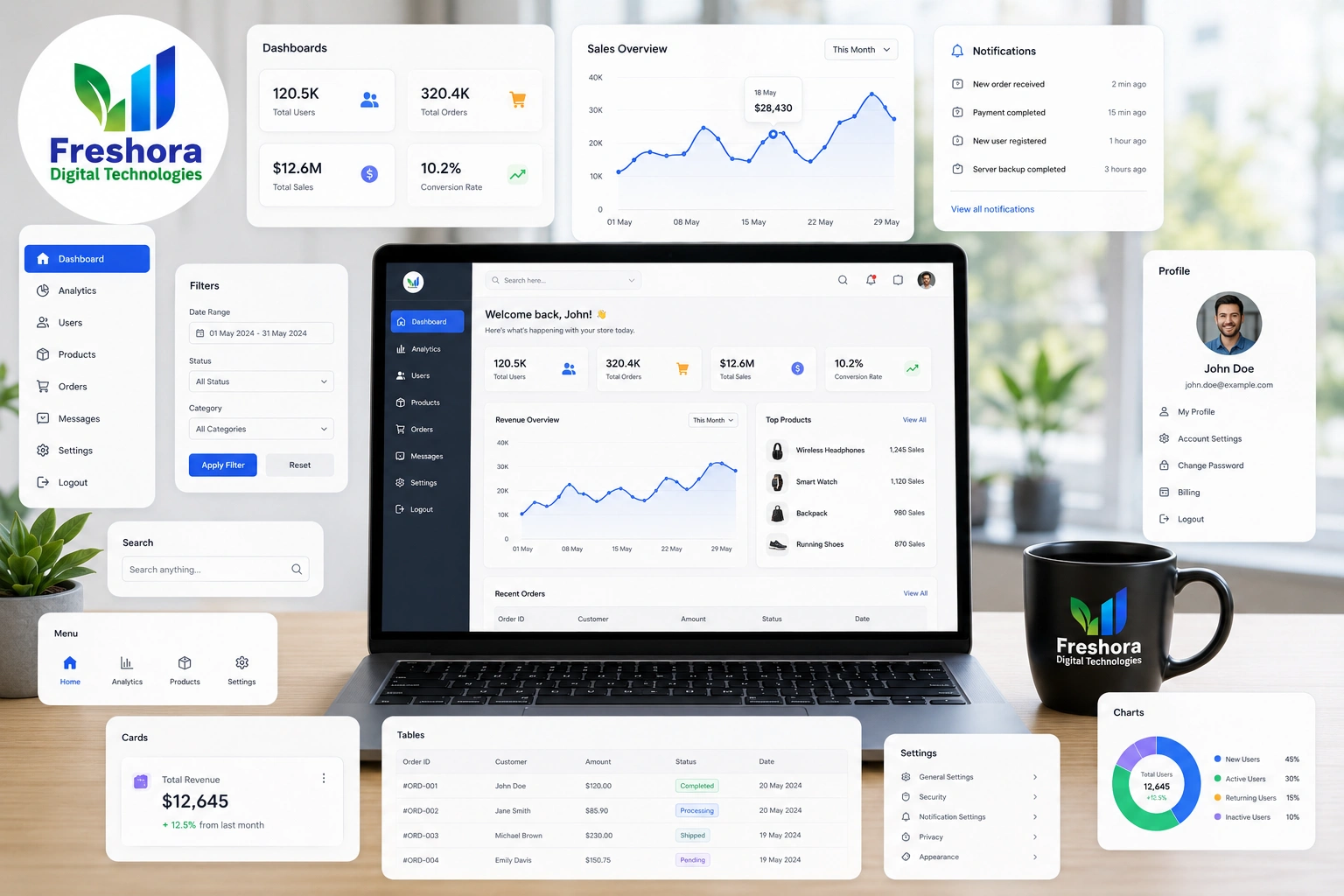
A professional front end should be:
The back end handles much of the application's logic and data processing.
It may manage:
For example:
Customer submits booking → Application validates data → Back end checks availability → Database stores booking → Notification is triggered → Customer receives confirmation
The back end is effectively the operational engine behind the application.
Application architecture defines how different parts of the system communicate.
A typical architecture may include:
Presentation Layer (The interface used by customers, employees or administrators) → Application Layer (Business rules and processing) → API Layer (Communication between systems) → Data Layer (Database and data storage) → External Services (Payments, messaging, maps, cloud services, CRM, ERP and other integrations)
A strong architecture helps keep the system organised and maintainable.
Not every business requires the same architecture.
| Traditional Monolithic Application | Modular Architecture |
|---|---|
| Many components are deployed together. This can be practical for smaller or moderate-sized applications. | Different functional components are separated logically. This can make large systems easier to maintain and evolve. |
The right architecture depends on:
Technology should follow the business requirements.
The database is one of the most important parts of a data-driven application.
It may store:
A well-planned database should make it easier to:
Poor database design can create performance and maintenance problems later.
Many business applications use relational databases where information is organised into related tables.
For example:
Customers → Orders → Products → Payments
This allows information to remain organised and connected.
The database structure should reflect the application's actual business relationships.
Applications containing large amounts of data often require advanced search.
For example, an admin may want to find:
All customers from Trichy who placed orders in the last 30 days.
Or:
All products under a specific category that are currently in stock.
Efficient search requires thoughtful:
A dashboard should help users understand important information quickly.
Depending on the application, dashboards can display:
A good dashboard avoids information overload.
It highlights what the user actually needs to know.
An administration panel gives authorised users control over the application.
An admin area may allow authorised staff to:
Administrative interfaces should be designed with the same care as customer-facing interfaces.
A customer portal can provide a secure digital area where customers manage their relationship with your business.
Depending on the application, customers may be able to:
This can reduce repeated calls and manual communication.
An employee-facing application can centralise internal workflows.
Possible functionality includes:
Instead of maintaining multiple spreadsheets or communication channels, an application can provide one central interface.
One major advantage of custom web applications is the ability to automate business workflows.
For example:
Lead Submitted → Lead Assigned → Sales Follow-Up → Quotation Created → Manager Approval → Customer Confirmation → Invoice → Payment
The exact workflow depends on the organisation.
Automation can be valuable when repetitive manual processes consume significant employee time.
Businesses frequently require approvals before actions can be completed.
Examples include:
A workflow application can route requests to the correct person automatically.
Booking applications can support:
Suitable use cases include:
The application should be built around the actual appointment process.
Inventory applications can track:
Integration with an ERP or accounting system may also be considered where appropriate.
Real estate businesses can use custom web applications to manage:
Search and filtering become particularly important when the number of properties grows.
Educational organisations can require:
A school or college may also need integration with existing learning or administrative platforms.
Healthcare organisations may require applications such as:
Projects involving health-related information require appropriate consideration of privacy, security, data access and applicable regulatory requirements.
Manufacturing businesses can use custom applications for:
Integration with ERP systems can provide additional opportunities for connected workflows.
Professional firms may use web applications for:
The application can centralise information that might otherwise be spread across emails and spreadsheets.
Modern web applications frequently communicate with external systems through APIs.
For example:
Web Application → CRM API → Customer Data
Or:
Web Application → Payment API → Transaction Status
Or:
Web Application → WhatsApp API → Customer Notification
API architecture should consider authentication, permissions, data mapping, error handling, rate limits and monitoring.
Some business processes require immediate notifications when an event occurs.
For example:
Payment Completed → Webhook → Application → Order Status Updated
Or:
New CRM Lead → Webhook → Notification System
Webhook-based architecture can reduce the need for constant polling where the connected system supports it.
Secure application access begins with proper identity management.
Depending on project requirements, authentication can include:
The solution should match the sensitivity of the application and the needs of its users.
Enterprise environments may have multiple internal systems.
Single Sign-On can allow users to authenticate through an approved identity system rather than maintaining separate credentials for every application.
This can simplify:
The appropriate approach depends on the organisation's existing infrastructure.
Business applications may need users to upload:
File-management architecture should consider:
Sensitive files should receive appropriate access controls.
Web applications can send notifications for events such as:
Depending on the system, notifications may use:
For large applications, search can become one of the most important functions.
Users may need to filter by:
A good search experience reduces the time required to locate information.
Applications can turn stored data into useful management information.
Reports may include:
Reports should be designed around actual decision-making requirements rather than simply displaying every available database field.
Businesses may need to export information for:
Export formats may include commonly used structured files depending on the application.
Access to exports should be controlled where data is sensitive.
Security should be considered across multiple layers.
Authentication and permissions.
Access control and request validation.
Restricted access and secure data handling.
Secure hosting and network configuration.
Password and account-management controls.
There is no single security feature that makes an application completely secure.
Security is an ongoing process.
Applications receive information from users and other systems.
Input should be validated before it is processed.
This helps reduce risks associated with:
Validation should happen at appropriate application boundaries.
Some applications require records of important actions.
For example:
Administrator changed customer status.
or:
Manager approved purchase request.
Audit trails can improve accountability and help investigate unexpected activity.
The appropriate level of logging depends on the application.
A business application can contain critical operational information.
Backup planning may consider:
The real measure of a backup system is not whether backups exist.
It is whether the business can actually restore important information when required.
Hosting requirements vary depending on the application.
A simple application may require modest infrastructure.
A large enterprise platform may require:
Hosting decisions should follow:
Users + Traffic + Data + Security + Performance + Budget
A professional deployment process may include:
Development → Testing → Staging → Final Validation → Production
This helps avoid making major changes directly in the live environment.
A staging environment provides a place to test:
before making them available to production users.
For business-critical systems, this can reduce deployment risk.
A successful application should evolve.
After launch, user behaviour may reveal:
Maintenance can therefore include not only bug fixing but also ongoing optimisation.
When a business receives a quote for web application development, the price represents more than coding hours.
It may include:
Business Analysis → UX Research → UI Design → Architecture → Front-End Development → Back-End Development → Database → API Integration → Testing → Deployment → Documentation → Support
This is why comparing two application quotes only by the final number can be misleading.
The real comparison should be:
What scope, architecture, quality and support are included?
Instead of treating cost as one fixed number, a project can be evaluated across:
Requirements and planning.
UI/UX and prototypes.
Front-end and back-end implementation.
APIs and third-party systems.
Functional, performance and security validation.
Hosting, databases, storage and related services.
Ongoing improvements and support.
This gives the business a clearer picture of the total technology investment.
A five-screen customer portal is not the same as:
The architecture, testing requirements, development effort and infrastructure can be substantially different.
That is why Freshora recommends requirement-based estimation rather than artificial one-price-fits-all packages.
Custom development is not always the correct answer.
An existing platform may be more appropriate when:
Freshora can evaluate whether custom development is actually justified.
This is important because the best technology decision is not always the one involving the most development.
Custom development may be more appropriate when:
The decision should be based on the business case.
Our approach can be summarised as:
Discover (Understand the problem) → Define (Document users, requirements and workflows) → Design (Create clear user experiences) → Architect (Plan application, database and integration structure) → Develop (Build the solution) → Secure (Apply appropriate security controls) → Integrate (Connect required systems) → Test (Validate reliability) → Deploy (Release carefully) → Maintain (Support continuous improvement)
Freshora Digital Technologies brings web development, software development, API integration, UI/UX and broader digital technology capabilities into one environment.
That means an application project can be evaluated from several perspectives:
Does it solve the right problem?
Is it easy to use?
Is the architecture appropriate?
Can it communicate with other systems?
Is access appropriately controlled?
Can it handle expected usage?
Can it evolve?
This broader perspective helps create applications that are useful beyond the initial launch.
Technology Built Around Your Workflow
Whether you need a Custom Web Application Development in Trichy, Web Application Integration in Trichy, Enterprise Web Application Development in Trichy, PHP Web Application Development in Trichy, E-commerce Web Application Development in Trichy, or ongoing Web Application Maintenance Services in Trichy, Freshora Digital Technologies can help you evaluate the technical requirement and build a practical solution.
Your business already has a process.
Your application should make that process easier, clearer and more connected.
Start With the Problem. Define the Workflow. Build the Right Technology.
Freshora Digital Technologies — Web Application Development in Trichy for businesses that need more than a website.
Get exclusive digital marketing tips, SEO insights, web & app updates, and job opportunities delivered straight to your inbox.
Join our WhatsApp channel for instant digital marketing tips, SEO insights, web & app updates, and latest job opportunities.
Join NowFreshora Digital Technologies proudly serves businesses across Tiruchirappalli (Trichy), including Cantonment, Puthur, Thillai Nagar, Palakarai, Subramaniyapuram, Mela Chinthamani, Woraiyur, KK Nagar, Karumandapam, Crawford, Edamalaipatti Pudur (EMP), Kattur, Airport Area, Ariyamangalam, Panjappur, Thuvakudi, Tiruverumbur, BHEL Township, Srirangam, Thiruvanaikaval, Samayapuram, No.1 Tollgate, Central Bus Stand Area, and Chathiram Bus Stand Area.
We also serve clients across Tamil Nadu, India, and globally in Singapore, the UAE, Saudi Arabia, Canada, Australia, the United Kingdom, and the United States, delivering innovative Website Development, Mobile App Development, Software Development, SEO, Google Business Profile Management, and Digital Marketing solutions that help businesses grow and succeed in the digital world.

