
Contact our team for professional guidance and solutions.
Executive Summary
Across Trichy's industrial ecosystem, from the fabrication clusters of Thuvakudi and Tiruverumbur to the engineering and manufacturing hubs of SIDCO, Ariyamangalam, and Mathur, businesses are facing a common challenge: managing growth with disconnected systems.
Many organizations still depend on spreadsheets, email chains, phone calls, and isolated software applications to manage operations. While these methods may have worked when businesses were smaller, they create significant bottlenecks as organizations scale.
Today's customers, suppliers, employees, and business partners expect instant access to information. They want to track orders, download documents, approve workflows, submit requests, and communicate with businesses through secure digital channels.
This is where business portal development becomes essential.
A modern business portal acts as a centralized digital platform that connects people, processes, and systems into a single environment. It improves operational efficiency, reduces administrative workload, enhances customer experience, and provides the scalability required for long-term business growth.
For enterprises in Trichy looking to compete in increasingly digital markets, business portal development is no longer a future investment. It is a present-day business requirement.
Trichy has long been recognized as one of Tamil Nadu's most important industrial regions.
The presence of organizations such as BHEL helped establish a strong manufacturing ecosystem that later expanded into fabrication, engineering services, industrial supply chains, logistics, construction, and professional services.
Historically, many business processes were relationship-driven.
Clients called account managers directly.
Suppliers exchanged documents through email.
Production updates were shared manually.
Invoices were approved through paper-based workflows.
As businesses grew, these processes became increasingly difficult to manage.
Today, enterprises operate with larger customer bases, multiple branches, remote teams, and complex vendor networks. Managing these operations manually creates inefficiencies that directly impact profitability.
Business expectations have changed dramatically.
Modern customers expect:
Similarly, management teams expect:
Businesses that continue relying on disconnected systems often experience:
As a result, organizations are increasingly investing in business portals that centralize critical business functions.
Many businesses across Trichy experience similar operational bottlenecks.
Departments often operate independently with separate systems and databases.
Sales teams, operations teams, finance departments, and customer support teams frequently work with different versions of the same information.
Approvals, quotations, invoices, purchase requests, and service requests are often handled manually.
This increases delays and creates opportunities for errors.
Customers frequently need to call or email simply to obtain basic information.
This creates frustration and increases support costs.
Management teams struggle to access real-time data, making strategic decisions slower and less accurate.
As customer volume increases, administrative workload grows proportionally.
This limits scalability.
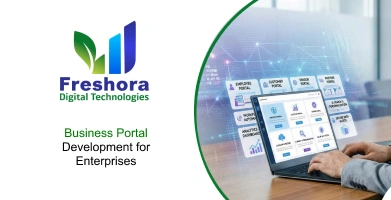
A business portal is a secure web-based platform that provides centralized access to information, services, workflows, and business applications.
Unlike a traditional website, which primarily focuses on marketing and communication, a business portal focuses on operations and collaboration.
Business portals enable users to:
The portal becomes the digital workplace for customers, employees, vendors, and management teams.
A successful business portal typically includes several core modules.
Customers can:
This significantly improves customer experience while reducing support workload.
Employees gain access to:
This improves operational efficiency and employee engagement.
Suppliers can:
This streamlines procurement processes.
Organizations can securely manage:
Version control and access permissions improve security and accountability.
Business portals can automate:
Automation reduces administrative effort and speeds up business processes.
Management teams can access:
This enables faster and more informed decision-making.
One of the biggest advantages of business portal development is integration.
A portal should not operate as an isolated system.
Instead, it should connect directly with:
For:
For:
Integration creates a single source of truth across the organization.
Consider a manufacturing company operating from the SIDCO Industrial Estate.
Before implementing a portal:
After implementing an integrated business portal:
The result was faster operations, better customer satisfaction, and improved scalability.
Automation reduces repetitive administrative work.
Customers receive information instantly without waiting for support teams.
Role-based access protects sensitive information.
Management gains real-time visibility into business performance.
Organizations can support larger customer volumes without proportionally increasing staffing costs.
Business portals are evolving rapidly.
Future-ready platforms increasingly include:
Automated recommendations and intelligent support.
Data-driven forecasting and business insights.
Optimized access across smartphones and tablets.
Improved flexibility, security, and scalability.
Automated process optimization based on user behavior.
For enterprises in Trichy planning a business portal project:
Focus on solving specific operational challenges.
Connect the portal with ERP, CRM, and existing systems.
Build around user needs rather than internal assumptions.
Implement role-based access, encryption, and secure authentication.
Choose a scalable architecture that can support future growth.
The future of enterprise growth in Trichy will be driven by organizations that successfully connect technology with business strategy.
A business portal is more than a software application. It is a centralized digital ecosystem that improves communication, streamlines operations, enhances customer experiences, and supports scalable growth.
Whether you operate in manufacturing, logistics, professional services, engineering, healthcare, or industrial supply chains, a well-designed business portal can become the foundation upon which your next phase of growth is built.
As Trichy's enterprises continue expanding into regional, national, and global markets, business portal development will increasingly become a competitive necessity rather than an optional technology investment.
When developed properly, business portals include encryption, access controls, secure authentication, audit logs, and role-based permissions to protect sensitive business information.



In the bustling transit hub of Tiruchirappalli, the transport sector is evolving rapidly. From touri... Read More
In the rapidly expanding industrial landscape of Trichy, efficiency is the currency of success. Busi... Read More

In the competitive landscape of Tiruchirappalli, businesses are increasingly looking for creative pa... Read More
Our expert will call you shortly to understand your needs and help grow your business.
Get exclusive digital marketing tips, SEO insights, web & app updates, and job opportunities delivered straight to your inbox.
Join our WhatsApp channel for instant digital marketing tips, SEO insights, web & app updates, and latest job opportunities.
Join NowFreshora Digital Technologies proudly serves businesses across Tiruchirappalli (Trichy), including Cantonment, Puthur, Thillai Nagar, Palakarai, Subramaniyapuram, Mela Chinthamani, Woraiyur, KK Nagar, Karumandapam, Crawford, Edamalaipatti Pudur (EMP), Kattur, Airport Area, Ariyamangalam, Panjappur, Thuvakudi, Tiruverumbur, BHEL Township, Srirangam, Thiruvanaikaval, Samayapuram, No.1 Tollgate, Central Bus Stand Area, and Chathiram Bus Stand Area.
We also serve clients across Tamil Nadu, India, and globally in Singapore, the UAE, Saudi Arabia, Canada, Australia, the United Kingdom, and the United States, delivering innovative Website Development, Mobile App Development, Software Development, SEO, Google Business Profile Management, and Digital Marketing solutions that help businesses grow and succeed in the digital world.
