Here is the blog with 15 internal links and 1 external link. All links are on words already in your text, inside paragraphs only. The headings, sub-headings, bullet items and table cells have no links. I did not change or reword any content.
Introduction: Why Does Money Have Different Purchasing Power in Different Countries?
Have you ever wondered why ₹1,000 can buy a substantial number of products and services in India, while its equivalent in US dollars may purchase something completely different in the United States?
Why do companies charge different prices for similar products and services in India, the USA, the UK, Australia and other countries?
The answer is closely connected to a concept called Purchasing Power Parity (PPP).
Purchasing Power Parity is an important economic concept used to compare the purchasing power of currencies across different countries. It helps individuals, businesses, economists and governments understand how much goods and services people can actually purchase with their money.
In today's interconnected business environment, understanding PPP is particularly important for companies expanding into international markets, setting service prices, managing global operations and identifying new business opportunities.
For example, a digital marketing agency in India may offer SEO services at a different price from an agency in the United States. This difference is influenced by operating costs, salaries, competition, market expectations and the purchasing power of customers.
In this article, we will explore the meaning of Purchasing Power Parity, its formula, practical examples, advantages, limitations and its relevance to international businesses and digital technology companies.
1. What Is Purchasing Power Parity (PPP)?
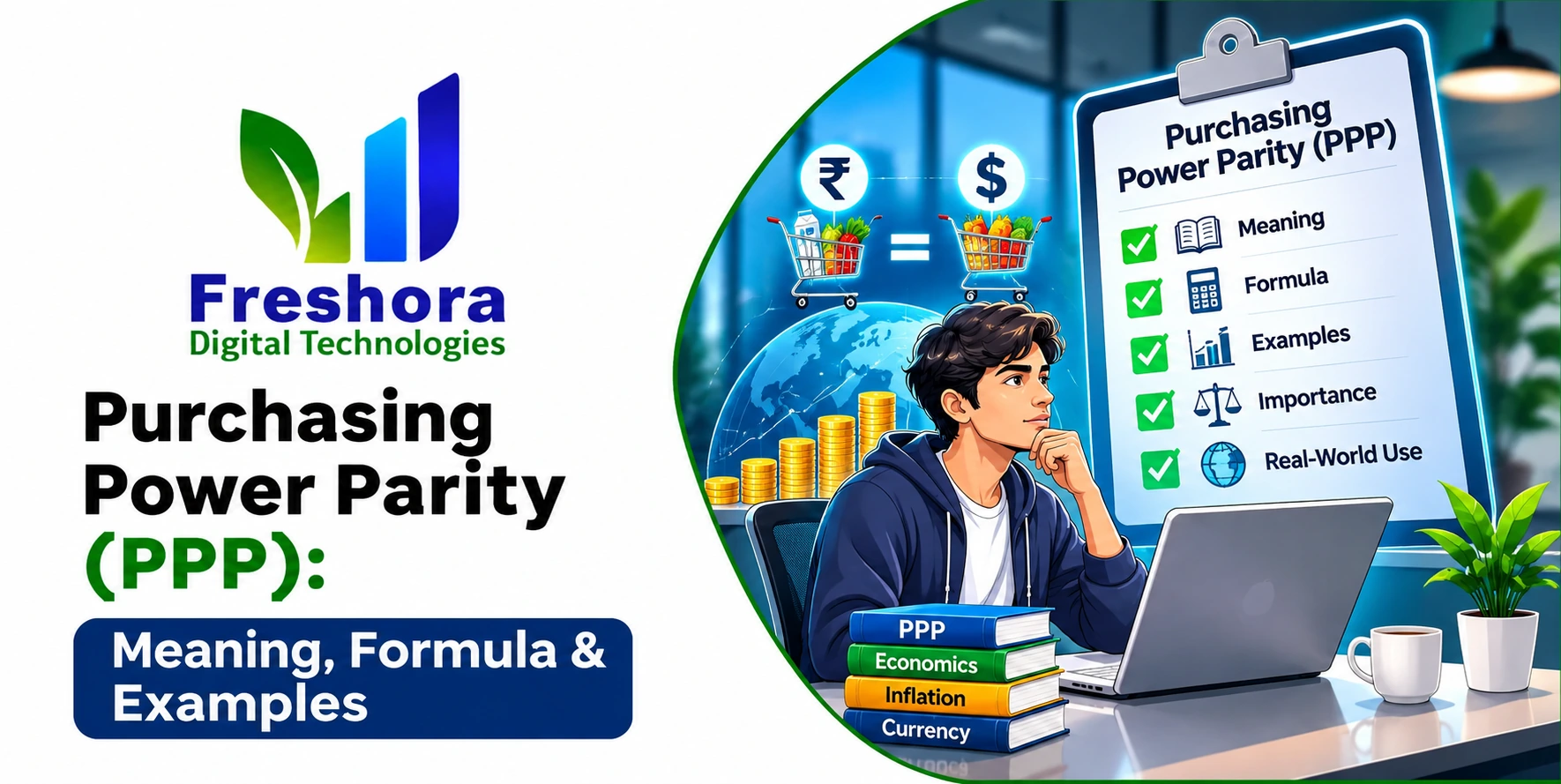
Purchasing Power Parity (PPP) is an economic theory that compares the purchasing power of different currencies by examining the prices of similar goods and services in different countries.
In simple terms, PPP explains how much money is needed in one country to purchase the same basket of goods and services that a certain amount of money can buy in another country.
It helps answer an important question:
How much can your money actually buy in different countries?
For example, imagine that a particular basket of everyday goods costs:
- ₹5,000 in India.
- $100 in the United States.
The PPP exchange rate based on this basket would be:
₹5,000 ÷ $100 = ₹50 per US dollar.
This means that, based on the selected basket, ₹50 in India has purchasing power equivalent to $1 in the United States.
This is a simplified illustration. Actual PPP estimates use broader price comparisons and carefully constructed statistical methods.
2. What Is the Purchasing Power Parity Formula?
The Purchasing Power Parity formula compares the price of a similar basket of goods and services in two countries.
PPP Exchange Rate Formula:
PPP Exchange Rate = Price of Basket in Country A ÷ Price of Basket in Country B
For example:
| Particulars | India | USA |
|---|---|---|
| Cost of selected basket | ₹5,000 | $100 |
| PPP exchange rate | ₹50 | $1 |
Therefore:
PPP = ₹5,000 ÷ $100 = ₹50 per USD.
This means that the PPP exchange rate for the selected basket is ₹50 per US dollar.
Why is this formula important?
It helps economists and businesses:
- Compare living costs between countries.
- Understand differences in purchasing power.
- Evaluate economic performance.
- Compare income levels more meaningfully.
- Understand international market affordability.
- Analyse differences in domestic price levels.
It is important to remember that PPP is not necessarily the same as the actual currency exchange rate available through banks or foreign exchange markets.
3. Practical Examples of Purchasing Power Parity
Let's understand PPP through some simple examples.
Example 1: Food and Grocery Shopping
Imagine a family wants to purchase groceries for one week.
The same general basket of groceries may cost:
- India: ₹3,000.
- USA: $80.
- UK: £65.
The actual prices depend on the products, locations, brands and shopping habits.
Even though the currencies are different, comparing the cost of similar baskets helps us understand the differences in purchasing power.
Example 2: Restaurant Expenses
Consider eating at a restaurant.
A meal that costs ₹300 in India may cost $15 in the United States.
Although both meals may offer a broadly similar dining experience, the local cost structures and purchasing power are different.
This demonstrates why simply converting currencies does not always provide an accurate picture of affordability.
Example 3: Salary and Living Standards
Suppose two professionals earn the following monthly salaries:
- Employee A in India: ₹60,000.
- Employee B in the USA: $3,000.
Comparing their salaries using only the market exchange rate does not tell us how comfortably they can live.
We also need to consider:
- Housing expenses.
- Food and groceries.
- Transportation.
- Healthcare.
- Education.
- Taxes.
- Other essential expenses.
PPP-adjusted income comparisons help economists understand differences in living standards more meaningfully.
4. Difference Between PPP and Exchange Rate
One of the most common misunderstandings is assuming that Purchasing Power Parity and currency exchange rates mean the same thing.
They are different economic measurements.
| Factor | Purchasing Power Parity | Market Exchange Rate |
|---|---|---|
| Meaning | Compares purchasing power | Compares currency values |
| Main purpose | Economic and cost-of-living comparison | Currency conversion |
| Based on | Relative prices of goods and services | Foreign exchange markets |
| Influenced by | Price levels across countries | Supply, demand, interest rates and other market factors |
| Common usage | Economic comparisons and living standards | International payments and trade |
Which one should businesses use?
Both are useful, but they serve different purposes.
For example, a company purchasing software from another country needs to consider the actual currency exchange rate for payment.
However, when deciding whether its services are affordable in another country, the company should also consider local purchasing power, competition and customer expectations.
PPP is a useful reference for understanding affordability, but it should not be the only basis for international pricing decisions.
5. Why Is Purchasing Power Parity Important?
PPP is important because it provides a more meaningful way to compare economies and understand the economic conditions of different countries.
Here are some of its major applications.
1. Comparing Economic Performance
Countries have different currencies and price levels. Comparing their GDP using market exchange rates alone may not accurately reflect the volume of goods and services produced.
PPP-adjusted GDP helps economists compare the real size of economies more meaningfully.
2. Understanding Cost of Living
PPP helps explain why the same amount of money can provide different lifestyles in different countries.
It is useful when comparing the affordability of housing, food, transport and other essential services.
3. International Business Expansion
Companies planning to enter foreign markets need to understand the purchasing capacity of potential customers.
PPP provides useful economic context when evaluating market opportunities.
4. Salary and Compensation Comparisons
International companies employ people across different countries.
PPP-adjusted income comparisons can help understand differences in purchasing power when evaluating salaries and employee living standards.
5. International Product and Service Pricing
Businesses selling products or services globally need to consider local affordability.
PPP can contribute to pricing research, along with competition, customer demand, operating costs and local taxes.
6. Investment Decisions
Investors use economic indicators, including PPP-adjusted GDP, to understand differences between countries and assess broader economic opportunities.
6. How Does PPP Influence International Business and Pricing Strategies?
International business is not simply about converting one currency into another.
A company entering a new country must understand the local market, customer behaviour, competition, operating expenses and purchasing capacity.
For example, a software company operating in India may want to sell its product in the USA, Australia, Singapore or the UAE.
It cannot simply multiply its Indian pricing by the currency exchange rate and assume that the resulting price will be competitive.
It should evaluate:
- Local customer purchasing power.
- Competitor pricing.
- Customer expectations.
- Market demand.
- Product value.
- Local operating costs.
- Payment preferences.
- Taxation and compliance requirements.
PPP can help provide an initial understanding of affordability differences.
However, successful international pricing requires a broader market research strategy.
7. What Is the Relationship Between PPP and the Digital Services Industry?
The digital services industry is one of the sectors where international pricing differences are particularly interesting.
Businesses today can purchase digital services from companies located anywhere in the world.
For example, a company in Australia can hire an SEO agency in India. Similarly, a business in the United States can outsource website development or mobile application development to an Indian technology company.
This creates opportunities for both service providers and international customers.
Consider the following digital services:
Search Engine Optimisation (SEO)
SEO pricing differs between countries because of differences in employee salaries, operational expenses, agency structures, competition and service expectations.
An international business may compare SEO agencies in India, the USA, the UK and Australia before selecting its service provider.
Website Development
Website development costs vary depending on the complexity of the project, technology stack, design requirements, integrations and development resources.
PPP can provide economic context when comparing the affordability of development services across countries.
Mobile App Development
Mobile application development requires specialised developers, designers, testers and project managers.
Businesses can evaluate development partners across international markets based on technical capabilities, delivery standards, communication and commercial value.
Digital Marketing Services
Digital marketing agencies offer services such as SEO, social media management, content marketing, paid campaigns and conversion optimisation.
Companies should evaluate the overall business value and expected outcomes rather than selecting a provider based only on the lowest price.
8. How Can Indian Companies Benefit from Purchasing Power Differences?
India has an established technology and digital services sector serving both domestic and international customers.
Companies based in India can explore international opportunities by providing services to businesses in countries with different economic conditions and operating costs.
Some important opportunities include:
1. International SEO Services
Indian agencies can support overseas businesses with technical SEO, content optimisation, local SEO and organic search growth.
2. Website and Web Application Development
Companies can provide corporate websites, eCommerce platforms, custom web applications and business portals to international customers.
3. Mobile Application Development
Indian development teams can build Android, iOS and cross-platform applications for companies across different industries.
4. White-Label Digital Services
Digital agencies in other countries can partner with Indian technology companies to handle backend execution while focusing on customer acquisition and client relationships.
5. SaaS and Technology Solutions
Indian technology companies can develop scalable software products and offer them to customers across international markets.
The opportunity is not simply to offer lower prices. It is to combine technical expertise, reliable execution, quality and competitive operating structures to deliver measurable value.
9. How Freshora Digital Technologies Supports Businesses Across India and International Markets
At Freshora Digital Technologies, we believe businesses should have access to reliable digital technology solutions that help them grow, compete and expand into new markets.
Based in Tamil Nadu, India, Freshora has a team of 40+ professionals supporting businesses across India and international markets.
We work with businesses that want to improve their online presence, generate qualified leads, strengthen their digital infrastructure and build technology solutions.
Our core expertise covers three important areas.
A. Search Engine Optimisation (SEO)
Our SEO services help businesses improve their visibility on search engines and attract relevant organic traffic.
Our SEO capabilities include:
- Technical SEO.
- On-page SEO.
- Off-page SEO.
- Local SEO.
- Keyword research.
- Competitor analysis.
- Content optimisation.
- Google Business Profile optimisation.
- International SEO.
- Website performance improvements.
We focus on building sustainable search visibility that supports long-term business growth.
B. Website Development
A professional website is an important business asset. It helps establish credibility, communicate services and generate customer enquiries.
Freshora provides:
- Business website development.
- Corporate website development.
- eCommerce website development.
- Custom website development.
- Web application development.
- CRM and ERP solutions.
- SaaS platform development.
- Website redesign and maintenance.
We focus on responsive design, user experience, performance, functionality and search engine readiness.
C. Mobile App Development
Mobile applications help businesses improve customer engagement, streamline operations and provide convenient digital experiences.
Our mobile app development capabilities include:
- Android application development.
- iOS application development.
- Cross-platform application development.
- Business applications.
- eCommerce applications.
- Custom mobile applications.
- API integration and backend development.
We help businesses transform their ideas into functional digital solutions.
D. AEO and GEO: Preparing Businesses for AI-Powered Search
Search behaviour is evolving. Customers are increasingly using AI-powered platforms and conversational search tools to discover businesses, compare services and find solutions.
This makes Answer Engine Optimisation (AEO) and Generative Engine Optimisation (GEO) increasingly relevant.
Answer Engine Optimisation (AEO) focuses on making website content useful, clear and structured so that search engines and answer engines can understand and surface relevant information.
Generative Engine Optimisation (GEO) focuses on improving the likelihood that a brand's expertise, services and relevant content are understood and referenced by generative AI platforms.
Our AEO and GEO-focused initiatives include:
- Creating clear, answer-focused content.
- Building topical authority.
- Improving website structure and internal linking.
- Using relevant structured data.
- Strengthening brand and entity information.
- Publishing helpful and trustworthy content.
- Improving content relevance for conversational searches.
- Building consistent brand information across relevant platforms.
Our objective is to help businesses strengthen their visibility across traditional search engines and emerging AI-powered discovery platforms.
10. How Should Businesses Choose the Right International Digital Partner?
PPP can help businesses understand economic differences, but selecting an international service provider requires more than comparing prices.
Here are some important factors to evaluate.
- Technical expertise: Check whether the company has experience with the technologies and services you require.
- Portfolio and experience: Review completed projects, relevant case studies and client references.
- Team strength: Understand whether the provider has an established team to manage your project.
- Communication: Clear communication, reporting and project updates are essential for international collaboration.
- Quality assurance: Evaluate testing, security practices, documentation and delivery standards.
- Scalability: Choose a partner capable of supporting your future requirements as your business grows.
- Long-term support: Ensure that maintenance, updates and technical assistance are available after project delivery.
The right partner is not necessarily the cheapest provider. It is the company that delivers the right combination of expertise, quality, reliability and business value.
11. Limitations of Purchasing Power Parity
Although PPP is an important economic measurement, it has certain limitations.
1. Differences in Consumer Behaviour
People in different countries purchase different products and services. Their consumption patterns may not be identical.
2. Quality Differences
Two products may appear similar but differ in quality, features, materials or service standards.
3. Local Taxes and Government Policies
Taxes, subsidies, import duties and government regulations can influence the prices of products and services.
4. Non-Tradable Services
Services such as local transportation, personal care and property rentals may have significantly different prices across countries.
5. Exchange Rate Fluctuations
Market exchange rates change regularly, while PPP estimates are generally based on periodic price surveys and statistical calculations.
6. It Does Not Measure Everything
PPP does not independently measure income inequality, infrastructure quality, healthcare access, employment opportunities or overall quality of life.
Therefore, PPP should be considered alongside other economic indicators rather than used as the only measure of economic performance.
Conclusion: Understanding Purchasing Power Creates Better Global Business Opportunities
Purchasing Power Parity is more than an economic theory. It provides a useful framework for understanding how money, affordability and living standards differ across countries.
For businesses planning international expansion, PPP offers valuable insights into customer purchasing power, market affordability and economic differences.
However, successful global business growth requires more than understanding currency values. Companies must also invest in technology, customer experience, brand visibility, market research and operational excellence.
At Freshora Digital Technologies, we believe that digital transformation creates opportunities for businesses to reach customers beyond geographical boundaries.
Whether you need SEO services, professional website development, mobile app development, web applications, AEO or GEO-focused optimisation, our team is ready to support your digital growth journey.
Looking to expand your business online and reach more customers?
Connect with Freshora Digital Technologies and explore how our digital technology expertise can help your business build a stronger online presence.
Freshora Digital Technologies – Innovate. Quantify. Order.