
Introduction
Businesses increasingly depend on multiple applications to manage sales, finance, customer relationships, inventory, employee information and daily operations. These applications often need to exchange information to keep business processes connected. APIs make this communication possible by allowing different software systems to share data and trigger actions, which is a core part of building integrated digital ecosystems.
However, connecting applications through APIs without clear management standards can create operational challenges. Different teams may develop integrations using inconsistent authentication methods, data formats, access permissions and error-handling practices. As the number of connections grows, these inconsistencies can affect security, reliability and long-term maintenance.
This is where API governance for connected business applications becomes important. It establishes the policies, standards and responsibilities required to manage APIs throughout their lifecycle while allowing business applications to communicate in a controlled and consistent manner.
What Is API Governance?
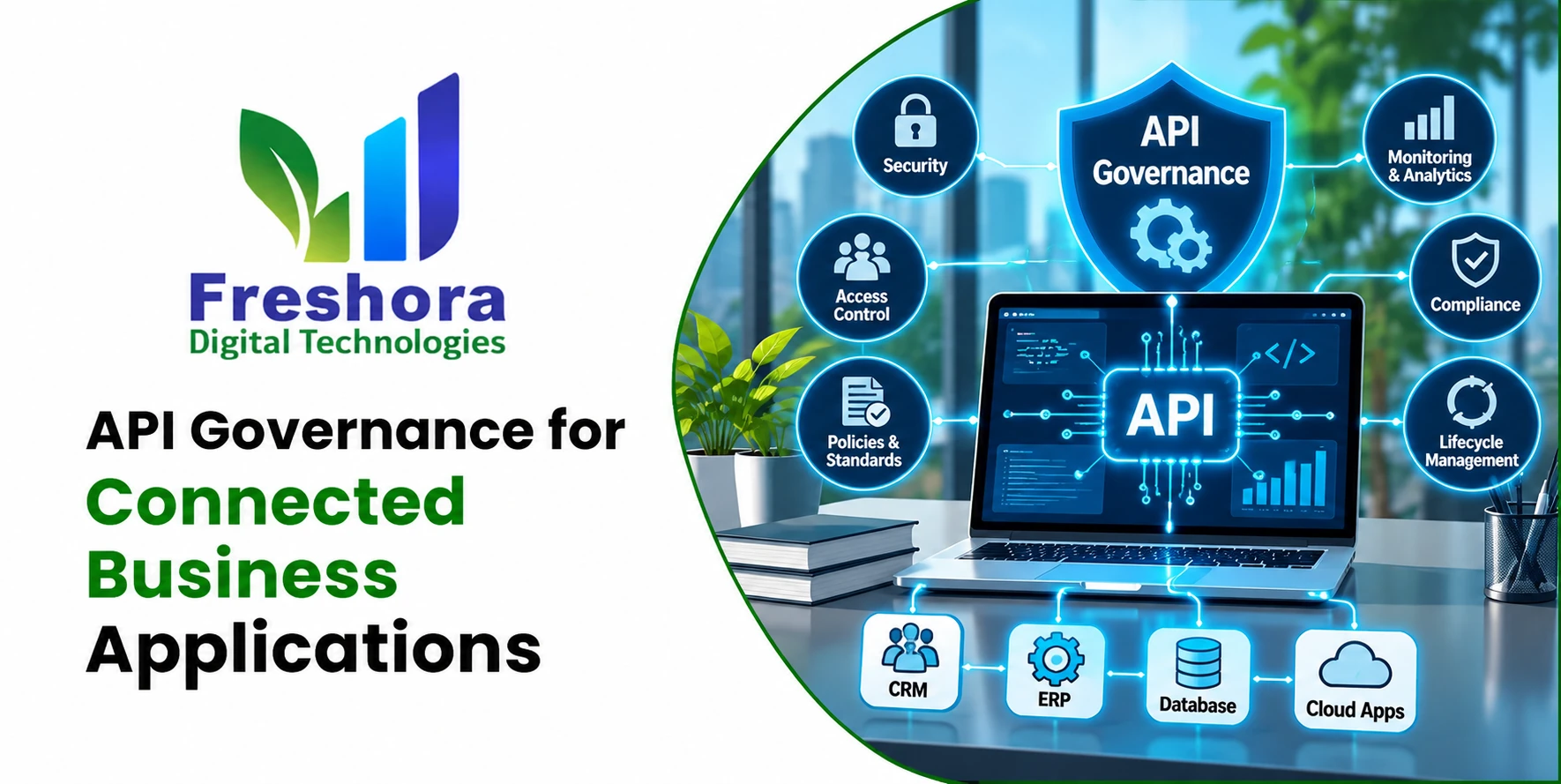
API governance is a structured approach to managing how APIs are designed, developed, secured, published, monitored and maintained. It defines the technical and operational standards that development teams should follow when creating or connecting application interfaces.
Governance is not limited to controlling API access. It also addresses documentation quality, version management, data consistency, ownership, performance expectations and retirement procedures.
For example, when a business connects its CRM with an ERP system, the integration may transfer customer records, order details and payment information. Learn more about why CRM integration improves business communication. API governance helps define which data can be exchanged, how it should be formatted, who can access it and how integration failures should be handled.
A consistent governance framework makes integrations easier to understand, maintain and expand as business requirements change.
Why Connected Business Applications Need API Governance
As businesses adopt more specialised software, the number of application connections can increase quickly. Without common standards, every integration may follow a different development approach.
This creates several risks.
Inconsistent Data Exchange
Different applications may represent the same information in different formats. For example, one system may store customer contact details in separate fields, while another expects a combined address structure. Standardised API contracts and data integration and mapping rules reduce these inconsistencies.
Uncontrolled Access to Business Data
APIs can expose sensitive information if authentication, authorisation and permission controls are not properly defined. Governance establishes access policies based on application roles, business requirements and data sensitivity.
Difficult Integration Maintenance
When applications change their data structures or API endpoints, connected systems may stop functioning as expected. Clear ownership, documentation and versioning policies help teams identify dependencies and manage changes safely.
Limited Visibility Across Integrations
Without central monitoring and reporting, businesses may struggle to identify failed requests, unusual traffic patterns or recurring performance issues. Governance encourages consistent logging, data monitoring and incident management practices.
Key Components of an Effective API Governance Framework
An effective governance framework should cover the complete API lifecycle rather than focusing only on development standards.
1. API Design Standards
Businesses should establish common rules for API naming, endpoint structures, request methods, response formats, error messages and documentation. Consistent design makes APIs easier for different development teams to understand and integrate.
Standards should also define when to use REST, GraphQL or other interface approaches based on the application's requirements rather than selecting technologies without considering the use case.
2. Authentication and Authorisation
Every API should have an appropriate access-control mechanism. Depending on the application and integration architecture, this may involve OAuth 2.0, API keys, mutual TLS or other security controls.
Authentication verifies the identity of the requesting application or user, while authorisation determines which resources and actions they are permitted to access. Strong identity management supports this process. Businesses should also establish policies for credential rotation, token expiry and access reviews.
3. API Documentation and Ownership
Each API should have clear documentation explaining its purpose, endpoints, request parameters, response structures, authentication requirements, limitations and error handling.
Ownership is equally important. Every production API should have an accountable team or individual responsible for maintenance, security updates, issue resolution and lifecycle decisions.
4. Version Control and Change Management
API changes can affect multiple connected applications. Governance should define how teams introduce new versions, communicate breaking changes, support older versions and retire outdated endpoints.
Backward compatibility should be considered wherever practical. When a breaking change is unavoidable, dependent application owners should receive sufficient notice and migration guidance.
5. Monitoring and Performance Management
API monitoring helps businesses understand how integrations behave in real operating conditions. Useful indicators include request volume, response time, error rates, availability and traffic patterns.
Teams should establish suitable performance thresholds and alerts based on business impact. Monitoring should also support investigation of failed transactions and recurring integration problems.
6. Data Governance and Privacy
Connected applications may exchange customer, employee, financial and operational information. Businesses should classify data according to sensitivity and define what each integration is allowed to access. See why data governance improves enterprise performance.
Data minimisation, encryption in transit, appropriate retention policies and audit trails help reduce unnecessary exposure. Organisations should also evaluate applicable privacy and regulatory requirements before enabling data exchange.
How to Implement API Governance Across Multiple Applications
API governance works best when it is introduced through a practical, phased approach.
Start by mapping existing integrations. Identify the applications currently connected, the APIs they use, the information exchanged and the business processes that depend on them. This provides a clear picture of integration complexity and potential risks.
Define shared governance policies. Establish standards for API design, security, documentation, ownership, versioning and monitoring. These standards should be realistic enough for development teams to follow across different projects.
Create an API inventory. Maintain a central record of available APIs, their owners, environments, versions, dependencies and business purposes. An organised inventory reduces duplicated development and helps teams discover existing integration capabilities.
Introduce security controls consistently. Apply suitable authentication, authorisation, encryption and traffic-management policies, following a security-first strategy. Access should follow the principle of least privilege, allowing applications to use only the resources they require.
Establish testing and approval procedures. APIs should undergo functional, security, compatibility and performance testing before production release, supported by solid software testing and quality assurance. Changes should also be reviewed for their impact on dependent applications.
Monitor and improve continuously. Review API performance, security events, usage patterns and integration failures. Governance policies should evolve as business applications, technologies and operational requirements change.
Choosing the Right API Management Approach
API governance defines the policies and responsibilities that guide API usage, while API management platforms provide tools to implement and enforce many of those policies.
Depending on business requirements, an API management solution may offer gateway controls, authentication, traffic limits, analytics, developer portals, API versioning and lifecycle management.
Businesses evaluating these solutions should consider their existing application architecture, deployment requirements, integration complexity, security needs and expected API traffic. A structured software architecture also makes it easier to scale integrations. The comparison should also examine how easily a platform supports development teams and connects with existing infrastructure.
For a broader evaluation of available solutions, businesses can refer to Top API Management Platforms for Enterprise Integrations in Chennai, which explores API management options and their enterprise integration capabilities.
The selection process should distinguish between the governance policies an organisation needs and the platform features available to enforce them. Buying a platform alone will not resolve unclear ownership, inconsistent data standards or missing change-management procedures.
Common API Governance Mistakes to Avoid
One common mistake is treating governance as a documentation exercise. Documentation is important, but it must be supported by security controls, ownership, monitoring and change-management practices.
Another problem is creating overly complicated approval processes. If every small API change requires unnecessary administrative steps, teams may avoid the official process. Governance should establish appropriate controls based on risk and business impact.
Businesses should also avoid allowing each development team to create independent standards. Different approaches to authentication, error handling and data structures can increase long-term integration costs.
Finally, organisations should not ignore older APIs. Legacy endpoints may continue to support important business operations. They should be inventoried, monitored and migrated or retired through a planned process, ideally as part of infrastructure modernisation.
Measuring the Effectiveness of API Governance
Businesses need measurable indicators to understand whether their governance framework is improving integration operations.
Useful measurements include:
- API availability: Measures whether APIs remain accessible when connected applications need them.
- Error rate: Tracks unsuccessful requests and recurring integration failures.
- Response time: Shows how quickly APIs process and return requests.
- Security incidents: Helps evaluate the effectiveness of access controls and security monitoring.
- Documentation coverage: Indicates whether active APIs have complete and updated technical documentation.
- Version compliance: Measures whether applications use supported API versions.
- Integration maintenance effort: Helps identify whether standardisation is reducing the time required to maintain connections.
These indicators should be reviewed alongside business outcomes. For example, a reliable CRM-to-ERP integration may reduce manual data entry, improve order visibility and help teams respond to customer requirements more efficiently. This is one way ERP systems streamline business workflows and operations.
Conclusion
As businesses connect more applications, API governance becomes essential for maintaining secure, consistent and dependable information exchange. Clear design standards, access policies, documentation, ownership, version management and monitoring help organisations control integration complexity without restricting development flexibility.
A well-planned governance framework also makes future integrations easier to manage because teams can build on established standards instead of creating separate approaches for every connection.
Freshora Digital Technologies supports businesses in planning and developing connected enterprise software solutions where application integration, workflow requirements and long-term maintainability need to work together. By treating API governance as an ongoing business and technology responsibility, organisations can build a more reliable foundation for connected applications.