Contact our team for professional guidance and solutions.
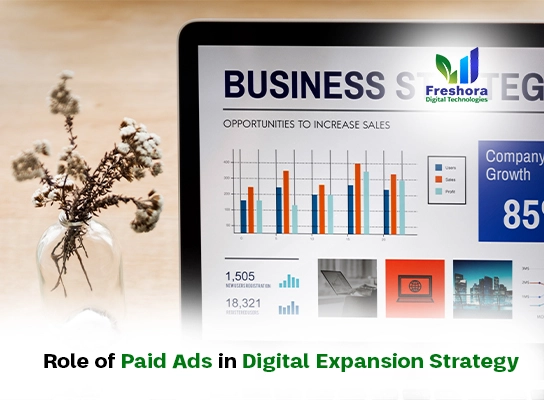
Paid advertising gives businesses a controllable way to reach potential customers, test demand, generate qualified traffic, and measure commercial outcomes. Unlike approaches that depend entirely on organic discovery, paid campaigns can place an offer in front of a defined audience at the moment of relevant intent. The real growth opportunity, however, is not simply spending more on advertisements; it is connecting audience targeting, creative messaging, landing-page experience, conversion tracking, attribution, and budget decisions into one measurable growth system.
Paid Advertising for Digital Business Growth works by placing relevant offers in front of carefully selected audiences and continuously improving campaigns according to measurable business outcomes.
A strong paid campaign follows this cycle:
Audience → Message → Advertisement → Landing Page → Conversion → Measurement → Optimisation → Scale
The objective should not be maximum clicks. It should be more valuable customer actions from an efficiently managed advertising investment.
India's digital advertising market represented 46% of total advertising expenditure in FY2025, according to a CRISIL Intelligence estimate reported by The Economic Times.
India's technology and e-commerce companies generated nearly ₹80,000 crore in advertising revenue during FY2024–25, up from approximately ₹66,000 crore in FY2023–24.
Google Ads attribution reports can analyse customer conversion paths across campaigns, keywords, devices, and multiple interactions rather than relying only on the final click.
Google describes conversion measurement as a way to quantify actions after an advertising interaction and connect those actions with campaign performance.
Google Ads supports conversion modelling and Smart Bidding to help advertisers optimise campaigns against business goals using privacy-safe measurement.
Digital advertising has evolved from simply buying online visibility into a measurable growth channel where businesses can control audiences, budgets, messaging, destinations, and conversion objectives. Paid Ads for Business Growth become especially valuable when campaigns are connected to meaningful outcomes such as qualified enquiries, purchases, bookings, applications, or revenue rather than impressions and clicks alone. When targeting, creative, landing pages, tracking, and optimisation work together, paid campaigns can create a repeatable system for acquiring customers and identifying where additional investment can generate commercially useful results.
Paid advertising is a marketing model in which a business pays a platform to distribute promotional messages to selected audiences.
Common platforms include:
Google Ads
Meta Ads
YouTube advertising
LinkedIn Ads
Display advertising
Shopping advertising
Other specialised advertising networks
The important distinction is that growth-focused advertising does not treat paid media simply as a traffic generator.
It connects:
Advertising Spend → Customer Action → Business Value
For example, a campaign for a service company should ideally measure more than how many people clicked the advertisement. It should identify how many people became qualified enquiries and, ultimately, customers.
Google's measurement framework supports this approach by connecting advertising interactions with conversions and customer journeys.
Digital competition has increased the importance of speed, precision, and measurable acquisition.
A business may have an excellent website but still struggle to reach enough relevant prospects. Paid campaigns can provide an additional distribution mechanism while organic channels, referrals, and brand visibility continue developing.
The Indian advertising market demonstrates this shift. CRISIL Intelligence estimated that digital media accounted for 46% of India's total advertising expenditure in FY2025, making digital one of the country's dominant advertising environments.
For businesses, the implication is straightforward: digital advertising is no longer only a supplementary promotional activity. It can become part of the core customer-acquisition infrastructure.
|
Metric |
Reported value |
|
Digital media share of India's ad expenditure in FY2025 |
46% |
|
Advertising revenue generated by India's tech & e-commerce companies in FY2024–25 |
~₹80,000 crore |
|
Previous-year figure |
~₹66,000 crore |
|
Increase from ₹66,000 crore to ₹80,000 crore |
~21.2% |
|
Google Ads attribution lookback options |
30, 60 or 90 days |
The ₹80,000-crore figure represents advertising revenue generated by technology and e-commerce companies, rather than total Indian digital advertising expenditure, so the two statistics should not be treated as interchangeable. Google also provides attribution reports with 30-, 60-, and 90-day lookback options, allowing advertisers to examine interactions preceding conversions.
Organic visibility can take time to develop, while paid campaigns can begin reaching selected audiences soon after launch.
This is particularly useful for:
New businesses
New services
Product launches
Seasonal offers
Local promotions
Time-sensitive campaigns
Paid media therefore provides a controllable visibility layer.
Modern advertising platforms allow businesses to work with combinations of:
Search intent
Demographics
Location
Interests
Website behaviour
Previous interactions
Customer lists
Remarketing audiences
This enables businesses to move from broad exposure toward more relevant audience selection.
Search advertising is particularly powerful when a potential customer is already looking for a solution.
For example:
“best accounting software for small business”
represents a different intent from:
“what is accounting software?”
A growth-focused campaign should recognise that difference and align the advertisement and landing page accordingly.
Google's conversion measurement framework allows businesses to measure actions taken after advertising interactions.
Depending on the business, these actions could include:
Purchases
Calls
Form submissions
Bookings
Appointments
Downloads
Registrations
Qualified leads
This changes the conversation from:
“How many people saw our ad?”
to:
“What did the advertising produce?”
Start with the desired commercial outcome.
For example:
Goal: Generate 100 qualified enquiries per month.
That goal is more useful than simply setting a target of 50,000 impressions.
Build an audience profile around:
Need
Location
Buying stage
Budget
Search behaviour
Existing relationship with the brand
Different objectives require different advertising environments.
Google Search: Capture existing intent.
Meta: Generate discovery and audience-based demand.
YouTube: Build awareness and consideration.
LinkedIn: Reach professional and B2B audiences.
A weak offer can make a strong campaign underperform.
The offer should clearly answer:
Why should the customer act now?
Examples include:
Free consultation
Product demonstration
Limited-time package
Quote request
Appointment
Downloadable resource
Strong advertisements connect:
Customer Problem + Relevant Promise + Clear Action
Avoid filling the advertisement with generic claims.
The landing page should continue the promise made in the advertisement.
If the advertisement promotes a specific service, the customer should not arrive on an unrelated homepage.
Track actions that matter commercially.
Google's attribution reports can show the paths users take before completing conversions, including interactions involving multiple campaigns and keywords.
Do not optimise only for:
Clicks
Impressions
Likes
Reach
Also examine:
Qualified leads
Sales
Revenue
Cost per acquisition
Conversion rate
Customer value
Use campaign data to improve:
Targeting + Creative + Bidding + Landing Page + Budget
Increase investment when the campaign demonstrates a repeatable relationship between spend and valuable outcomes.
Scaling should be evidence-led rather than simply doubling a budget because a campaign produced a good week.
|
Component |
Purpose |
|
Audience targeting |
Reach relevant prospects |
|
Keyword targeting |
Capture search intent |
|
Ad creative |
Earn attention and communicate value |
|
Offer |
Encourage action |
|
Landing page |
Convert traffic |
|
Conversion tracking |
Measure customer actions |
|
Attribution |
Understand conversion paths |
|
Budget management |
Control investment |
|
Testing |
Discover stronger combinations |
|
Analytics |
Guide decisions |
Google's attribution reports can show which campaigns and keywords assist conversions, providing more context than a simple last-click view.
Paid campaigns can generate targeted exposure without waiting for organic visibility to mature.
Businesses can establish daily or campaign-level spending limits.
Campaigns can be structured around specific customer characteristics and intent signals.
Conversion tracking makes it possible to connect advertisements with meaningful actions.
Businesses can test multiple messages, offers, audiences, and landing pages.
Successful campaigns can potentially be expanded when acquisition economics remain healthy.
Campaign data can reveal what customers search for, which offers attract attention, and which messages generate action.
A low-cost click is not automatically a valuable business outcome.
Specific advertisements usually perform better when the destination directly matches the advertised intent.
A first-time prospect and an existing customer may require completely different communication.
Without measurement, campaign optimisation becomes heavily dependent on assumptions.
If targeting, creative, budget, landing page, and bidding all change simultaneously, identifying the reason for performance changes becomes difficult.
More conversions are useful only when their economic value justifies the acquisition cost.
Start with a measurable business objective.
Define valuable conversion actions before launching.
Match campaigns to customer intent.
Use audience segmentation rather than generic targeting.
Build dedicated landing pages for important campaigns.
Track qualified leads instead of counting every enquiry equally.
Connect advertising data with sales information where possible.
Test creative concepts systematically.
Review search terms and audience behaviour.
Compare acquisition cost against customer value.
Use attribution to understand multi-touch journeys.
Scale gradually after performance becomes consistent.
Maintain strong first-party measurement foundations.
Use automation and bidding tools only after measurement quality is established.
Google highlights first-party data, conversion modelling, and automated bidding as important components of modern measurement and optimisation.
A campaign can appear successful inside an advertising dashboard while producing disappointing sales.
Create a simple comparison:
Ad Platform Conversions → Qualified Leads → Sales → Revenue
For example:
|
Stage |
Result |
|
Ad conversions |
120 |
|
Qualified leads |
48 |
|
Sales opportunities |
22 |
|
Customers |
12 |
|
Revenue |
₹2,40,000 |
This reveals where growth is actually being lost.
If 120 conversions produce only 12 customers, increasing advertising spend may not be the first solution. The business may need to improve lead qualification, follow-up, pricing, sales conversion, or the offer itself.
That is how advertising becomes a business growth system rather than a traffic-buying activity.
Consider a Trichy-based service company investing ₹40,000 per month in paid campaigns.
The campaign produces revenue, but the business identifies a large difference between enquiries and qualified opportunities.
Instead of immediately increasing the advertising budget, the growth strategy changes:
Audience refinement → Stronger offer → Better landing page → Lead qualification → Sales follow-up
After optimisation, assume:
Enquiries: 80
Qualified enquiries: 45
Customers: 12
Average customer value: ₹15,000
Revenue: ₹1,80,000
The improvement did not come from simply purchasing more traffic.
It came from improving the quality of the entire conversion system.
For businesses looking for Online Advertising Solutions, the process can begin with an advertising and conversion audit covering business goals, audience segments, campaign structure, existing tracking, landing pages, customer journey, and sales outcomes. Campaigns can then be structured around measurable objectives, with platform selection based on customer intent and business requirements.
The implementation can combine campaign planning, creative development, audience targeting, conversion tracking, landing-page optimisation, performance analysis, and ongoing budget refinement. This creates a feedback loop where real campaign data informs the next optimisation decision rather than relying on assumptions.
Paid advertising can provide businesses with immediate, targeted market visibility.
Strong campaigns optimise for business outcomes, not vanity metrics.
Conversion tracking is essential for understanding what advertisements actually produce.
Google Ads attribution reports can reveal customer conversion paths across multiple interactions.
India's digital media sector accounted for 46% of advertising expenditure in FY2025, according to CRISIL Intelligence data reported by The Economic Times.
India's technology and e-commerce companies generated approximately ₹80,000 crore in advertising revenue in FY2024–25, compared with ₹66,000 crore in FY2023–24.
Better advertising performance often comes from improving the complete funnel rather than simply increasing spend.
Audience quality, offer strength, landing-page relevance, conversion tracking, and sales follow-up can all influence advertising profitability.
Data-driven optimisation creates a stronger foundation for scalable growth.
The most effective Digital Advertising Growth Strategies connect advertising expenditure with qualified customer acquisition and measurable business value.
Paid advertising can become a powerful growth engine when it is managed as an integrated business system rather than a standalone source of website traffic. The combination of precise audience targeting, compelling offers, relevant landing pages, reliable conversion measurement, attribution, and continuous optimisation allows businesses to understand what their advertising investment is actually producing. With digital advertising representing a substantial share of India's overall advertising market and measurement technologies becoming increasingly sophisticated, businesses have greater opportunities to make marketing decisions using evidence rather than assumptions. Ultimately, sustainable paid-media growth comes from finding the right customers, delivering the right message, measuring the right outcome, and scaling only when the underlying economics make business sense.



In the vibrant city of Tiruchirappalli, where culture and tradition meet, photography studios often... Read More
Blog Summary: In the competitive digital landscape of Trichy, your website's visibility is the found... Read More
Blog Summary: In today’s digital era, the journey of a new congregant often begins with a simp... Read More
Our expert will call you shortly to understand your needs and help grow your business.
Get exclusive digital marketing tips, SEO insights, web & app updates, and job opportunities delivered straight to your inbox.
Join our WhatsApp channel for instant digital marketing tips, SEO insights, web & app updates, and latest job opportunities.
Join NowFreshora Digital Technologies proudly serves businesses across Tiruchirappalli (Trichy), including Cantonment, Puthur, Thillai Nagar, Palakarai, Subramaniyapuram, Mela Chinthamani, Woraiyur, KK Nagar, Karumandapam, Crawford, Edamalaipatti Pudur (EMP), Kattur, Airport Area, Ariyamangalam, Panjappur, Thuvakudi, Tiruverumbur, BHEL Township, Srirangam, Thiruvanaikaval, Samayapuram, No.1 Tollgate, Central Bus Stand Area, and Chathiram Bus Stand Area.
We also serve clients across Tamil Nadu, India, and globally in Singapore, the UAE, Saudi Arabia, Canada, Australia, the United Kingdom, and the United States, delivering innovative Website Development, Mobile App Development, Software Development, SEO, Google Business Profile Management, and Digital Marketing solutions that help businesses grow and succeed in the digital world.
