Quick Answer: What Is Generative Engine Optimization?
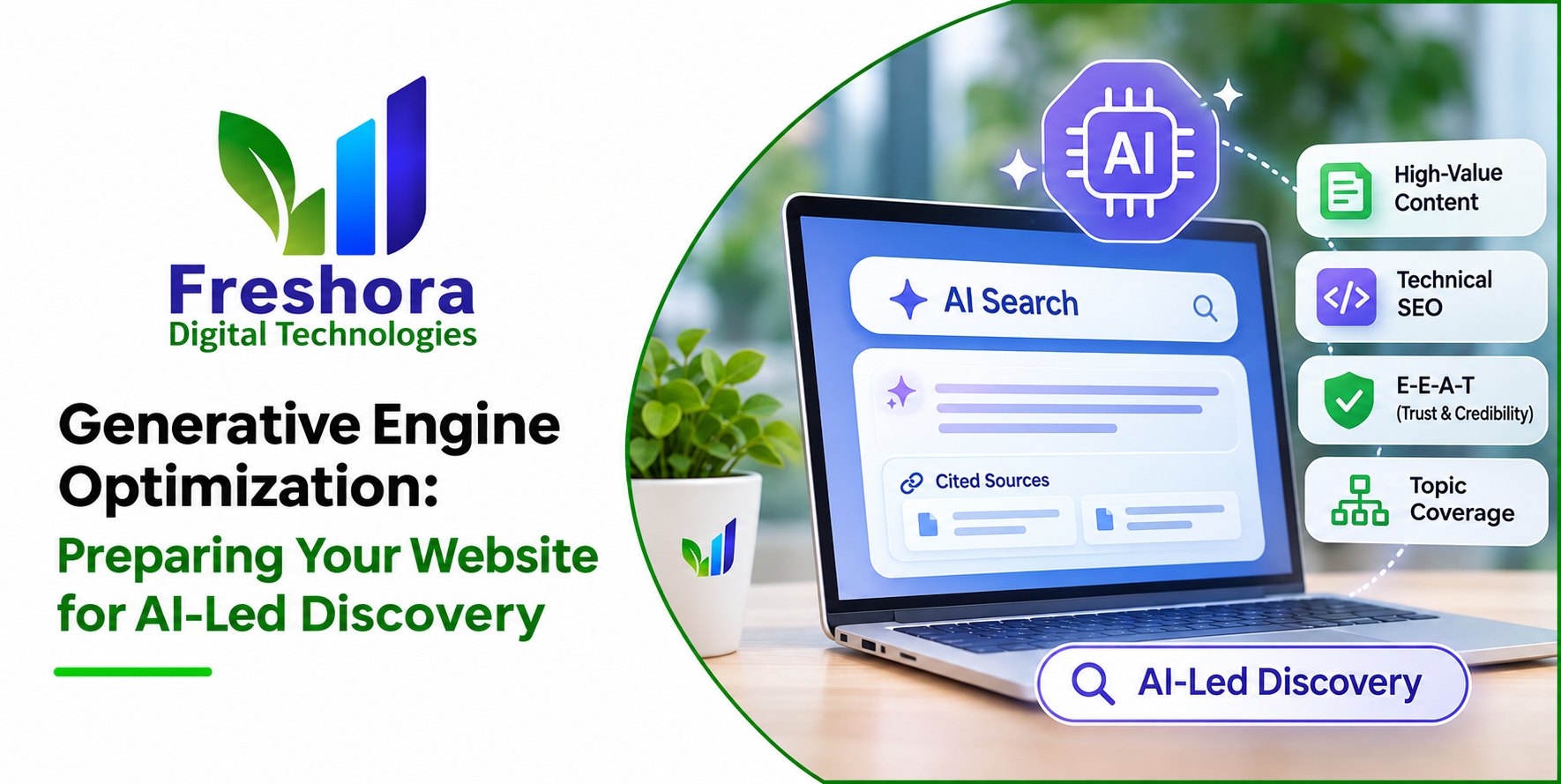
Generative engine optimization (GEO) is the practice of improving a website's ability to be discovered, understood, and potentially referenced by AI-powered search experiences. These experiences include AI-generated search summaries and conversational search tools that answer questions using information from multiple sources. Effective GEO focuses on original information, clear explanations, reliable evidence, accessible website content, and strong technical SEO foundations. It complements traditional SEO rather than replacing it, and no optimization technique can guarantee that an AI system will mention or cite a particular website. Businesses can strengthen these foundations through 7 content optimization tips for better SEO rankings.
Introduction
The way people discover information online is expanding beyond conventional search results. Instead of entering a short keyword and opening several websites, users increasingly ask detailed questions through AI-powered search experiences. They may request product comparisons, service recommendations, technical explanations, or step-by-step solutions and receive a synthesized response with links to supporting sources.
This change creates a new consideration for website owners: visibility is not limited to ranking in a list of search results. Businesses also need to understand how their content can be discovered and used within AI-generated answers.
Generative engine optimization addresses this opportunity. It encourages website owners to create content that answers meaningful questions, provides information that other pages do not offer, and makes important facts easy to understand and verify.
However, GEO is not a shortcut for bypassing search algorithms. Google's published guidance confirms that established SEO practices remain foundational to visibility in its generative search experiences. Original, useful content and a technically accessible website continue to matter. Google Search Central's guide to generative AI search provides further guidance on this relationship. Businesses can also explore content marketing strategies that work in 2026 to understand how useful information supports online visibility.
The practical objective is to build a website that serves people well and is technically prepared for the different ways information is discovered.
1. Understanding GEO Meaning in SEO
The GEO meaning in SEO refers to optimizing online content for discovery and potential inclusion in responses produced by generative AI systems. These systems can interpret a question, gather relevant information, and create a response that combines details from different sources.
Traditional search engines commonly present a list of pages that users can explore. Generative search experiences may provide a direct explanation first, followed by citations or links that allow users to investigate the original information.
For example, someone searching for a web development company might ask an AI assistant, "What should a small business look for when choosing a Laravel development agency?"
A useful AI-generated response could discuss technical expertise, security practices, project experience, maintenance support, and pricing transparency. A website that explains these factors clearly, supports its recommendations with relevant evidence, and demonstrates practical experience may be a useful source for such a response.
GEO therefore involves more than placing a keyword in a heading. It requires a combination of content quality, subject relevance, factual clarity, discoverability, and credibility. Following SEO-friendly content writing practices can help businesses communicate these topics clearly.
It is also important to distinguish between being accessible to an AI crawler, being retrieved for a particular question, being cited in an answer, and earning a website visit. These are different outcomes, and success at one stage does not guarantee success at the next.
2. Why Generative AI Search Optimization Matters
Generative AI search optimization matters because potential customers can discover businesses through answers, summaries, and recommendations rather than only through traditional organic listings.
A user might ask an AI system to explain a service, compare providers, identify common problems, or suggest a solution based on specific requirements. A business with useful and relevant information has an opportunity to become part of that discovery process.
There are several reasons to prepare a website for this changing environment.
Discovery can begin with detailed questions. Users often describe their situation instead of searching for a single keyword. Content that addresses specific needs, constraints, and follow-up questions can serve these more detailed searches.
Original information can differentiate a business. Many websites publish similar introductory explanations. Practical examples, genuine project insights, original research, and expert commentary give readers a reason to consult one source rather than another.
Trust influences how information should be presented. Clear authorship, accurate claims, transparent business details, and verifiable references help readers assess whether information is dependable.
Website usability remains important. A technically accessible website with logical navigation and readable content makes it easier for users and search systems to access important information.
Visibility needs broader measurement. Search performance should be evaluated alongside referral visits, qualified enquiries, conversions, and brand discovery. A single ranking metric cannot describe every way a customer may encounter a business.
GEO should therefore be treated as an extension of a sustainable SEO and long-term business visibility strategy, not an isolated activity that guarantees immediate traffic.
3. GEO vs SEO: Understanding the Difference
GEO vs SEO is often presented as a choice between traditional search optimization and AI search optimization. In practice, the two approaches share many foundations.
SEO improves a website's ability to appear in relevant search results. GEO focuses more specifically on how content may be discovered, interpreted, and referenced in generative responses. The distinction is mainly about the discovery experience and the way visibility is evaluated.
|
Area |
Traditional SEO |
Generative Engine Optimization |
|---|---|---|
|
Main objective |
Improve visibility in search results and attract relevant visitors. |
Improve the likelihood that useful content is discovered or referenced in AI-generated responses. |
|
Content approach |
Match search intent and provide relevant, useful information. |
Answer questions clearly while offering distinctive facts, evidence, and context. |
|
Technical foundation |
Crawling, indexing, internal links, performance, and accessible page content. |
The same foundations, with attention to whether relevant pages can be accessed by the systems being targeted. |
|
Content credibility |
Demonstrate relevance, expertise, reliability, and value to readers. |
Make important claims clear, accurate, attributable, and easy to verify. |
|
Visibility signals |
Rankings, impressions, clicks, organic sessions, and conversions. |
Available AI search reporting, observed citations, referral traffic, and business outcomes. |
|
Expected outcome |
Search exposure and qualified organic traffic. |
Potential inclusion in generated answers and additional discovery opportunities. |
Neither approach guarantees a particular position or citation. Search and generative systems use different mechanisms, and their outputs can change with the question, context, available sources, and system design.
The most effective strategy is to maintain strong SEO fundamentals and best practices while improving the usefulness, originality, and clarity of content for question-based discovery.
4. How AI Systems Cite Web Content
Understanding how AI systems cite web content helps explain why simply publishing an article does not guarantee a citation.
Depending on the platform, an AI search system may retrieve information from an index or other available sources, assess relevant passages, and generate an answer with supporting links. Google's documentation describes approaches such as retrieval-augmented generation and query fan-out in its generative search experiences. Other AI platforms may use different retrieval and citation processes.
Although the exact mechanisms vary, several practical factors are worth considering.
Relevance to the question: A page should address the user's actual need rather than rely on a broad collection of loosely related keywords.
Clear factual statements: Specific explanations help readers understand what is being claimed, under which conditions, and why it matters.
Supporting evidence: Relevant primary sources, credible research, transparent methodology, and accurately attributed quotations can help readers verify important claims.
Distinctive information: Original analysis, first-hand experience, and detailed examples may offer value beyond content that repeats common explanations.
Accessible page content: Important information should be available as readable text, with meaningful headings and a logical structure.
Consistent information: Business names, service descriptions, product details, author information, and other important facts should remain accurate across the website and relevant public sources.
These factors support content quality and discoverability, but they should not be mistaken for a confirmed citation formula. No universal word count, heading pattern, schema type, or keyword density guarantees selection by an AI system. Creating high-value content that builds trust and boosts SEO can help provide readers with more useful information.
A useful principle is to write every important section so that a reader can understand its main point without having to interpret vague language or search through unrelated paragraphs.
5. Create Content That Provides More Than a Basic Summary
One of the most valuable GEO improvements is to publish information that contributes something meaningful to the subject.
A website that repeats widely available definitions may provide little additional value. A website that explains a problem, identifies the conditions under which a solution works, compares alternatives, and presents original evidence gives readers a more complete resource.
Consider an article about website speed optimization.
A basic article might define page speed and list several popular tools. A stronger article would explain how to identify the slowest templates, distinguish server response problems from large images, compare field data with laboratory measurements, and prioritize fixes based on their effect on real users.
The second article is more useful because it connects concepts to practical decisions.
To create more distinctive content:
-
Use first-hand project experience where available, and explain what was actually tested, changed, or learned.
-
Include original screenshots, demonstrations, calculations, or research when they genuinely support the topic.
-
Explain the limitations of recommendations rather than suggesting that one approach works for every website.
-
Compare relevant options using transparent criteria, such as cost, complexity, suitability, and maintenance requirements.
-
Update outdated information and identify the dates, versions, or conditions that affect its accuracy.
-
Remove repetitive paragraphs that restate the same idea without adding evidence or a new perspective.
Generative tools can assist with research and drafting, but publishing large volumes of lightly edited, repetitive pages is not a substitute for originality. Google's guidance on AI-generated website content emphasizes accuracy, relevance, quality, and compliance with search spam policies. A consistent content marketing strategy can help businesses develop original and relevant information for their audiences.
6. Structure Website Content for Clear Interpretation
A well-organized page helps visitors understand the topic and locate the information they need. It also provides a clearer structure for systems that process web content.
Start with a descriptive page title that reflects the main topic. Use a single clear primary heading, followed by logical subheadings that separate different questions or concepts.
Introduce the main answer early, particularly when the page targets an informational query. Then expand on the reasoning, examples, limitations, and related considerations.
For instance, a page about technical SEO could follow this structure:
-
Direct explanation: Define technical SEO and explain the problem it addresses.
-
Core components: Discuss crawling, indexing, canonicalization, sitemaps, and page performance.
-
Practical process: Explain how to audit the website and prioritize issues.
-
Examples: Show how a technical issue can affect discovery or usability.
-
Limitations: Clarify which fixes depend on the website's architecture or business goals.
-
Further resources: Link to official documentation and relevant supporting pages.
This structure is useful because each section has a distinct purpose.
Avoid forcing every article into the same template. A troubleshooting guide, an original case study, a product comparison, and a research report need different structures. The format should follow the information and the user's intent.
Where a question has a short, factual answer, provide that answer before exploring its details. Where the topic requires careful explanation, introduce the context needed to prevent an oversimplified or misleading response. These principles also support better on-page SEO for improved website rankings.
7. Strengthen E-E-A-T and Content Trust
Experience, expertise, authoritativeness, and trustworthiness are important considerations when creating helpful content. They should be demonstrated through the substance and transparency of a page rather than treated as a checklist of badges.
A business can strengthen credibility by identifying who created or reviewed important content, explaining relevant professional experience, linking to authoritative sources, and providing evidence for specific claims.
For example, an article about choosing a cleaning service could explain the difference between routine cleaning and specialist cleaning, identify factors that affect service scope, and describe how businesses should assess safety requirements. If the author has genuine experience with commercial cleaning projects, the article can include relevant observations without disclosing confidential client information.
Trust also depends on what a website avoids. Unsupported performance claims, fabricated case studies, misleading testimonials, and inaccurate statistics can undermine credibility.
Use these practices to strengthen trust:
-
Provide clear author or reviewer information where it helps readers assess expertise.
-
Link important factual claims to reliable original sources.
-
Identify the date of publication or review when information changes over time.
-
Explain the methodology behind original research, comparisons, or reported results.
-
Keep company details, contact information, service descriptions, and policies accurate.
-
Distinguish measured results from estimates, assumptions, and opinions.
Google's people-first content guidance offers useful questions for assessing whether content is original, reliable, and genuinely valuable to its intended audience. Businesses can further understand how SEO improves trust and online credibility.
8. Improve Technical Accessibility for AI-Led Discovery
Content cannot contribute to discovery if the relevant systems cannot access it. Technical optimization is therefore an essential part of a GEO strategy, although requirements differ across platforms.
Begin by checking whether important pages can be crawled and indexed by the search systems you want to reach. Review robots.txt rules, meta robots directives, canonical tags, HTTP responses, internal links, and sitemap accuracy.
A page included in a sitemap is not automatically indexed, and indexing does not guarantee that it will be cited in a generated answer. Each step should be assessed separately.
For websites built with frameworks such as Laravel or other JavaScript-heavy technologies, verify that essential page content is available to search systems in a usable form. Check whether important text depends on client-side interactions, whether internal links are crawlable, and whether different URLs unintentionally serve duplicate or incomplete content.
Other practical checks include:
Readable page content: Ensure the main information is not available only inside images or inaccessible interactive elements.
Logical internal linking: Link related pages using descriptive anchor text so visitors can explore the subject and crawlers can discover relevant URLs.
Accurate structured data: Use appropriate schema markup when it genuinely describes the visible page content and meets the relevant guidelines. Structured data does not guarantee AI citations.
Mobile usability and performance: Provide a reliable experience across devices, with responsive layouts, readable text, and reasonable loading performance.
Platform-specific crawler access: Review the published guidance for each AI search platform. For example, OpenAI's publisher and developer FAQ explains the role of OAI-SearchBot for discovery in ChatGPT search.
Do not assume that one crawler directive controls every AI platform. Access rules, search indexing, and training-related crawlers may serve different purposes, so make decisions based on the official documentation relevant to your objectives. Following technical SEO steps every website should follow can help maintain these technical foundations.
9. Build Topic Coverage Instead of Publishing Isolated Articles
Generative engine optimization benefits from a coherent website that covers a subject in sufficient depth. A collection of disconnected articles may leave important questions unanswered and make it harder for users to understand how the information fits together.
Topic coverage begins with the questions your audience asks at different stages of decision-making.
For a web development business, these questions might include:
-
What is custom web development, and when is it necessary?
-
How does Laravel development compare with other approaches?
-
What affects website development costs?
-
How should a business assess security, maintenance, and scalability?
-
What should be included in a website development proposal?
-
How can website performance and organic visibility be evaluated after launch?
Each question may deserve its own page if it represents a distinct user need. Related pages should then link to one another naturally.
A practical topic map could include a main service page, supporting educational guides, comparison articles, technical explanations, project examples, and FAQs. The pages should complement one another rather than repeat the same paragraphs with slightly different keywords.
This approach creates a more useful information resource for visitors while strengthening the website's topical organization. A well-planned content marketing approach that builds trust can support this topic coverage.
10. Use a Practical GEO Framework: CLEAR
A simple way to implement generative engine optimization is to use the CLEAR framework: Clarity, Legitimacy, Evidence, Accessibility, and Review. This is a practical planning model, not an official search engine ranking system.
C — Clarity: Make the page's purpose obvious. Use descriptive headings, direct explanations, consistent terminology, and examples that answer the intended question.
L — Legitimacy: Demonstrate why readers should trust the information. Provide appropriate authorship, genuine experience, accurate business details, and transparent limitations.
E — Evidence: Support important claims with reliable sources, original data, documented observations, or clearly explained reasoning.
A — Accessibility: Check crawlability, indexability, readable text, internal links, mobile usability, and platform-specific crawler access.
R — Review: Revisit content for accuracy, usefulness, outdated information, technical problems, and measurable performance.
For example, when optimizing an article about ecommerce website development, first clarify the audience and the questions they need answered. Then add authentic project knowledge, explain technical trade-offs with evidence, check that the page is accessible, and review its performance after publication.
The framework turns GEO from a vague trend into a repeatable content and technical review process. Businesses can complement it with SEO best practices for higher Google rankings and sustainable organic traffic.
11. How to Measure Content Visibility in AI Search
Content visibility in AI search is more difficult to evaluate than a conventional keyword ranking because different platforms may generate different responses for similar questions. Reporting options also vary, and some platforms may not provide comprehensive citation analytics.
A useful measurement plan combines several forms of evidence rather than relying on a single visibility score.
|
Measurement area |
What to monitor |
Why it matters |
|---|---|---|
|
Organic search |
Impressions, clicks, relevant queries, and landing pages. |
Shows whether traditional search visibility is improving or declining. |
|
AI referrals |
Visits from identifiable AI platforms, where analytics can record them. |
Helps identify traffic that may originate from AI-powered discovery. |
|
Citation observations |
Whether relevant pages appear as cited sources for a documented set of questions. |
Provides directional evidence of potential inclusion in generated answers. |
|
Engagement |
Relevant landing-page engagement, enquiries, and meaningful conversions. |
Helps assess whether discovered visitors find the content useful. |
|
Brand discovery |
Qualified mentions, referral patterns, and branded search trends. |
Can provide additional context about awareness, although these changes cannot automatically be attributed to GEO. |
|
Technical health |
Crawl errors, index coverage, broken links, and canonical issues. |
Identifies barriers that may limit discovery. |
For manual citation checks, create a consistent set of representative questions relevant to your business. Record the platform, question wording, date, cited URLs, and whether the answer accurately represents your content.
Repeat the checks over time, but avoid treating a small sample as a definitive measure of total AI visibility. Responses can vary because of changes in wording, location, model behavior, and source availability.
Where available, use official analytics and search reporting. In May 2026, Google Search Central published additional guidance on generative AI search optimization and reporting; consult its official documentation for the current capabilities and recommendations.
Most importantly, connect visibility metrics to business outcomes. An increase in mentions is not necessarily valuable if it does not reach the right audience, while a smaller number of highly relevant visits may generate meaningful enquiries. Businesses can use SEO analytics to improve digital marketing decisions.
12. Common GEO Mistakes to Avoid
As interest in AI-led discovery grows, some optimization advice promises guaranteed citations or recommends tactics that have little established evidence behind them.
Avoid these common mistakes:
Treating GEO as a replacement for SEO: Technical accessibility, useful content, internal linking, and search intent remain essential foundations.
Publishing content without original value: Rewriting existing articles with different headings does not necessarily give readers a compelling reason to choose your page.
Adding keywords unnaturally: Repeating the same phrase throughout a page can make the writing awkward without guaranteeing better discovery.
Creating unsupported claims: Invented statistics, fabricated testimonials, and unverified comparisons weaken the credibility of the content.
Assuming schema guarantees citations: Structured data can describe a page to supported systems, but it does not force an AI system to reference it.
Blocking relevant crawlers unintentionally: Technical restrictions may prevent particular platforms from accessing content you intend to make discoverable.
Using automated content at scale without review: AI-assisted production still requires editorial judgment, fact-checking, and meaningful additions.
Measuring only mentions: A citation or brand mention is one signal, not proof of qualified traffic, trust, or revenue.
The strongest response to uncertainty is to invest in useful information, reliable technical implementation, and careful measurement rather than relying on shortcuts. Following SEO techniques for improving website rankings can help businesses avoid relying on short-term optimization tactics.
13. GEO Implementation Checklist for Website Owners
Before publishing or updating a page, use this checklist to assess its readiness.
-
The page addresses a specific audience need and search intent.
-
The primary topic and main answer are clear near the beginning.
-
The content adds original insight, practical detail, or useful evidence.
-
Headings and paragraphs create a logical reading sequence.
-
Important claims are accurate and supported where necessary.
-
Relevant author, business, or source information is available.
-
Internal links help visitors explore related information.
-
The page's main text is readable and not hidden behind unnecessary interactions.
-
Canonical tags, indexing directives, and HTTP responses are correct.
-
Sitemap entries and internal links point to the intended canonical URLs.
-
Relevant crawler access has been reviewed for the platforms being targeted.
-
Structured data, where used, accurately reflects visible page content.
-
The page works well on mobile devices and offers a reasonable user experience.
-
Analytics and reporting methods are in place to assess search visibility and business outcomes.
-
The content has a review plan for factual changes and future improvements.
This checklist should be applied according to the purpose of each page. A service landing page may need more business information and conversion support, while a research article may require stronger methodology, source attribution, and evidence. Regularly reviewing content optimization techniques for better SEO rankings can help maintain content quality.
14. The Future of Generative Engine Optimization
AI-led discovery will continue to evolve as search platforms improve their ability to understand complex questions, retrieve relevant sources, and support more interactive experiences. The exact mechanisms and reporting options will differ between platforms and may change over time.
Businesses should avoid building their entire strategy around a single AI product or an optimization technique that has not been demonstrated to work reliably. Instead, they should build durable foundations: helpful content, technical accessibility, clear business information, original expertise, and trustworthy evidence.
It is also worth preparing content for more specific and conversational questions. A customer may ask not only what a service is, but whether it suits their business size, how much it could cost, what risks to consider, and what results are realistic. Content that addresses these decisions can remain useful across traditional search, AI-assisted discovery, and direct website visits.
The long-term goal is not simply to make a website appear in an AI-generated response. It is to make the website a credible, relevant resource that deserves attention whenever people seek information in its area of expertise. Businesses can prepare for this through long-term SEO strategies for sustainable business visibility.
Conclusion
Generative engine optimization is best approached as an extension of sound SEO and content strategy. As people increasingly use conversational interfaces and AI-generated summaries to discover information, websites need to offer more than keyword-focused pages. They need clear answers, distinctive expertise, reliable evidence, accessible technical foundations, and useful information that supports real decisions.
Start by auditing your most important pages, identifying questions your audience still needs answered, and improving the accuracy and originality of your content. Review technical access for the relevant platforms, establish a repeatable measurement process, and evaluate progress using both visibility signals and meaningful business outcomes.
For businesses looking to strengthen their website strategy, Freshora can help turn these priorities into a practical approach to website development, search optimization, and digital visibility, with the focus on building a useful online presence rather than chasing guaranteed AI citations. A consistent SEO strategy for long-term business growth can support this objective.