Quick Answer: What Is Search Intent in SEO?
Search intent in SEO refers to the primary goal a user wants to achieve when entering a query into a search engine. A person might want to learn something, find a specific website, compare available options, or complete a purchase. Understanding that goal helps businesses create content that answers the right questions in the right format.
The four commonly recognized types of search intent are informational, navigational, commercial investigation, and transactional. By identifying the intent behind each target keyword and matching it with an appropriate page, businesses can improve content relevance, support a better user experience, and build a more effective organic search strategy.
Introduction: Why the Right Content Matters More Than the Right Keyword Alone
Imagine a business targeting the keyword "website development." The company publishes a service page describing its development packages, technologies, and enquiry process. Despite the relevant keyword, the page struggles to attract the expected traffic.
One possible reason is that the keyword can represent several different needs. Some users may want to understand website development, others may be researching how the process works, and some may be ready to hire a development company.
If most users are looking for an educational guide, a service-focused landing page may not satisfy their immediate expectations. Conversely, someone searching for a website development company may not want to read a lengthy introductory article before finding relevant services.
This illustrates why search intent matters.
SEO is not simply about identifying popular keywords and placing them throughout a webpage. It also requires understanding what users expect to find after submitting a query. For a broader understanding, explore advanced SEO strategies.
Search intent helps connect keyword research with content planning. It allows businesses to decide whether a query deserves a blog post, a service page, a product page, a comparison guide, or another type of resource.
When the content matches the user's goal, it becomes easier for visitors to find relevant information and take the next appropriate step. For businesses, this creates a stronger foundation for attracting relevant traffic rather than pursuing search volume without considering the quality of the audience.
What Is Search Intent in SEO?
Search intent in SEO is the underlying reason behind a search query. It describes what the user is trying to accomplish, rather than simply identifying the words they have entered.
Consider the query "best website builder for small businesses." The user is probably comparing alternatives and evaluating which option suits their needs. A page that directly compares available solutions is likely to be more relevant than a generic article defining website development.
Now consider "how to build a website." This query suggests that the user wants instructions or an explanation of the process. A step-by-step guide may be a more suitable format.
Although keywords provide useful clues, their meaning depends on context. Some queries can have multiple possible interpretations, and the dominant intent may vary by industry, location, or the information displayed in search results.
Understanding intent therefore requires more than classifying a keyword based on its wording. SEO professionals should examine the actual query, the likely user goal, and the types of pages that appear for that search.
The objective is to create a page that meets the user's expectations while supporting the website's broader business goals.
The Four Types of Search Intent
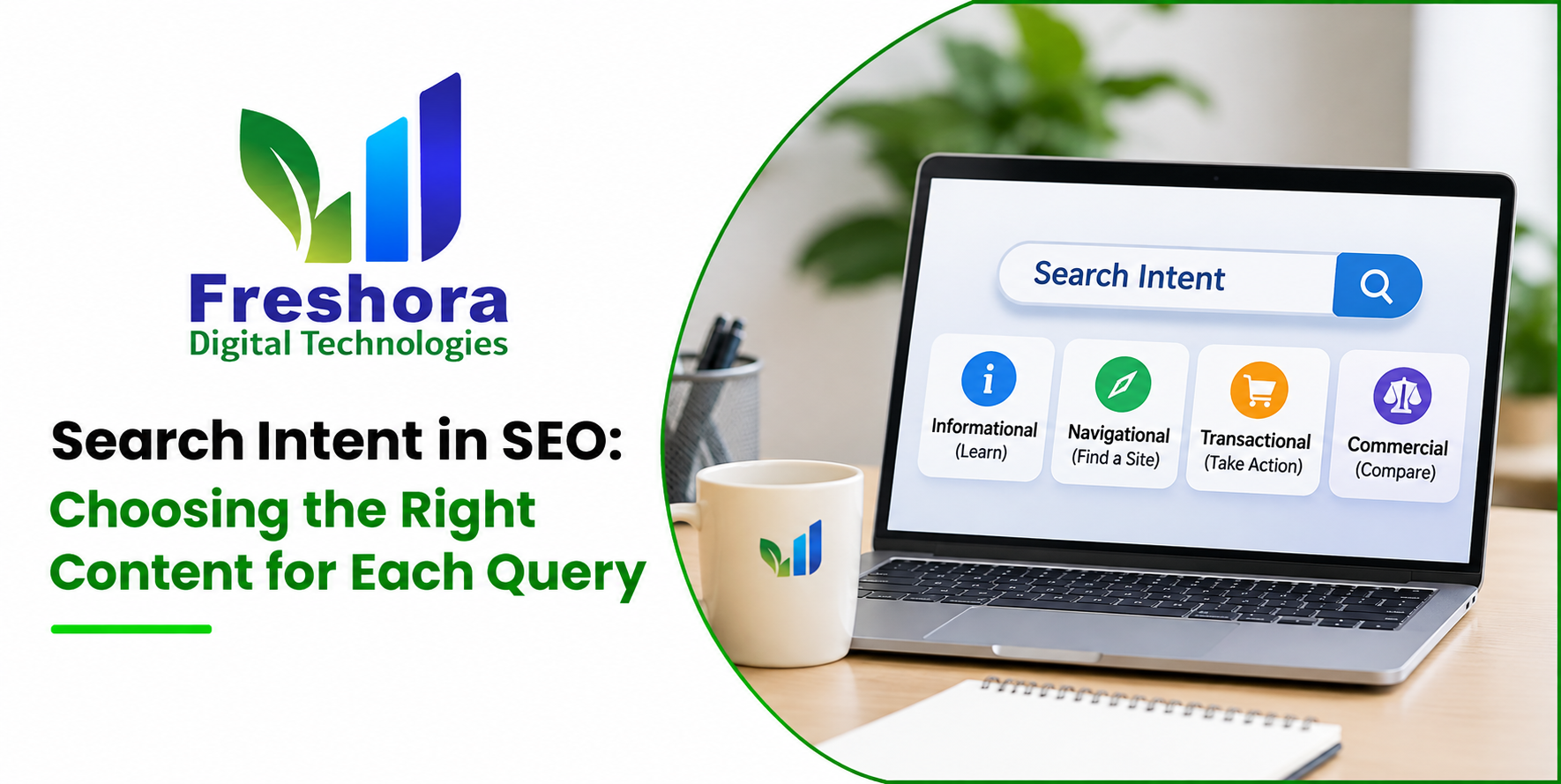
The types of search intent are commonly grouped into four categories: informational, navigational, commercial investigation, and transactional.
These categories provide a practical framework for organizing keywords and selecting appropriate content formats. They are not rigid rules, because some searches combine more than one intent.
1. Informational Search Intent
Informational intent occurs when users want to learn something, understand a concept, or find an answer to a question.
Examples include "what is technical SEO," "how does website hosting work," and "why is my website slow."
Users performing these searches are generally seeking knowledge rather than trying to complete an immediate purchase. They may be beginners exploring a topic or experienced users investigating a specific problem.
Suitable content formats include:
-
Educational blog posts that explain a topic clearly and provide relevant context.
-
Step-by-step tutorials that help users complete a task.
-
Glossaries that define technical terminology.
-
Troubleshooting guides that explain common problems and possible solutions.
-
Frequently asked questions that address genuine user concerns.
Informational content should answer the main question directly before expanding into related explanations.
For example, a blog targeting "how to improve website speed" could explain how to measure performance, identify common causes of slow loading, prioritize improvements, and monitor the results. Businesses can also explore this guide to improving website speed for related performance insights.
The purpose is to help the reader understand the problem and determine what to do next.
2. Navigational Search Intent
Navigational intent occurs when a user wants to reach a particular website, brand, platform, or online destination.
Examples include searches for a company's official website, a brand's login page, or a named product's support page.
These users generally know where they want to go and use the search engine to reach that destination.
Suitable content formats include:
-
Official homepage and brand pages.
-
Login and account access pages.
-
Contact pages and location pages.
-
Product support pages and documentation.
-
Clearly named service and resource pages.
For example, someone searching for "Freshora official website" is likely trying to reach the company's website rather than read a general article about digital marketing.
Businesses can support navigational intent by maintaining consistent brand information, using clear page titles, and ensuring that important destinations are easy to find.
Navigational searches may also overlap with informational or commercial intent when users want to research a brand before contacting it.
3. Commercial Investigation Intent
Commercial investigation occurs when users are evaluating alternatives before making a decision. They may compare products, services, providers, features, pricing, or reviews.
This intent often appears during the consideration stage of the customer journey.
Examples include "best SEO tools for small businesses," "custom website development vs website builders," and "SEO agency pricing comparison."
These users generally need enough information to understand the available options and decide which one is most suitable.
Suitable content formats include:
-
Comparison articles that explain differences between alternatives.
-
Product or service evaluation guides.
-
Detailed reviews with clear evaluation criteria.
-
Pricing guides that explain cost factors.
-
Case studies that demonstrate how a solution works in practice.
Commercial investigation keywords can be valuable for businesses because they may indicate that users are actively evaluating solutions. However, the level of purchase readiness varies, and the search volume alone does not determine commercial value.
For example, a business targeting "best website development company for small businesses" could publish a transparent guide explaining what to evaluate when choosing a provider, including technical capabilities, project scope, maintenance, and communication.
The content should help readers make an informed decision rather than simply declaring the business to be the best option. Learn more about how a professional website supports business success.
4. Transactional Search Intent
Transactional intent occurs when users want to complete an action. This may involve purchasing a product, booking a service, requesting a quote, registering for a course, or signing up for a platform.
Examples include "buy website hosting," "book website consultation," and "request SEO services quote."
These users often benefit from a clear route to the action they want to complete.
Suitable content formats include:
-
Product pages with relevant specifications and purchasing options.
-
Service landing pages with clear descriptions and enquiry forms.
-
Pricing pages that explain available packages and terms.
-
Booking pages with accessible scheduling options.
-
Registration pages with clear instructions and next steps.
For example, a page targeting "request website development quote" should make the enquiry process easy to understand. It might explain the information needed to prepare an estimate and provide a straightforward form for submitting project requirements.
The page should reduce unnecessary friction and provide the information required for a confident decision.
Informational Search Intent Examples Across Different Industries
Understanding informational search intent examples helps businesses turn keyword research into practical content ideas.
Example 1: Digital Marketing
Keyword: What is local SEO?
Likely intent: The user wants to understand local SEO and why it matters.
Recommended content: An educational guide explaining local search visibility, Google Business Profile, location relevance, reviews, and practical optimization steps.
A direct service pitch would not fully answer the user's initial question. The guide can introduce relevant services naturally after explaining the topic. For additional information, see why local SEO matters for small businesses.
Example 2: Web Development
Keyword: How to choose a website framework
Likely intent: The user wants to understand the available options and selection criteria.
Recommended content: A guide comparing framework requirements, scalability, development complexity, maintenance, and project suitability.
The article should explain how the choice depends on the project rather than recommending one technology for every situation.
Example 3: Ecommerce
Keyword: How to reduce cart abandonment
Likely intent: The user wants to understand why shoppers abandon carts and how to address the problem.
Recommended content: A practical guide covering checkout friction, unexpected costs, payment options, mobile usability, trust, and measurement.
Relevant examples and a clear prioritization framework can make the content more actionable.
Example 4: Business Software
Keyword: What is ERP software?
Likely intent: The user wants to understand the concept and its business applications.
Recommended content: An educational article explaining ERP systems, common modules, integration, implementation considerations, and business use cases.
A well-structured guide can answer the initial question while helping readers understand whether further evaluation is necessary.
These examples demonstrate that informational intent is about solving a knowledge gap. The article should match the user's level of understanding and provide a logical path toward more detailed information.
Commercial Investigation Keywords: How to Identify Valuable Opportunities
Commercial investigation keywords help identify users who are comparing options before committing to a purchase or service.
These queries often include words such as "best," "top," "review," "comparison," "alternatives," "pricing," and "versus." However, the wording alone is not sufficient to determine intent. A query containing "best" may request a general recommendation, while a pricing query may be informational or transactional depending on its context.
Examples include:
-
Best SEO tools for small businesses.
-
Website development company comparison.
-
Custom website development vs WordPress.
-
SEO services pricing guide.
-
Ecommerce platforms for growing businesses.
-
Best CRM software for service companies.
To evaluate these keywords, consider three important factors.
First, identify the decision being made. Determine which products, services, or approaches the user is likely comparing.
Second, understand the information required. A meaningful comparison may need to cover features, costs, limitations, implementation, support, and suitability for different situations.
Third, assess the business relevance. A keyword with lower search volume may still be valuable if it reaches a relevant audience that is actively evaluating a service.
The best commercial investigation content provides balanced information and clear decision criteria. It should help users understand their options rather than disguise an advertisement as an objective comparison.
How to Identify Search Intent for Any Keyword
Identifying search intent is a research process. Keyword wording provides an initial clue, but the strongest approach combines query analysis, search result observations, and knowledge of the target audience.
Step 1: Examine the Keyword Wording
Start by identifying words that suggest the user's goal.
Queries containing "what is," "why," and "how to" often indicate informational intent. Searches containing brand names or login-related terms may suggest navigational intent. Words such as "comparison," "reviews," and "alternatives" may indicate commercial investigation. Phrases such as "buy," "book," and "sign up" may indicate transactional intent.
Treat these as clues rather than fixed rules. The actual search results should help confirm the likely intent.
Step 2: Review the Search Engine Results Page
Search for the target keyword and examine the pages that appear prominently.
Look at whether the results mainly contain educational articles, product pages, service landing pages, comparison guides, videos, local listings, or other formats.
The dominant page types can reveal what search engines appear to consider relevant for the query.
For example, if the results for a keyword are dominated by detailed tutorials, publishing a short service page may not satisfy the same user need.
Search results can vary by location, device, language, and time, so use observations as evidence rather than assuming every user sees an identical page.
Step 3: Understand the User's Next Expected Action
Ask what the searcher is likely to do after finding the information.
Will they continue learning, visit a particular website, compare providers, or complete a purchase?
This question helps distinguish queries that appear similar but require different content formats.
For example, "SEO pricing explained" may call for an educational pricing guide, while "buy monthly SEO package" is more likely to require a service page with clear package details and an enquiry option.
Step 4: Review Existing Search Performance
If the website already receives traffic for related queries, use Google Search Console to examine the pages and keywords generating impressions and clicks.
Review whether the page's content matches the query's likely intent. If a page receives impressions but few clicks, investigate ranking position, result presentation, competition, and search intent before deciding what to change.
Search Console data can reveal performance patterns, but it does not directly label every query by intent.
Step 5: Check the Competition and Content Gaps
Review competing pages to understand what information they cover, how they organize their content, and which questions remain unanswered.
Do not copy their structure automatically. Instead, identify opportunities to provide clearer explanations, better examples, more accurate information, or a more useful decision-making framework.
The goal is to meet the intent more effectively, not merely reproduce the pages that already rank.
Step 6: Validate the Content Choice
Before publishing, ask whether the proposed page genuinely satisfies the user's likely goal.
If the query is informational, the content should explain. If it is commercial, the page should help evaluate alternatives. If it is transactional, the page should make the intended action clear.
When intent is mixed, decide which goal is most important and address related needs without making the page unfocused.
Search Intent and Content Mapping: Turning Keywords into the Right Pages
Search intent and content mapping is the process of assigning target keywords to appropriate website pages based on the needs behind those searches.
It helps prevent businesses from choosing content formats based solely on search volume and reduces the risk of creating multiple pages that compete for essentially the same purpose.
A practical content map connects each keyword group with its primary intent, recommended page type, and business objective.
| Target keyword |
Likely intent |
Recommended page type |
Main objective |
| What is technical SEO? |
Informational |
Educational blog |
Explain the concept |
| Freshora official website |
Navigational |
Homepage or brand page |
Help users reach the brand |
| Best SEO tools for small businesses |
Commercial investigation |
Comparison guide |
Help users evaluate options |
| SEO services pricing |
Commercial or transactional, depending on the query |
Pricing guide or service page |
Explain costs and support decisions |
| Request SEO consultation |
Transactional |
Service landing page |
Encourage relevant enquiries |
| How to improve website speed |
Informational |
Practical tutorial |
Explain the process |
| Website development company comparison |
Commercial investigation |
Comparison article |
Support provider selection |
The table illustrates typical patterns, not universal rules. The actual search results and user needs should determine the final page type.
How to Build a Content Map
Start by collecting target keywords and grouping queries that share the same underlying goal. Avoid creating separate pages for minor keyword variations when one comprehensive page can satisfy the same intent.
Next, assign each group to an existing page where possible. If no suitable page exists, determine whether creating a new resource would provide meaningful value.
Then, connect related pages through internal links. An informational article might link to a detailed comparison guide, which can then direct readers to a relevant service page when appropriate. This is also where a clear content marketing strategy can support a more organized publishing plan.
Finally, review the map periodically. Search intent can evolve as user needs, products, and search results change.
A well-maintained content map gives every important page a clear purpose and helps the website cover the customer journey without unnecessary duplication.
How Search Intent Influences the Customer Journey
Search intent can also help businesses understand how content supports different stages of decision-making.
Awareness: Understanding a Problem
At this stage, users are learning about a subject or identifying a problem.
Queries such as "why is my website slow" or "what is local SEO" may indicate that the user needs an explanation before considering a solution.
Educational guides, definitions, and troubleshooting articles are often appropriate formats.
Consideration: Exploring Possible Solutions
Users begin comparing approaches, providers, or products.
Queries such as "SEO agency vs in-house SEO" and "custom website development vs website builders" suggest that users need decision-making information.
Comparison articles, detailed guides, and transparent service explanations can support this stage.
Decision: Choosing a Provider or Taking Action
Users may be ready to contact a business, request a quote, or purchase a product.
Queries such as "hire website developer" or "request SEO consultation" often indicate stronger action-oriented intent.
Relevant service pages, clear pricing information, credible examples, and accessible enquiry forms can help users complete the next step.
Not every customer follows these stages in a straight line. Someone may compare services before understanding all the technical details, while another person may return to educational content after evaluating a provider.
The purpose of intent-based content planning is to provide useful resources for different needs, not to force every visitor through a predetermined sequence.
Common Search Intent Mistakes That Can Weaken SEO Performance
Even well-researched keywords may underperform when the published content does not meet the user's expectations.
-
Choosing content based only on search volume: A popular keyword may attract visitors who are not looking for the product or service being promoted.
-
Using a service page for every keyword: Informational queries often require educational resources rather than immediate sales messaging.
-
Treating keyword modifiers as absolute rules: Words such as "best," "price," and "how to" provide clues but do not always determine the complete intent.
-
Creating multiple pages for the same purpose: Overlapping articles can confuse the content strategy and make it harder to distinguish each page's role.
-
Ignoring the search results: Failing to review the actual results can lead to a content format that does not align with the query.
-
Forcing commercial calls to action into every article: A relevant next step is useful, but aggressive sales messaging can distract from the reader's immediate need.
-
Never revisiting the content map: Search results and user expectations can change, so content plans should be reviewed when performance or the topic indicates a need.
Avoiding these mistakes helps ensure that keyword research leads to relevant pages rather than simply increasing the number of published URLs.
A Practical Search Intent Checklist for SEO Teams
Before creating or optimizing a page, use the following checklist to validate the content decision.
Keyword research
-
Identify the primary keyword and relevant variations.
-
Group keywords by their underlying user goal.
-
Check whether different queries can be served by the same page.
Intent validation
-
Review the current search results.
-
Identify the dominant content formats.
-
Determine what the user wants to know, compare, or accomplish.
Content planning
-
Select a suitable page type.
-
Create headings that address the main question and related needs.
-
Include original examples and useful supporting information.
-
Provide a relevant next step without distracting from the primary intent.
Technical and editorial checks
-
Confirm that the page can be accessed and is eligible for indexing.
-
Use a descriptive title, relevant internal links, and appropriate metadata.
-
Check for overlapping pages targeting the same purpose.
-
Ensure the content is accurate, readable, and useful.
Performance review
-
Monitor impressions, clicks, and relevant queries.
-
Evaluate enquiries or conversions where applicable.
-
Reassess intent if the page consistently underperforms or the search results change.
This checklist can be incorporated into a keyword research process, content calendar, or website audit to improve consistency across SEO projects.
How to Measure the Results of Intent-Based Content
Search intent alignment should be evaluated through both search performance and business outcomes.
Organic Impressions and Clicks
Google Search Console can show whether pages are appearing for relevant queries and whether users are clicking through. Examine query-level performance rather than relying only on overall website traffic.
Click-Through Rate and Average Position
A low click-through rate may indicate a mismatch between the query and page presentation, but it can also reflect ranking position, competition, or the search result layout. Review these factors before changing the content.
Engagement and Navigation
Analytics data can help reveal whether visitors explore related pages, use important site features, or continue toward a relevant next step. Interpret engagement in the context of the page's purpose.
Leads and Conversions
For commercial and transactional pages, track meaningful actions such as enquiries, bookings, purchases, or qualified leads.
An informational article may succeed by helping users understand a topic, while a service page may be expected to generate enquiries. Evaluate each page against its intended role.
Content Quality and Search Relevance
Review whether the page still answers the query clearly and provides the information users need. When the search intent is not being met, revise the structure, depth, examples, or page format as appropriate.
No single metric proves that search intent has been correctly identified. A more reliable assessment combines search data, page-level observations, and business results.
The Future of Search Intent in SEO
As search engines develop more conversational and AI-assisted experiences, users may express complex needs through longer questions rather than short keyword phrases.
A user might ask for a comparison of website platforms based on budget, maintenance requirements, and expected growth instead of searching for each factor separately.
This makes understanding the underlying intent increasingly important. Businesses should develop content that addresses the full question, explains relevant trade-offs, and helps readers make informed decisions.
However, traditional keyword research remains useful. Search queries still reveal how people describe their needs, and search results can provide valuable clues about the content formats that users find relevant.
The strongest approach combines keyword data with genuine audience understanding. Rather than publishing a page for every phrase, businesses should create useful resources that serve distinct purposes and connect naturally to the rest of the website.
Conclusion
Search intent in SEO provides the connection between keyword research and meaningful content creation. Understanding why users search helps businesses decide whether a query requires an educational guide, a brand destination, a comparison resource, or a page designed to support an action.
The most effective strategy begins with the user's goal, validates that goal against search results, and assigns each keyword group to a page that genuinely satisfies the need. Clear content mapping, relevant internal links, and consistent performance reviews can then help maintain a coherent website structure.
Instead of measuring SEO success only by the number of keywords targeted, businesses should focus on how well their content answers questions, supports decisions, and contributes to relevant business outcomes.
At Freshora, businesses can explore digital solutions that support their online presence, including website development, SEO, and digital growth strategies. A content strategy built around search intent can help connect useful information with the people who need it.
CTA: Want to build an SEO content strategy that matches what your audience is searching for? Explore Freshora's digital solutions and plan content around your business goals.