
Contact our team for professional guidance and solutions.
In 2025, web development has become faster, smarter, and more dynamic than ever before. With businesses demanding high-performance websites, seamless user experiences, and scalable digital platforms, developers now rely on advanced web tools to streamline workflows and improve productivity. Modern tools powered by automation, AI-support systems, cloud integration, and real-time collaboration make it easier for developers to build complex applications efficiently.
As digital transformation continues to accelerate, developers need tools that support code optimization, responsive UI design, debugging, version control, API testing, and performance monitoring. These tools not only speed up the development process but also ensure high-quality output across all stages of a project. Using the right developer-friendly web tools for 2025 helps teams stay competitive, reduce errors, and deliver better digital experiences.
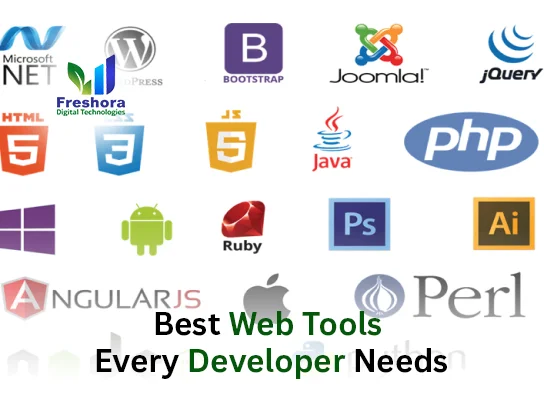
This article highlights the best web tools every developer needs, explaining how each tool improves workflow efficiency and strengthens web development quality.
A powerful code editor is the foundation of every developer’s workflow.
Modern editors offer intelligent features that simplify coding, reduce mistakes, and speed up development.
Developers benefit from:
· Editors that use AI-powered suggestions to complete code faster.
· Real-time syntax highlighting to identify errors instantly.
· Integrated terminal support for running commands without switching tools.
· Extensions that automate formatting and debugging seamlessly.
· Cross-platform compatibility for maximum flexibility.
These editors help developers write cleaner, more efficient code.
Version control systems allow developers to track project changes and collaborate smoothly.
They are essential for managing complex, multi-developer projects.
Key advantages include:
· Organized change tracking with clear revision histories.
· Secure cloud repositories that prevent data loss.
· Branching features that allow developers to test updates safely.
· Merge tools that reduce conflicts between contributions.
· Project automation for deployment and testing workflows.
Version control strengthens teamwork and ensures development stability.
Modern frameworks help developers build responsive, user-friendly interfaces with ease.
They reduce repetitive work and speed up design processes.
Benefits include:
· Pre-built UI components that shorten development time.
· Virtual DOM technology for faster rendering.
· Strong community support for tutorials and updates.
· Mobile-responsive builds that work across devices.
· Integration with backend tools for full-stack development.
These frameworks enable developers to create sleek and interactive user experiences.
Backend frameworks help developers manage server logic, APIs, and databases efficiently.
They are essential for building secure and scalable applications.
They offer:
· Structured templates for faster backend setup.
· Built-in security features to protect sensitive data.
· Database management tools that simplify queries.
· Robust routing systems for clean API development.
· Multi-layer architecture for stable performance under heavy traffic.
These frameworks ensure powerful and efficient backend operations.
Every modern application relies on APIs, making testing tools essential.
Developers use these tools to ensure endpoints work correctly.
Benefits include:
· Automated API testing to reduce manual workload.
· Real-time response validation for accuracy.
· Secure environment setup for production-ready testing.
· Multi-protocol support for REST, GraphQL, and SOAP.
· Integration with CI/CD pipelines for continuous testing.
API testing tools ensure smooth and dependable application performance.
Built-in browser tools help developers identify and fix issues quickly.
They play a major role in performance checks and layout debugging.
Developers use Dev-Tools to:
· Inspect elements and debug UI problems instantly.
· Monitor network calls to detect performance bottlenecks.
· Analyse CSS styles in real time for layout optimization.
· Test responsive layouts across different screen sizes.
· Track JavaScript errors without external plugins.
Browser Dev-Tools accelerate troubleshooting and performance improvements.
Performance monitoring is essential for websites that need strong user engagement.
These tools evaluate loading speed, resource usage, and overall page health.
Developers benefit from:
· Speed audit reports with improvement suggestions.
· Real-time error tracking for seamless performance.
· Core Web Vitals measurements for SEO improvements.
· Load testing tools that simulate heavy user traffic.
· Automated alerts for unexpected performance drops.
Performance tools ensure fast and reliable websites for users.
Design tools help developers visualize layouts and user journeys before coding.
They bridge the gap between design and development teams.
Key features include:
· Real-time collaboration on design files.
· Interactive prototypes that simulate user flow.
· Component libraries for consistent design patterns.
· Exportable assets optimized for web use.
· Easy integration with development tools and workflows.
These tools result in intuitive and engaging user experiences.
Cloud deployment platforms allow developers to deploy apps easily and securely.
They manage hosting, scaling, and infrastructure automatically.
Developers rely on:
· Auto-scaling features that handle traffic spikes.
· One-click deployment for fast project launches.
· Built-in monitoring for server health.
· Global CDN support for faster content delivery.
· Secure hosting that meets modern compliance standards.
Cloud deployment tools make application hosting smooth and hassle-free.
Automation helps developers save time and avoid repetitive tasks.
These tools support continuous integration and continuous delivery (CI/CD).
Advantages include:
· Automated builds that reduce human error.
· Scripted deployments for consistent results.
· Real-time notifications for build or test failures.
· Task automation for optimizing workflow.
· Integration with multiple development tools.
Automation tools enhance productivity and ensure faster project delivery.
The right web development tools help developers:
· Improve coding speed
· Reduce bugs and system errors
· Strengthen teamwork
· Build scalable digital products
· Improve UI/UX quality
· Maintain strong system security
· Deliver projects faster
· Stay competitive in a rapidly evolving tech world
These tools are essential for modern web development success.
Web development in 2025 demands advanced tools that support speed, efficiency, security, and creativity. From intelligent code editors and version control systems to robust frameworks, automation tools, and cloud deployment platforms, developers need a strong toolkit to build high-quality digital products. Using these must-have web tools ensures faster workflows, better performance, and long-term development success.
Freshora Digital Technologies helps businesses and developers adopt modern web development tools, streamline workflows, and build high-performance digital solutions. Their expertise supports seamless development, secure infrastructure, and long-term digital growth. To explore how Freshora Digital Technologies can strengthen your web development ecosystem, visit our website for more informations.


In the bustling transit hub of Tiruchirappalli, the transport sector is evolving rapidly. From touri... Read More

In the rapidly expanding industrial landscape of Trichy, efficiency is the currency of success. Busi... Read More

In the competitive landscape of Tiruchirappalli, businesses are increasingly looking for creative pa... Read More
Our expert will call you shortly to understand your needs and help grow your business.
Get exclusive digital marketing tips, SEO insights, web & app updates, and job opportunities delivered straight to your inbox.
Join our WhatsApp channel for instant digital marketing tips, SEO insights, web & app updates, and latest job opportunities.
Join NowFreshora Digital Technologies proudly serves businesses across Tiruchirappalli (Trichy), including Cantonment, Puthur, Thillai Nagar, Palakarai, Subramaniyapuram, Mela Chinthamani, Woraiyur, KK Nagar, Karumandapam, Crawford, Edamalaipatti Pudur (EMP), Kattur, Airport Area, Ariyamangalam, Panjappur, Thuvakudi, Tiruverumbur, BHEL Township, Srirangam, Thiruvanaikaval, Samayapuram, No.1 Tollgate, Central Bus Stand Area, and Chathiram Bus Stand Area.
We also serve clients across Tamil Nadu, India, and globally in Singapore, the UAE, Saudi Arabia, Canada, Australia, the United Kingdom, and the United States, delivering innovative Website Development, Mobile App Development, Software Development, SEO, Google Business Profile Management, and Digital Marketing solutions that help businesses grow and succeed in the digital world.
