
Contact our team for professional guidance and solutions.
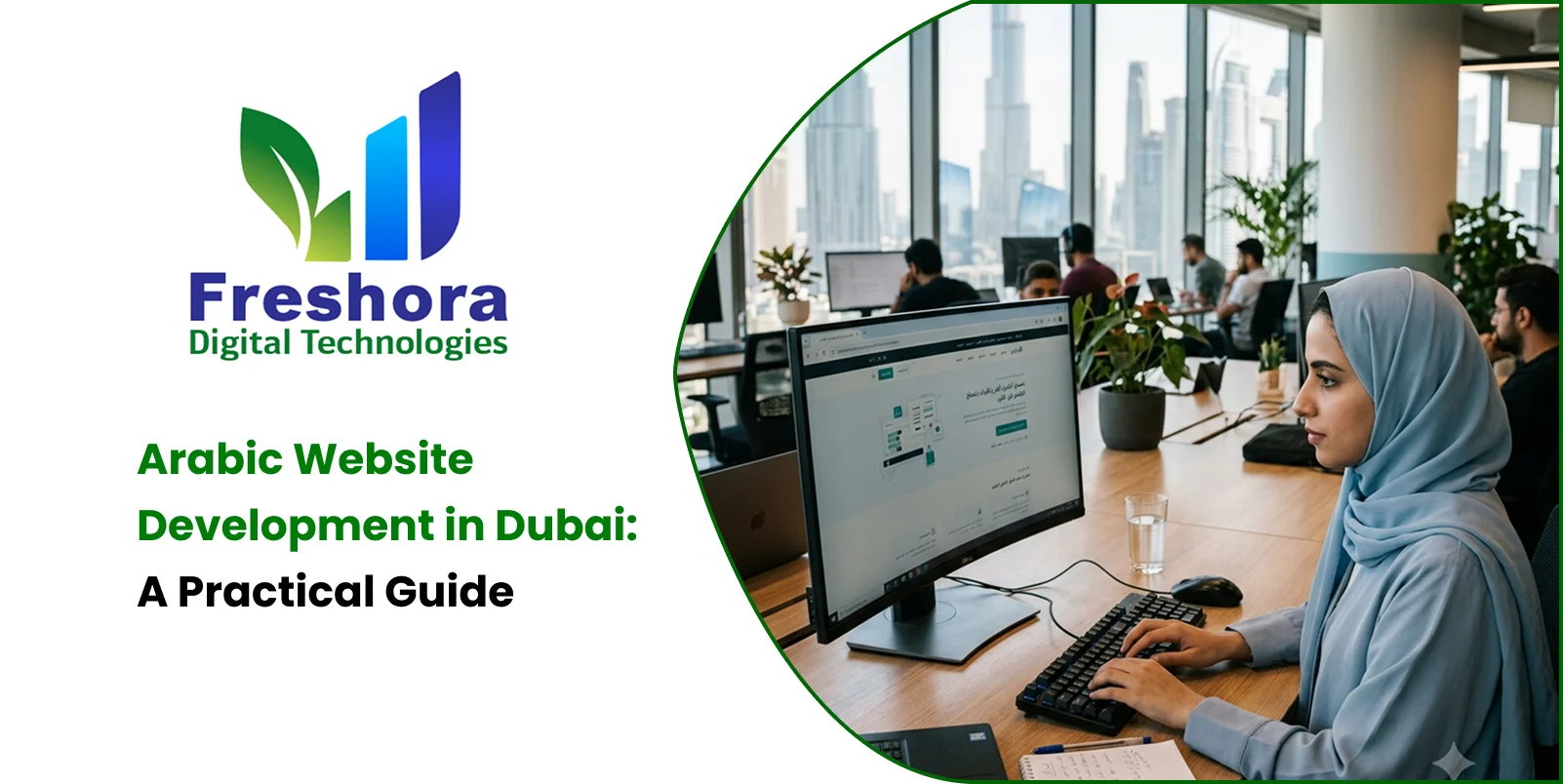
Dubai is a multilingual business market where companies often communicate with customers in both Arabic and English. For businesses targeting the UAE market, Arabic website development in Dubai involves much more than translating an existing English website.
Arabic follows a right-to-left (RTL) reading direction, which affects navigation, page layouts, buttons, forms, typography, menus and other interface elements. A successful bilingual website should feel natural in both languages while maintaining a consistent brand experience across desktop, tablet and mobile devices.
For businesses operating in Dubai, Arabic website development can support better communication with Arabic-speaking audiences while providing a more locally relevant digital experience.
An English website can serve an international audience, but providing an Arabic experience can make a business more accessible to Arabic-speaking customers in the UAE.
A properly developed Arabic website can help businesses:
Communicate information in the customer's preferred language
For Dubai businesses, the objective should not simply be to add Arabic text to an existing website. The Arabic version should be designed around the way Arabic-speaking users interact with websites.
Translation changes the language of the content. Arabic website development also changes how the website interface works.
A bilingual website may require different treatment for:
Navigation and menus
Text alignment
Buttons and forms
Spacing and content hierarchy
Icons and directional elements
Typography
Mobile layouts
Sliders and carousels
Breadcrumbs and filters
Arabic content can also appear alongside English brand names, numbers, technical terms, email addresses and URLs. These mixed-language areas should be tested carefully because text direction can affect how information is displayed.
This is why RTL requirements should be considered during the design and development stages rather than added after the English website has already been completed.
RTL means right-to-left. Arabic interfaces generally require the visual direction of the page to follow the way Arabic is read.
RTL implementation can affect:
Navigation
Page columns
Breadcrumbs
Forms
Sliders
Filters
Sidebars
Dropdown menus
Content alignment
However, an RTL website should not simply mirror every element.
Logos, product images, photographs and certain icons may need to retain their original orientation. The development approach should therefore determine which elements should change direction and which should remain unchanged.
A well-developed RTL website uses a consistent layout system so that Arabic and English versions remain usable and visually coherent across desktop, tablet and mobile devices.
Businesses serving both Arabic- and English-speaking audiences can manage both languages within one bilingual website rather than maintaining two completely separate websites.
Depending on the CMS and website architecture, the business may need to manage:
Page content
Navigation
Services
Products
Blog posts
Images
Metadata
Calls to action
Forms
Customer messages
The exact language structure depends on the size of the website, CMS, SEO requirements and content management approach.
For example, language-specific URLs such as /en/ and /ar/ may be suitable for some websites. Other projects may use different URL structures.
The important point is to define the language architecture before development begins rather than changing it after the website has been indexed.
Arabic website development can include different services depending on the business model and technical requirements.
A professional Arabic-English website project may include:
Arabic website design
Arabic-English bilingual website development
RTL website development
Responsive Arabic website development
Arabic website localisation
Arabic e-commerce development
Arabic CMS development
Arabic SEO implementation
Website redesign and migration
CRM and third-party integrations
Website maintenance and support
The exact combination depends on whether the project is a corporate website, service website, e-commerce store, booking platform or custom web application.
Arabic typography deserves the same attention as the rest of the interface. A font that works well for English is not automatically suitable for Arabic content.
Designers should consider:
Arabic font selection
Font size and weight
Line height
Paragraph width
Heading hierarchy
Mobile readability
Button labels
Consistency between Arabic and English
Arabic text can have different visual proportions from English text. A heading that occupies one line in English may take more or less space in Arabic.
The interface should therefore be tested using the actual Arabic content rather than placeholder text.
Arabic SEO should be planned alongside website development rather than added after launch.
Arabic search behaviour can differ from English search behaviour, so directly translating an English keyword does not always produce the search phrase used by Arabic-speaking customers.
An Arabic SEO strategy may include:
Arabic keyword research
UAE-focused search intent research
Localised page titles
Arabic meta descriptions
Arabic headings and content
Language-specific URLs where appropriate
Internal linking
Arabic image alt text
Structured data
Mobile performance
Search Console monitoring
Appropriate hreflang implementation
hreflang helps search engines understand the relationship between different language or regional versions of a page, such as the English and Arabic versions of the same website page.
Arabic and English SEO should therefore be planned as related but distinct search strategies rather than treating one as a direct translation of the other.
Good Arabic content should sound natural to its intended audience.
A direct translation can be grammatically correct while still feeling unnatural or disconnected from the local market. Content should be reviewed for terminology, tone, calls to action and cultural context.
This is particularly important for:
Service pages
Product descriptions
Advertising messages
Contact forms
Calls to action
Customer support information
For businesses targeting customers in Dubai and the wider UAE, localisation should consider the actual audience and business context rather than relying entirely on automated translation.
The Arabic version should be tested independently on mobile devices.
An RTL layout that looks correct on a desktop screen can still create problems with menus, forms, buttons, spacing or content overflow on smaller screens.
Mobile testing should cover:
RTL navigation
Mobile menus
Forms and validation messages
CTA buttons
Images and sliders
Dropdown menus
Product filters
Checkout flows
Arabic text rendering
Content spacing
Testing both language versions separately helps identify layout problems that may not appear in the English version.
Depending on the business, an Arabic-English website may include:
| Feature | Purpose |
|---|---|
| RTL support | Correct Arabic interface direction |
| Language switcher | Easy movement between languages |
| Responsive design | Better mobile and tablet experience |
| Arabic typography | Improved readability |
| CMS | Easier content management |
| Arabic metadata | Support language-specific SEO |
| Analytics | Measure language-specific behaviour |
| CRM integration | Manage enquiries and leads |
| Secure forms | Protect customer submissions |
hreflang |
Help search engines understand language relationships |
The required features should be selected according to the website's business objectives rather than adding unnecessary functionality.
RTL and bilingual requirements should be considered before development begins.
Poor font choices, incorrect sizing or insufficient line spacing can reduce readability.
A website may appear correct on desktop while menus, forms and buttons create problems on smaller screens.
Arabic SEO requires its own keyword research because search behaviour is not always a direct translation of English search behaviour.
Not every logo, image or icon should automatically be reversed. Each interface element should be reviewed based on its purpose.
Both language versions need to remain updated as services, products and blog content change.
Arabic and English pages should be tested independently for layout, content, links, forms, SEO elements and mobile usability.
The cost of Arabic website development in Dubai depends on several factors, including:
Number of pages
Design complexity
CMS requirements
Arabic and English content requirements
Custom functionality
E-commerce features
SEO requirements
Content localisation
Indicative planning ranges are:
| Website Type | Approximate Budget |
|---|---|
| Basic bilingual business website | AED 8,000–20,000+ |
| Custom Arabic-English website | AED 20,000–50,000+ |
| Bilingual e-commerce website | AED 25,000–75,000+ |
| Advanced custom platform | AED 75,000–150,000+ |
These figures are planning ranges, not fixed Dubai market prices. The actual project cost should be determined by the website scope, number of languages, design requirements, functionality, integrations, content requirements and ongoing support.
A small corporate website with standard functionality may require a very different budget from a multilingual e-commerce platform or custom web application.
A practical Arabic-English website development process can include:
Define the Arabic and English audiences.
Identify business goals and conversion requirements.
Research Arabic and English search intent.
Plan the website structure and content architecture.
Design both language experiences.
Build the RTL foundation.
Prepare and localise Arabic and English content.
Implement bilingual SEO.
Test both languages across desktop and mobile devices.
Launch, monitor and improve the website.
Planning both language experiences from the beginning can reduce redevelopment work and help maintain consistency between the two versions.
A successful Arabic website in Dubai should feel designed for Arabic users, not simply translated for them.
RTL development, Arabic typography, localisation, bilingual SEO, mobile usability, content architecture and ongoing content management all need to work together. Businesses should also consider the differences between Arabic and English search behaviour when planning their website and SEO strategy.
For businesses targeting customers in Dubai and the wider UAE, a well-planned Arabic-English website can provide a more accessible digital experience while supporting the company's broader online presence.
Freshora can help businesses plan and develop Arabic-English websites with RTL layouts, responsive user experiences, bilingual content structures and SEO-ready foundations for the UAE market. Explore our Dubai website development solutions or visit our home page.

Choosing between WordPress and a custom website is an important decision for a business planning a n... Read More
The website development cost in Dubai can vary from a few thousand dirhams to well over AED 1... Read More
Dubai has developed a highly digital business environment where startups, SMEs, multinational compan... Read More
Our expert will call you shortly to understand your needs and help grow your business.
Get exclusive digital marketing tips, SEO insights, web & app updates, and job opportunities delivered straight to your inbox.
Join our WhatsApp channel for instant digital marketing tips, SEO insights, web & app updates, and latest job opportunities.
Join NowFreshora Digital Technologies proudly serves businesses across Tiruchirappalli (Trichy), including Cantonment, Puthur, Thillai Nagar, Palakarai, Subramaniyapuram, Mela Chinthamani, Woraiyur, KK Nagar, Karumandapam, Crawford, Edamalaipatti Pudur (EMP), Kattur, Airport Area, Ariyamangalam, Panjappur, Thuvakudi, Tiruverumbur, BHEL Township, Srirangam, Thiruvanaikaval, Samayapuram, No.1 Tollgate, Central Bus Stand Area, and Chathiram Bus Stand Area.
We also serve clients across Tamil Nadu, India, and globally in Singapore, the UAE, Saudi Arabia, Canada, Australia, the United Kingdom, and the United States, delivering innovative Website Development, Mobile App Development, Software Development, SEO, Google Business Profile Management, and Digital Marketing solutions that help businesses grow and succeed in the digital world.
