
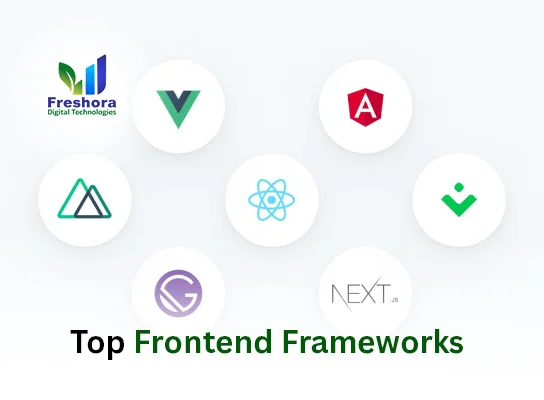
Contact our team for professional guidance and solutions.
Summary: Modern frontend frameworks enhance website speed, scalability, SEO, and user experience through advanced UI architectures and optimized performance.Frameworks like React, Vue, Angular, Next.js, Svelte, and SolidJS support responsive applications, faster development workflows, and scalable digital platforms.Businesses adopting modern frontend technologies achieve stronger engagement, flexibility, innovation, and sustainable digital growth.
Frontend development continues to evolve rapidly, and in 2025, the demand for fast, interactive, and visually appealing user experiences has become stronger than ever. As users expect websites and applications to load instantly, perform smoothly, and provide rich interfaces, frontend frameworks play a crucial role in shaping modern digital experiences. Today’s developers rely on advanced frontend development technologies, component-based architectures, and performance-optimized UI frameworks to build robust applications that meet the needs of both businesses and end-users.
In the era of cloud integration, AI-enhanced development tools, and mobile-first design strategies, frontend frameworks have grown more powerful, flexible, and efficient. From dynamic web apps and single-page applications to high-scalability enterprise platforms, choosing the right framework influences performance, speed, SEO, and long-term maintainability. This article explores the top frontend frameworks in 2025, analysing their features, advantages, and why they dominate the development ecosystem today.
React remains one of the most widely used frameworks because it simplifies UI development with reusable components.
• React speeds up development through its virtual DOM, improving UI performance significantly.
• Its ecosystem supports powerful libraries for routing, state management, and server-side rendering.
• Developers prefer React for interactive interfaces and large-scale applications.
• React’s community support makes troubleshooting and upgrading easier.
• The framework integrates smoothly with cloud and API-driven architectures.
Angular is preferred for enterprise-level applications due to its stability and full-featured ecosystem.
• Angular provides built-in tools for routing, form management, testing, and performance optimization.
• Its TypeScript-based environment improves code consistency and maintainability.
• The framework supports advanced modular design for complex applications.
• Angular’s CLI automates development tasks, speeding up workflows.
• With strong security and scalability, it remains a top enterprise choice.
Vue.js continues to grow because of its lightweight structure and developer-friendly features.
• Vue supports two-way data binding, making UI updates fluid and responsive.
• Its modular design is ideal for both small and large applications.
• Developers love Vue for its clear syntax and easy onboarding process.
• Vue’s ecosystem includes tools for routing, state management, and animations.
• Its performance and adaptability attract both startups and enterprise developers.
Svelte is becoming increasingly popular for its fast and minimalistic performance.
• Svelte compiles components during build time, eliminating heavy runtime overhead.
• This approach results in clean, optimized, and lightweight code.
• It simplifies state management with built-in reactivity.
• Svelte apps load faster, offering better user experience on low-power devices.
• Developers appreciate its simplicity in building highly responsive interfaces.
Next.js is the go-to framework for high-performance, SEO-friendly web apps.
• It supports server-side rendering and static site generation for improved speed.
• Next.js enhances SEO by delivering content faster and more efficiently.
• Its built-in routing and API features simplify full-stack development.
• Developers use Next.js for e-commerce, dashboards, and complex dynamic websites.
• The framework integrates seamlessly with edge computing and cloud platforms.
Nuxt.js extends the capabilities of Vue.js with enhanced performance features.
• It provides automatic routing for faster and cleaner development.
• Nuxt excels in SEO-friendly site rendering, similar to Next.js.
• Developers use Nuxt for scalable, production-ready web applications.
• Its modular architecture improves maintainability and flexibility.
• Nuxt simplifies server-side rendering for Vue-based projects.
Flutter Web is emerging as a top solution for unified cross-platform experience.
• Developers can use one codebase for mobile, desktop, and web interfaces.
• Flutter’s UI engine delivers high-performance, native-like animations.
• It is ideal for interactive dashboards, web apps, and branded experiences.
• Flutter supports customizable components with easy design consistency.
• The framework continues growing as companies adopt multi-platform strategies.
Qwik introduces a new performance-first concept for ultra-fast applications.
• It focuses on "resumeable apps" that load only the necessary parts initially.
• This dramatically improves first-load performance and SEO.
• Qwik’s architecture benefits large, dynamic sites with high user activity.
• Developers choose Qwik for speed-critical applications.
• Its modern design patterns attract teams focused on user experience.
Alpine.js is perfect for adding dynamic behaviour without heavy frameworks.
• It helps developers add interactive elements using minimal JavaScript.
• Alpine is excellent for small features like dropdowns, forms, and toggles.
• Its syntax is simple and inspired by Vue's style.
• Alpine improves performance by keeping codebases small.
• Ideal for websites that do not require full SPA complexity.
SolidJS blends React’s developer experience with unmatched performance.
• It uses fine-grained reactivity for extremely fast UI updates.
• SolidJS avoids virtual DOM overhead, making it lighter and faster.
• Developers appreciate its clean, efficient rendering process.
• SolidJS excels in building high-performance interactive interfaces.
• It continues to gain traction for modern, scalable web applications.
These frontend frameworks help businesses and developers:
· Build faster, more responsive interfaces
· Improve performance and SEO
· Reduce development time with reusable components
· Scale applications efficiently
· Stay competitive in modern digital markets
Frontend development remains essential to creating strong user experiences and supporting long-term digital growth.
The top frontend frameworks of 2025 empower developers to build faster, smarter, and more efficient digital experiences. With powerful tools like React, Vue, Angular, Next.js, Svelte, and SolidJS, businesses can deliver high-performing applications that meet the demands of modern users. As technology evolves, these frameworks will continue driving innovation and shaping the future of web development.
Freshora Digital Technologies helps organizations adopt the best frontend frameworks through expert web development services, UI/UX design solutions, performance optimization, and scalable digital architectures. Their development expertise ensures modern, responsive, and future-ready web experiences.



In the bustling transit hub of Tiruchirappalli, the transport sector is evolving rapidly. From touri... Read More

In the rapidly expanding industrial landscape of Trichy, efficiency is the currency of success. Busi... Read More

In the competitive landscape of Tiruchirappalli, businesses are increasingly looking for creative pa... Read More
Our expert will call you shortly to understand your needs and help grow your business.
Get exclusive digital marketing tips, SEO insights, web & app updates, and job opportunities delivered straight to your inbox.
Join our WhatsApp channel for instant digital marketing tips, SEO insights, web & app updates, and latest job opportunities.
Join NowFreshora Digital Technologies proudly serves businesses across Tiruchirappalli (Trichy), including Cantonment, Puthur, Thillai Nagar, Palakarai, Subramaniyapuram, Mela Chinthamani, Woraiyur, KK Nagar, Karumandapam, Crawford, Edamalaipatti Pudur (EMP), Kattur, Airport Area, Ariyamangalam, Panjappur, Thuvakudi, Tiruverumbur, BHEL Township, Srirangam, Thiruvanaikaval, Samayapuram, No.1 Tollgate, Central Bus Stand Area, and Chathiram Bus Stand Area.
We also serve clients across Tamil Nadu, India, and globally in Singapore, the UAE, Saudi Arabia, Canada, Australia, the United Kingdom, and the United States, delivering innovative Website Development, Mobile App Development, Software Development, SEO, Google Business Profile Management, and Digital Marketing solutions that help businesses grow and succeed in the digital world.
