
Contact our team for professional guidance and solutions.
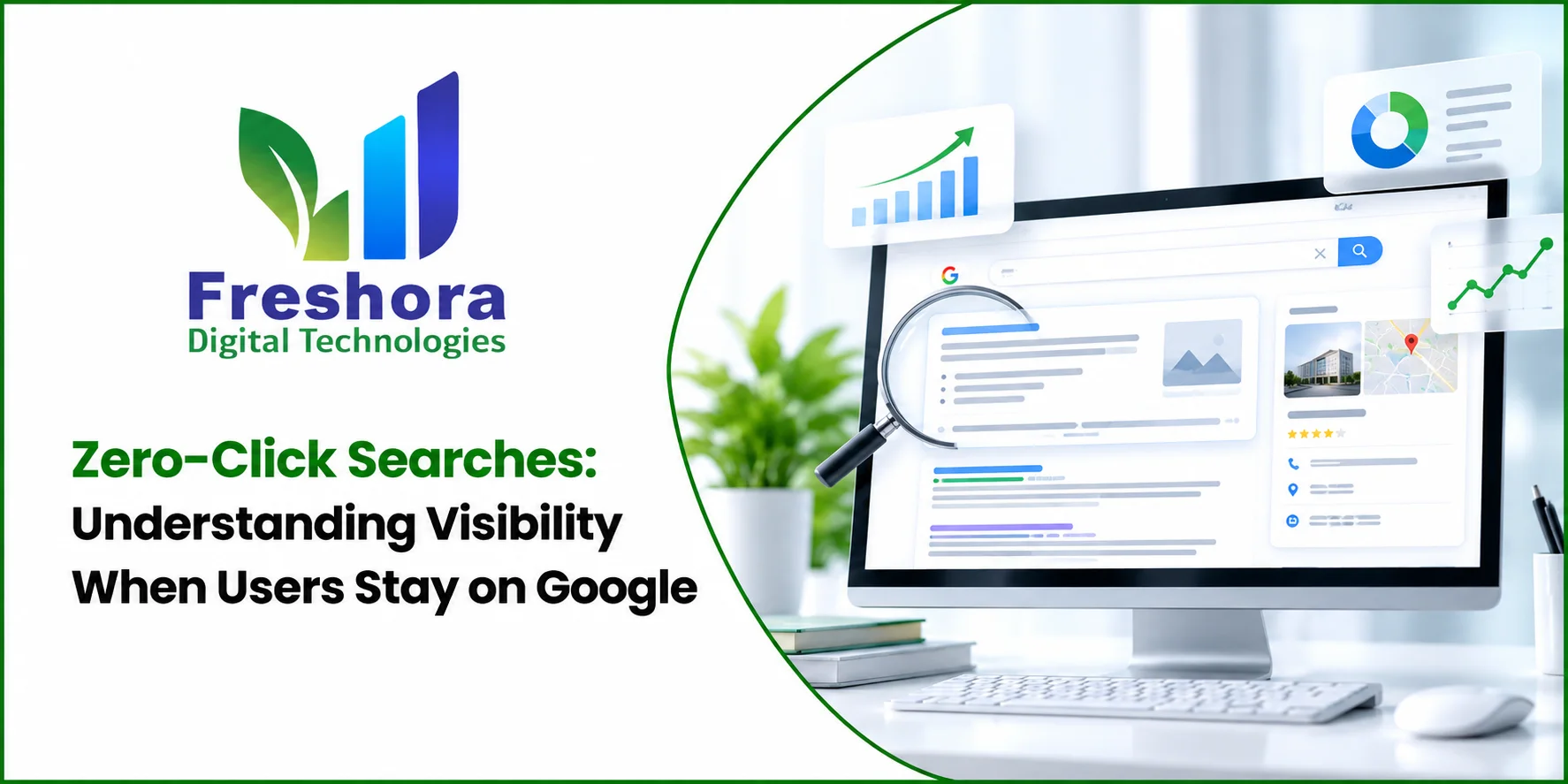
Zero-click searches occur when users complete their search journey without clicking an external website from the search results page. They may find the information they need through featured snippets, knowledge panels, local business listings, calculators, weather results, or AI-generated summaries.
For businesses, zero-click searches create a measurement challenge because search visibility does not always lead to a website visit. However, appearing in relevant search results can still introduce a brand to potential customers, answer questions, and influence future decisions. A successful SEO strategy should therefore measure both website traffic and the broader visibility that helps users discover and recognize a business.
For many years, SEO performance was commonly evaluated through rankings, organic clicks, and website traffic. Businesses worked to secure higher positions in Google Search because stronger visibility could bring more visitors to their websites.
However, the search experience has changed. Google increasingly provides useful information directly within its results, allowing people to find answers without necessarily opening an external page.
Someone searching for a nearby restaurant might see its address, opening hours, reviews, and directions immediately. A user looking for a currency conversion may receive the result through an interactive calculator. Another person searching for a simple definition may find the answer in a featured snippet or an AI-generated overview.
In each case, the user may complete the immediate task without visiting a website.
This behaviour is known as a zero-click search, and it presents an important challenge for modern SEO. A website can appear in search results and contribute to brand discovery without generating a measurable click for every impression.
For businesses, the goal should not be to treat every zero-click interaction as a lost opportunity. Instead, it is important to understand which searches naturally end on Google, which searches should encourage website visits, and how to measure the value of both.
The zero-click search meaning is straightforward: a user performs a search but does not click through to an external website from the search results.
This can happen for several reasons. The user might find a complete answer directly on the results page, use an interactive search feature, decide that the available information is sufficient, or refine the query without visiting any website.
A zero-click search does not necessarily mean that the user saw no website links. It means that the search session or query did not result in an external click, according to the particular definition and measurement method being used.
For SEO professionals, this distinction matters because impressions and clicks measure different aspects of search performance. Impressions indicate visibility, while clicks indicate that users chose to visit a website from the results.
A page can earn impressions without receiving many clicks, particularly when the search query has a simple answer or when prominent search features satisfy the user's immediate need.
However, zero-click behaviour is not uniform across all industries or queries. A search for a basic fact may be resolved directly on Google, while a search for a complex service, detailed comparison, or specialist solution may require further research on an external website.
Understanding search intent is therefore essential before deciding whether a zero-click result represents a problem or a normal part of the user journey.
Zero-click searches occur because search engines increasingly help users complete tasks directly within the results page. Several features and user behaviours contribute to this pattern.
Featured snippets display selected information from a webpage near the top of eligible search results. They can provide a short definition, a list of steps, or a concise explanation that answers a user's question.
For example, someone searching for "What is a meta description?" may see a brief explanation before deciding whether to visit the source page.
Featured snippets can improve the visibility of a website, but some users may obtain the information they need without clicking through.
Knowledge panels can display information about recognized people, organizations, places, and other entities. Depending on the search, users may find a description, website link, location, or other relevant details.
For a business, accurate information across its website and official profiles can support discovery and recognition, even when a user does not immediately visit the website.
Local searches often allow users to review business details, ratings, operating hours, directions, and contact options directly within Google.
For example, a person searching for a digital marketing agency nearby may compare available businesses before deciding whether to call, request directions, or visit a website.
These interactions show why website clicks alone may not capture every useful outcome of local SEO.
Some searches can be completed using built-in tools and interactive results. Currency conversions, basic calculations, time information, and certain measurement conversions are common examples.
If a user receives the required result immediately, there may be little reason to open an external website.
For publishers whose content primarily answers simple calculations or factual queries, this behaviour can affect click-through rates.
Google AI Overviews can provide AI-generated summaries with links to relevant sources. Users may obtain an initial understanding of a topic without immediately opening a webpage.
Some users will still click through to verify details, compare recommendations, or explore a subject more deeply. Others may continue searching or leave after finding a sufficient answer.
The impact depends on the query, the information presented, and the user's needs. AI search should therefore be considered one contributor to changing search behaviour rather than the sole explanation for zero-click searches.
Understanding zero-click search examples helps businesses identify which types of queries are most likely to be resolved directly in search results.
A user searches for "What does SEO stand for?" and sees a direct definition in the results.
The user understands the abbreviation without visiting a website. A publisher may receive an impression but no click for that particular search.
SEO lesson: Basic definitions can support brand awareness, but detailed educational resources should offer additional value through practical examples, implementation guidance, and related insights.
A customer searches for "web development company near me" and sees local business profiles with ratings, opening hours, and contact options.
The customer may call a business directly without visiting its website.
SEO lesson: Local SEO should include accurate business information, relevant categories, useful photos, genuine customer reviews, and a complete Google Business Profile where eligible. Website traffic is only one potential outcome of local visibility.
A person searches for "percentage increase from 100 to 150" and uses a calculator or direct result.
The user completes the calculation without clicking an external page.
SEO lesson: If a website publishes calculation-based content, it should consider whether the page offers something beyond the result, such as a reusable tool, detailed explanation, examples, or a practical application.
A potential customer searches for a company name and sees a knowledge panel, its official website, and other relevant information.
The customer may recognize the brand and return later without clicking during the initial search.
SEO lesson: Maintain consistent business information, a clear official website, useful branded content, and accurate company details to support brand discovery.
A user searches for the benefits of website optimization and reads an AI-generated summary on Google.
The user may stop there, explore follow-up questions, or visit a source for deeper information.
SEO lesson: Publish accurate, original resources that explain not only the basic benefits but also the implementation process, limitations, examples, and business considerations.
These examples demonstrate that zero-click behaviour varies with the task. A search that requires a simple answer is different from one in which the user must evaluate a business or make a significant purchasing decision.
Zero-click searches are not inherently good or bad for SEO. Their impact depends on the type of query, the website's business model, and the outcome the business expects from search visibility.
For some websites, a reduction in clicks can be a serious concern. Publishers that depend on advertising revenue may need visitors to access their articles. Ecommerce websites may require product-page visits to generate sales. Service businesses may need potential customers to explore their offerings before submitting an enquiry.
For other businesses, visibility without an immediate click may still provide value. A local business could receive a phone call through its business profile, while a company might become familiar to a potential customer who later searches for its brand directly.
The right approach is to distinguish between visibility, engagement, and conversion rather than treating them as interchangeable metrics.
Greater brand exposure: Appearing prominently in search results can introduce a business to people who may not have encountered it otherwise.
Convenient user experiences: Direct answers help users complete simple tasks quickly, improving the usefulness of search.
Local discovery opportunities: Business profiles can help potential customers find contact information, directions, reviews, and other essential details.
Opportunities to establish expertise: A useful search result can demonstrate that a business understands a subject, even when the user does not immediately visit the website.
Reduced organic website traffic: Some users may obtain the information they need directly from Google, reducing clicks to external pages.
Lower click-through rates: Search features can change how much attention traditional organic listings receive.
Measurement difficulties: Impressions may increase without a corresponding increase in visits or conversions.
Greater competition for attention: Businesses must compete not only with other websites but also with additional information and features displayed within search results.
The key is to evaluate the effect at the query and page level. A zero-click result for a simple definition may be acceptable, while a decline in clicks for a high-intent service query may require investigation.
The effect of zero-click searches on website traffic depends on the relationship between search impressions, user intent, and click-through behaviour.
Imagine that a page receives 10,000 impressions in Google Search during a month. If 500 users click through, its click-through rate is 5%.
If impressions later increase to 12,000 but clicks remain at 500, the click-through rate falls to approximately 4.17%.
This example shows how a page can gain visibility without receiving additional website visits. However, the numbers alone do not prove that zero-click searches caused the change. Ranking positions, seasonality, competition, search demand, and search result layouts may also influence performance.
Businesses should investigate several questions before changing their SEO strategy.
Did the page's average position change during the same period?
Did impressions increase for queries that can be answered directly in search results?
Did the page lose clicks for commercially important queries?
Did the search result layout change?
Did enquiries or conversions change alongside organic traffic?
The answers can help distinguish a normal change in search behaviour from a technical issue, ranking decline, or content problem.
It is also important to avoid assuming that every impression represents a meaningful business opportunity. Impressions for broad informational searches may have a different commercial value from impressions for searches indicating that a user is ready to contact a service provider.
Businesses can use search intent and performance data to identify which pages are most affected by zero-click behaviour and where additional value can be created.
Group target keywords into informational, navigational, commercial, and transactional categories.
Informational keywords often involve definitions, explanations, and quick answers. Commercial searches involve comparisons and evaluations. Transactional searches may indicate that a user wants to buy, book, contact, or complete an action.
This classification helps set realistic expectations for each page.
Search for important keywords and examine the results displayed for them. Look for featured snippets, local listings, knowledge panels, calculators, AI Overviews, and other features that could satisfy a user's immediate need.
The search experience may vary by location, device, language, and time, so review relevant queries rather than relying on a single example.
Use Google Search Console to identify pages and queries that receive substantial impressions but relatively few clicks.
A low click-through rate is not automatically evidence of a zero-click problem. Compare the page's average position, search intent, and historical performance before drawing conclusions.
Identify service pages, product pages, and other landing pages that contribute directly to business outcomes.
If these pages receive impressions but few clicks, investigate title relevance, search intent, competition, result presentation, and whether the page clearly communicates the value of visiting it.
Give users a reason to continue beyond the search result. Offer detailed explanations, useful comparisons, original examples, interactive resources, clear service information, and practical next steps.
The objective is not to prevent Google from answering questions. It is to make the website valuable when users need more than a short answer.
Measuring search visibility without clicks requires a broader approach than counting organic sessions alone. Businesses should distinguish between search exposure, website visits, and actions that occur through other channels.
Google Search Console reports impressions for eligible search appearances. This metric can help show how often a website appears in Google Search results.
Review impressions alongside clicks, click-through rate, and average position. These metrics provide useful context, but impressions do not measure the number of people who noticed, remembered, or engaged with a brand.
Click-through rate helps identify queries for which a website receives visibility but relatively few clicks.
Segment data by page, query, device, country, and relevant date range when appropriate. Compare similar periods and account for changes in rankings and search demand before deciding that a page needs optimization.
For eligible businesses using Google Business Profile, review available performance data for interactions such as calls, website clicks, and direction requests.
These actions can help explain how local search visibility contributes to customer discovery. They should be evaluated according to the available reporting and should not be treated as proof that every interaction led to a sale.
Monitor branded search queries to understand how often users search for a company name or related brand terms.
Changes in branded search demand may provide useful context about brand awareness, but they can also be influenced by advertising, offline campaigns, public relations, seasonality, and other factors. They should not be interpreted as a direct measure of zero-click value.
Use analytics and conversion tracking to understand whether organic visitors generate enquiries, purchases, bookings, or other valuable actions.
For a service business, a smaller number of relevant visitors may generate more qualified enquiries than a large volume of low-intent traffic. Measuring business outcomes helps prevent the SEO strategy from becoming focused solely on traffic volume.
Compare performance over consistent time periods and annotate major changes such as website migrations, content updates, campaign launches, and technical fixes.
Avoid attributing every change in traffic to zero-click searches. Multiple factors can influence organic search performance, and reliable conclusions require evidence.
Businesses cannot control every feature displayed by Google, but they can improve their content strategy and the value their websites offer.
If a query can be answered in one sentence, consider what additional information would help the reader. Include implementation steps, examples, comparisons, limitations, and practical recommendations.
For example, a basic article explaining website speed can be expanded with instructions for identifying performance problems, understanding Core Web Vitals, and prioritizing improvements.
Not every search should be treated as a quick-answer opportunity. Comparisons, detailed guides, service selection, and complex problem-solving often require more information than a short summary can provide.
Develop content that supports these research needs while keeping the information accurate and useful.
Make it easy for users to recognize your company and understand what it offers. Maintain accurate business information, publish consistent and useful content, and provide a clear experience across important website pages.
Brand recognition can support future discovery, although its direct impact should be evaluated carefully rather than assumed.
Write accurate page titles and meta descriptions that reflect the content and communicate why the page is useful. These elements can help users understand what to expect from a visit, but Google may generate different snippets and does not guarantee that a supplied meta description will always appear.
Avoid misleading claims or exaggerated promises. Relevant search presentation is more sustainable than attempting to attract clicks from users whose needs the page does not meet.
Connect related articles and service pages with descriptive, relevant internal links. This helps visitors continue their research when they arrive on the website and creates a clearer relationship between related resources.
For example, an article about zero-click searches could link to relevant guides about keyword research, Google Search Console, technical SEO, and content optimization.
Identify pages that have lost clicks, pages that earn impressions without attracting visits, and pages that continue to generate valuable enquiries.
Update content where the information is outdated, the explanation is incomplete, or the page no longer matches the search intent. Avoid rewriting every low-click page without first understanding why the page is receiving that performance.
Zero-click analysis can lead to poor decisions when businesses rely on assumptions instead of evidence.
Treating every low-click query as a problem: Some searches are naturally resolved without a website visit, so the appropriate goal depends on the query and business model.
Assuming impressions equal brand awareness: An impression indicates a reported search appearance, not proof that a user noticed or remembered the business.
Ignoring average position: A low click-through rate may be related to ranking position or competing search features rather than zero-click behaviour alone.
Using one industry-wide statistic for every website: Zero-click patterns vary by query, market, device, and search experience.
Optimizing only for traffic volume: Traffic quality, enquiries, sales, and other meaningful outcomes should influence SEO decisions.
Attributing every decline to AI search: Algorithm updates, competition, technical problems, seasonality, and changes in demand may also explain performance changes.
A more reliable approach combines query-level analysis, technical checks, search result observations, and business performance data.
Search engines are increasingly designed to help users find information and complete tasks without always visiting an external website. As search features evolve, businesses may need to rethink how they interpret visibility and evaluate the contribution of organic search.
However, zero-click searches do not make SEO irrelevant. Search engines still help people discover businesses, compare services, evaluate products, and identify useful resources.
The important shift is from treating every impression as a potential website visit to understanding the role each search plays in the customer journey. Some searches support initial awareness, others help users evaluate a solution, and others generate direct visits or enquiries.
Businesses that understand these differences can make better decisions about keyword targeting, content development, local optimization, and reporting. Rather than pursuing clicks at any cost, they can focus on earning relevant visibility and creating useful experiences when people choose to visit.
Zero-click searches are changing how businesses should interpret organic search performance. A website may appear in Google Search, support brand discovery, or contribute to customer decisions without generating a click for every impression.
The most effective response is to understand search intent, monitor impressions and clicks together, evaluate commercially important queries, and create content that offers genuine value beyond a short answer. Businesses should also measure relevant local interactions, enquiries, and conversions wherever reliable data is available.
SEO success should not be defined by traffic volume alone. It should reflect how effectively a website earns relevant visibility, helps users make informed decisions, and contributes to business objectives.
At Freshora, businesses can explore digital solutions that support their online presence, including website development, SEO, and digital growth strategies. A well-planned approach to search visibility can help businesses adapt to changing search behaviour while continuing to build a useful and discoverable online presence.
CTA: Want to improve your website's search visibility and organic growth? Explore Freshora's digital solutions and build an SEO strategy aligned with your business goals.

In the vibrant city of Tiruchirappalli, where culture and tradition meet, photography studios often... Read More
Blog Summary: In the competitive digital landscape of Trichy, your website's visibility is the found... Read More
Blog Summary: In today’s digital era, the journey of a new congregant often begins with a simp... Read More
Our expert will call you shortly to understand your needs and help grow your business.
Get exclusive digital marketing tips, SEO insights, web & app updates, and job opportunities delivered straight to your inbox.
Join our WhatsApp channel for instant digital marketing tips, SEO insights, web & app updates, and latest job opportunities.
Join NowFreshora Digital Technologies proudly serves businesses across Tiruchirappalli (Trichy), including Cantonment, Puthur, Thillai Nagar, Palakarai, Subramaniyapuram, Mela Chinthamani, Woraiyur, KK Nagar, Karumandapam, Crawford, Edamalaipatti Pudur (EMP), Kattur, Airport Area, Ariyamangalam, Panjappur, Thuvakudi, Tiruverumbur, BHEL Township, Srirangam, Thiruvanaikaval, Samayapuram, No.1 Tollgate, Central Bus Stand Area, and Chathiram Bus Stand Area.
We also serve clients across Tamil Nadu, India, and globally in Singapore, the UAE, Saudi Arabia, Canada, Australia, the United Kingdom, and the United States, delivering innovative Website Development, Mobile App Development, Software Development, SEO, Google Business Profile Management, and Digital Marketing solutions that help businesses grow and succeed in the digital world.

