Contact our team for professional guidance and solutions.
Summary:
Integrated systems improve business operational accuracy by synchronizing data, automating workflows, and eliminating inconsistencies caused by disconnected platforms. Real-time data sharing, unified business rules, and cross-department coordination reduce errors, improve reliability, and support faster corrective actions. Integrated systems also enhance reporting accuracy, compliance, and decision-making by providing a single source of truth across operations. Freshora Digital Technologies helps organizations implement scalable integration frameworks that improve precision, reduce operational waste, and support long-term operational excellence.
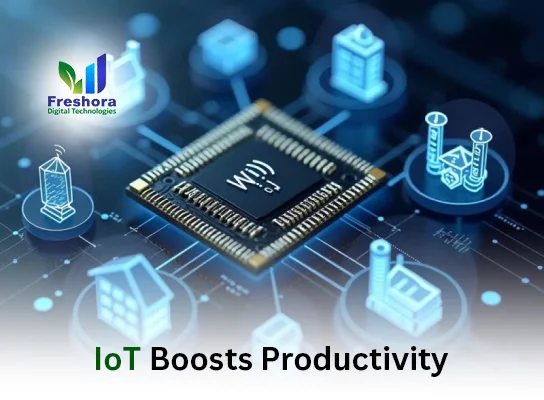
The Internet of Things (IoT) has fundamentally changed how modern businesses operate on a daily basis. It bridges the critical gap between physical assets and digital intelligence, giving leaders unprecedented control over their workflows. If you want to understand exactly How IoT Boosts Productivity, you must look beyond basic connectivity and focus on actionable, automated insights.
Organizations that embrace connected devices no longer rely on guesswork to manage their daily operations. Instead, they harness precise data to streamline communication, eliminate waste, and empower their workforce. This guide will explore the practical applications of IoT technology and how it delivers measurable improvements to your bottom line.
IoT dramatically increases productivity by automating routine tasks, providing instant operational visibility, and eliminating costly human errors. Connected devices gather continuous data, allowing managers to optimize workflows, prevent equipment failures, and make faster, data-backed decisions that directly improve overall business output.
Traditional workflows often rely heavily on manual oversight and reactive troubleshooting. Today, leaders are leveraging IoT for industrial manufacturing workflow optimization to eliminate these outdated bottlenecks entirely. Sensors communicate directly with central software systems to streamline every single phase of production seamlessly.
The Industrial Internet of Things (IIoT) scales these remarkable benefits for massive manufacturing and logistics operations globally. Facility managers no longer suffer from dangerous blind spots on the busy factory floor. Instead, interconnected machines report their mechanical status continuously, keeping massive operations running at peak efficiency.
This seamless digital communication forms the very foundation of true smart factory optimization. Operations managers can monitor assembly lines remotely and adjust operational speeds dynamically to meet demanding production targets. Consequently, factories produce higher yields with significantly less manual intervention.
Scaling a manufacturing business historically required massive leaps of faith regarding equipment capacity and labor limits. Today, embedded IoT sensors provide the exact daily utilization rates of every machine on your floor. Leaders can confidently expand their operations knowing precisely where their mechanical capacity bottlenecks exist.
Predictive maintenance uses IoT sensors to monitor equipment health continuously, identifying potential mechanical failures before they actually happen. This proactive approach eliminates unexpected breakdowns, saves costly emergency repair fees, and ensures maximum operational uptime for critical business functions.
Waiting for an expensive machine to break before fixing it is a guaranteed recipe for financial disaster. By utilizing advanced predictive maintenance software, organizations transition rapidly from a reactive stance to a highly proactive maintenance model. Sensitive monitors detect minor anomalies like unusual vibrations or temperature spikes instantly.
This is exactly where IoT enabled predictive maintenance for reducing business downtime becomes an absolute game-changer for enterprises. Mechanics receive automated alerts exactly when parts begin to wear out, allowing them to schedule preventative repairs during off-hours. The business completely avoids catastrophic halts in production and maintains a highly profitable, steady output.
Yes, tracking assets with IoT dramatically improves efficiency by providing precise location and status data for tools, inventory, and vehicles. This technology eliminates the time wasted searching for misplaced items, prevents asset theft, and ensures resources are deployed exactly where they are needed most.
Lost tools and misplaced inventory quietly drain thousands of highly paid hours from employee schedules every single year. Implementing automated asset tracking resolves this frustrating logistical issue instantly. Workers can locate exactly what they need immediately through a simple, centralized digital dashboard search.
We are seeing tremendous financial success in improving workplace efficiency with real-time IoT asset tracking across both sprawling factories and corporate campuses. Managers can map the physical movement of goods, identify logistical bottlenecks, and re-route vital materials dynamically. This high-level visibility keeps the entire supply chain moving smoothly and without costly administrative delays.
IoT benefits extend far beyond massive warehouses and industrial manufacturing plants. Many forward-thinking companies are rapidly adopting smart office IoT solutions for employee productivity enhancement. Smart climate control, automated ambient lighting, and intelligent room-booking systems create an optimal physical environment for deeply focused work.
Employees spend significantly less time managing their surroundings and far more time executing high-value corporate tasks. A comfortable, seamlessly automated workspace naturally reduces daily friction and boosts overall employee morale.
IoT data analytics processes massive volumes of raw sensor information instantly to reveal actionable operational trends. This rapid data processing allows corporate leaders to pivot strategies, reallocate human resources, and solve emerging logistical problems in minutes rather than days.
Raw data remains entirely useless unless you can extract meaningful, actionable insights from it quickly. Integrating real-time data analytics into your broader IoT ecosystem transforms basic information into a powerful strategic asset. Decision-makers view live operational dashboards that highlight production inefficiencies exactly as they occur.
The profound impact of IoT data analytics on operational decision making speed cannot be overstated in today's highly competitive market. When a sudden supply chain delay happens, the intelligent system automatically suggests the absolute best alternative route based on current conditions. This level of extreme agility allows modern businesses to easily outpace competitors who still rely on legacy reporting methods.
When teams have direct access to transparent, real-time metrics, their entire approach to daily problem-solving shifts dramatically. Employees no longer have to guess why a specific process failed; they simply review the historical sensor data. This transparency fosters a highly accountable workplace culture dedicated to continuous, measurable improvement.
Transitioning to an IoT-driven business model requires a highly solid strategy and the right technology partners. You must carefully align your IoT initiatives with your broader operational goals to guarantee a genuine return on investment. Start small by addressing your most significant pain points, such as complex inventory management or excessive machine downtime.
As your business scales, ensure your digital presence accurately reflects your new, modern capabilities to potential clients. Many innovative companies partner with a premier search engine optimization agency in Trichy to ensure their high-tech services reach the right audience online. Digital visibility is just as crucial to your success as internal operational efficiency.
You also need powerful, reliable software solutions to manage your newly connected ecosystem effectively. Cutting-edge tools like SmartPro help integrate your diverse operations seamlessly from top to bottom. Choosing the absolute right software foundation ensures your IoT devices communicate securely, rapidly, and effectively.
Understanding How IoT Boosts Productivity is just the first critical step toward building a more resilient, highly efficient business. From automated asset tracking to predictive equipment maintenance, the benefits are exceptionally clear, measurable, and highly transformative. Now is the perfect time to modernize your legacy workflows and fully embrace the power of connected devices.
If you are ready to explore how cutting-edge technology can elevate your brand, learn more about us and our ongoing mission to drive digital excellence. We provide the vital expertise needed to navigate this complex technological landscape confidently and securely. You can also visit our physical headquarters to discuss your customized strategy in person by finding us on the map.



Summary: Paid campaigns improve high-intent lead generation by targeting ready-to-buy audiences, inc... Read More
Summary: Smart analytics enhances business growth planning by delivering predictive insights, trend... Read More
Blog Summary Internal productivity is no longer determined only by how hard employees work. It incr... Read More
Our expert will call you shortly to understand your needs and help grow your business.
Get exclusive digital marketing tips, SEO insights, web & app updates, and job opportunities delivered straight to your inbox.
Join our WhatsApp channel for instant digital marketing tips, SEO insights, web & app updates, and latest job opportunities.
Join NowFreshora Digital Technologies proudly serves businesses across Tiruchirappalli (Trichy), including Cantonment, Puthur, Thillai Nagar, Palakarai, Subramaniyapuram, Mela Chinthamani, Woraiyur, KK Nagar, Karumandapam, Crawford, Edamalaipatti Pudur (EMP), Kattur, Airport Area, Ariyamangalam, Panjappur, Thuvakudi, Tiruverumbur, BHEL Township, Srirangam, Thiruvanaikaval, Samayapuram, No.1 Tollgate, Central Bus Stand Area, and Chathiram Bus Stand Area.
We also serve clients across Tamil Nadu, India, and globally in Singapore, the UAE, Saudi Arabia, Canada, Australia, the United Kingdom, and the United States, delivering innovative Website Development, Mobile App Development, Software Development, SEO, Google Business Profile Management, and Digital Marketing solutions that help businesses grow and succeed in the digital world.


