
Contact our team for professional guidance and solutions.
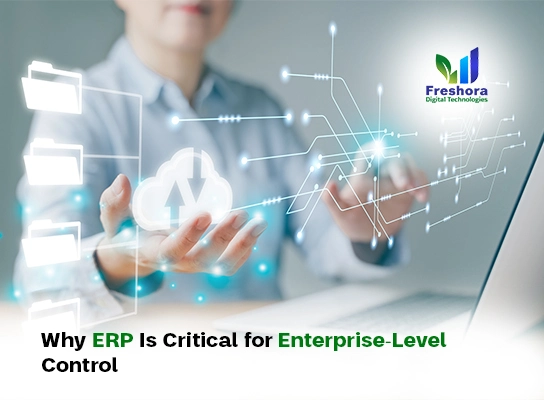
As businesses grow, managing operations through spreadsheets, disconnected software, and manual processes becomes increasingly difficult. Departments start working in silos, data becomes inconsistent, and decision-making slows down. This is where ERP Software plays a critical role. By connecting finance, inventory, sales, purchasing, HR, production, and customer management into a single platform, businesses gain greater visibility and control over daily operations. In this article, you'll learn why Enterprise Resource Planning systems have become essential for enterprise-level organizations, how they improve efficiency, reduce costs, support growth, and help businesses across Trichy operate with confidence and clarity.
ERP Software provides centralized control over business operations by integrating multiple departments into a single system. It improves visibility, automates workflows, reduces manual errors, and supports faster decision-making. Research shows that 95% of businesses report improved processes after ERP implementation, while many organizations reduce operational costs by up to 23%. For growing enterprises, ERP systems create a strong foundation for scalability, efficiency, and long-term business management.
A few years ago, I met the owner of a growing manufacturing company near Thuvakudi in Trichy.
Business was good.
Orders were increasing.
New customers were coming in regularly.
From the outside, everything looked successful.
But when we sat down for coffee, he shared a different story.
The sales team had one set of numbers.
Accounts had another.
Inventory records didn't always match production requirements.
Managers spent hours every week trying to reconcile information from different departments.
His comment stayed with me.
That's a challenge many businesses face.
Growth is exciting until operational complexity starts slowing everything down.
According to Panorama Consulting Group, 95% of businesses report improved business processes after ERP implementation, while organizations achieve up to 23% lower operational costs and significantly greater visibility across departments.
Those numbers explain why ERP Software is no longer something only large corporations consider. For many growing enterprises, it's becoming a necessity rather than a luxury.
In the early stages of a business, it's possible to manage operations using spreadsheets, emails, and manual records.
However, growth changes everything.
More customers.
More employees.
More suppliers.
More transactions.
More data.
Without proper systems, complexity grows faster than control.
This is where Enterprise Business Control becomes essential.
One common challenge I observe across businesses in Trichy is departmental separation.
Sales teams use one tool.
Finance teams use another.
Inventory management happens elsewhere.
HR records sit in separate files.
When information isn't connected, decisions become slower and less accurate.
An ERP system solves this problem by creating a single source of truth.
What Is ERP Software?
ERP Software stands for Enterprise Resource Planning.
It combines multiple business functions into one integrated platform.
Instead of using separate systems for:
everything works together within a unified environment.
Think of it as the central nervous system of a business.
Every department remains unique, but all information flows through one connected network.
Business leaders often struggle to answer basic questions quickly.
Questions like:
Without centralized systems, obtaining answers can take hours or days.
ERP systems provide real-time visibility.
Research indicates that businesses can automate up to 80% of routine administrative processes through ERP-enabled automation.
Manual work often includes:
Reducing these tasks allows employees to focus on higher-value activities.
According to Panorama Consulting Group, 83% of organizations state that ERP systems improve visibility across business functions.
When leaders can view information from every department in one place, decision-making becomes faster and more accurate.
This improves overall Enterprise Operations Management.
Consider a manufacturer in Ponmalai supplying products across Tamil Nadu.
Without ERP:
With ERP:
The result is better operational control.
Finance departments benefit significantly from ERP implementation.
Advantages include:
According to Deloitte, some organizations reduce month-end financial closing times by up to 50%.
That's a major improvement for growing enterprises.
Inventory problems can be expensive.
Too much stock ties up capital.
Too little stock creates delays.
Research from APICS shows ERP systems can reduce inventory carrying costs by 10%–30%.
This is particularly valuable for wholesalers in Palakkarai and retailers near Chathiram Bus Stand.
HR teams gain better visibility into:
This reduces administrative workload while improving accuracy.
Customer expectations continue rising.
Nucleus Research reports that organizations using ERP systems experience customer service improvements of up to 45%.
When customer information, inventory, and order status are instantly accessible, service quality naturally improves.
Colleges and training centers around KK Nagar and Thuvakudi often manage large volumes of student data.
ERP systems help coordinate admissions, attendance, fees, examinations, and reporting within one platform.
Hospitals and clinics in Cantonment and Woraiyur benefit from centralized patient records, billing systems, appointment scheduling, and operational reporting.
Retail stores in Thillai Nagar and Ponnagar frequently manage inventory across multiple product categories.
ERP platforms improve stock control and sales visibility.
Restaurants in Srirangam and Thiruvanaikovil use ERP solutions to track inventory consumption, vendor purchases, staff scheduling, and financial performance.
Business owners often spend significant time gathering information from various departments.
ERP eliminates much of this effort.
Instead of waiting for separate reports, leaders can access real-time dashboards.
This improves responsiveness and strategic planning.
Forrester Research reports that companies using real-time business data are five times more likely to make faster decisions.
That's a competitive advantage.
When market conditions change, businesses need information immediately—not next week.
According to Panorama Consulting Group, 92% of organizations report that ERP systems help standardize and streamline operations.
Standardization creates consistency.
Consistency improves quality.
Quality supports growth.
This is why Organizational Efficiency remains one of the most important outcomes of ERP implementation.
Manual processes often create:
ERP systems significantly reduce these issues through automation and integration.
One important lesson from successful ERP projects is that software alone doesn't solve problems.
Processes must also improve.
Teams must adopt new workflows.
Leadership must support change.
Successful ERP Implementation combines technology, process improvement, and employee engagement.
Before selecting an ERP platform, businesses should identify priorities.
Common objectives include:
The right system depends on organizational needs.
Research shows that 64% of organizations implement ERP primarily to support growth and operational control.
As businesses expand, ERP systems provide the structure needed to manage increasing complexity.
Without scalable systems, growth often creates operational stress.
With ERP, growth becomes more manageable.
Nucleus Research found that organizations achieve an average return of $7.23 for every $1 invested in ERP software.
That return comes from:
This explains why ERP continues gaining popularity across industries.
More businesses are adopting cloud-based ERP solutions because they offer flexibility, accessibility, and lower infrastructure requirements.
This trend is expected to continue.
Artificial intelligence is increasingly being integrated into ERP platforms.
Future capabilities include:
These features will further strengthen Enterprise Software Solutions.
The global ERP software market is projected to exceed $100 billion by 2030.
This growth reflects the increasing demand for centralized control, automation, and digital transformation.
Businesses that invest early often gain long-term advantages.
Trichy continues to grow as a center for manufacturing, education, healthcare, retail, and technology services.
Businesses across Karumandapam, Ponmalipatti, Central Bus Stand commercial zones, and surrounding industrial areas are managing increasing operational complexity.
As organizations expand, the need for Business Management Software and Integrated Business Solutions becomes more apparent.
Even companies involved in website development, software services, and digital operations, such as Freshora Digital Technologies, frequently observe growing businesses moving toward ERP platforms as operational requirements become more sophisticated.
The trend is clear.
Growth demands stronger systems.
Managing a growing enterprise without centralized systems can create inefficiencies, delays, and operational blind spots. ERP Software addresses these challenges by connecting departments, improving visibility, automating workflows, and supporting informed decision-making.
From finance and inventory management to customer service and workforce productivity, ERP systems provide the structure businesses need to operate efficiently and scale confidently.
Whether you're managing a manufacturing company in Thuvakudi, a healthcare facility in Cantonment, a retailer in Thillai Nagar, or an educational institution in KK Nagar, ERP can provide the operational control required for sustainable growth and long-term success.
If your business is looking to improve operational visibility, streamline workflows, reduce manual processes, and support long-term growth, exploring ERP solutions can be a practical next step.
Evaluating your current processes and identifying opportunities for integration may help create a stronger foundation for future business success.
In the fast-paced logistics landscape of Tiruchirappalli, efficiency is the difference between profi... Read More

In the heart of Tamil Nadu’s thriving commercial landscape, Trichy’s fashion industry is... Read More

Blog Summary Many business consultants build their reputation through referrals, networking, and lo... Read More
Our expert will call you shortly to understand your needs and help grow your business.
Get exclusive digital marketing tips, SEO insights, web & app updates, and job opportunities delivered straight to your inbox.
Join our WhatsApp channel for instant digital marketing tips, SEO insights, web & app updates, and latest job opportunities.
Join NowFreshora Digital Technologies proudly serves businesses across Tiruchirappalli (Trichy), including Cantonment, Puthur, Thillai Nagar, Palakarai, Subramaniyapuram, Mela Chinthamani, Woraiyur, KK Nagar, Karumandapam, Crawford, Edamalaipatti Pudur (EMP), Kattur, Airport Area, Ariyamangalam, Panjappur, Thuvakudi, Tiruverumbur, BHEL Township, Srirangam, Thiruvanaikaval, Samayapuram, No.1 Tollgate, Central Bus Stand Area, and Chathiram Bus Stand Area.
We also serve clients across Tamil Nadu, India, and globally in Singapore, the UAE, Saudi Arabia, Canada, Australia, the United Kingdom, and the United States, delivering innovative Website Development, Mobile App Development, Software Development, SEO, Google Business Profile Management, and Digital Marketing solutions that help businesses grow and succeed in the digital world.
