
Contact our team for professional guidance and solutions.
Online shoppers may abandon checkout when unexpected fees appear, payment options are unsuitable, forms are difficult to complete, delivery details are unclear, or the payment process feels untrustworthy. UAE e-commerce businesses can address these barriers through transparent pricing, mobile-friendly checkout, relevant payment methods, guest checkout, clear delivery information, and reliable error handling. Measuring each checkout stage helps stores identify which changes are most likely to improve completed purchases.
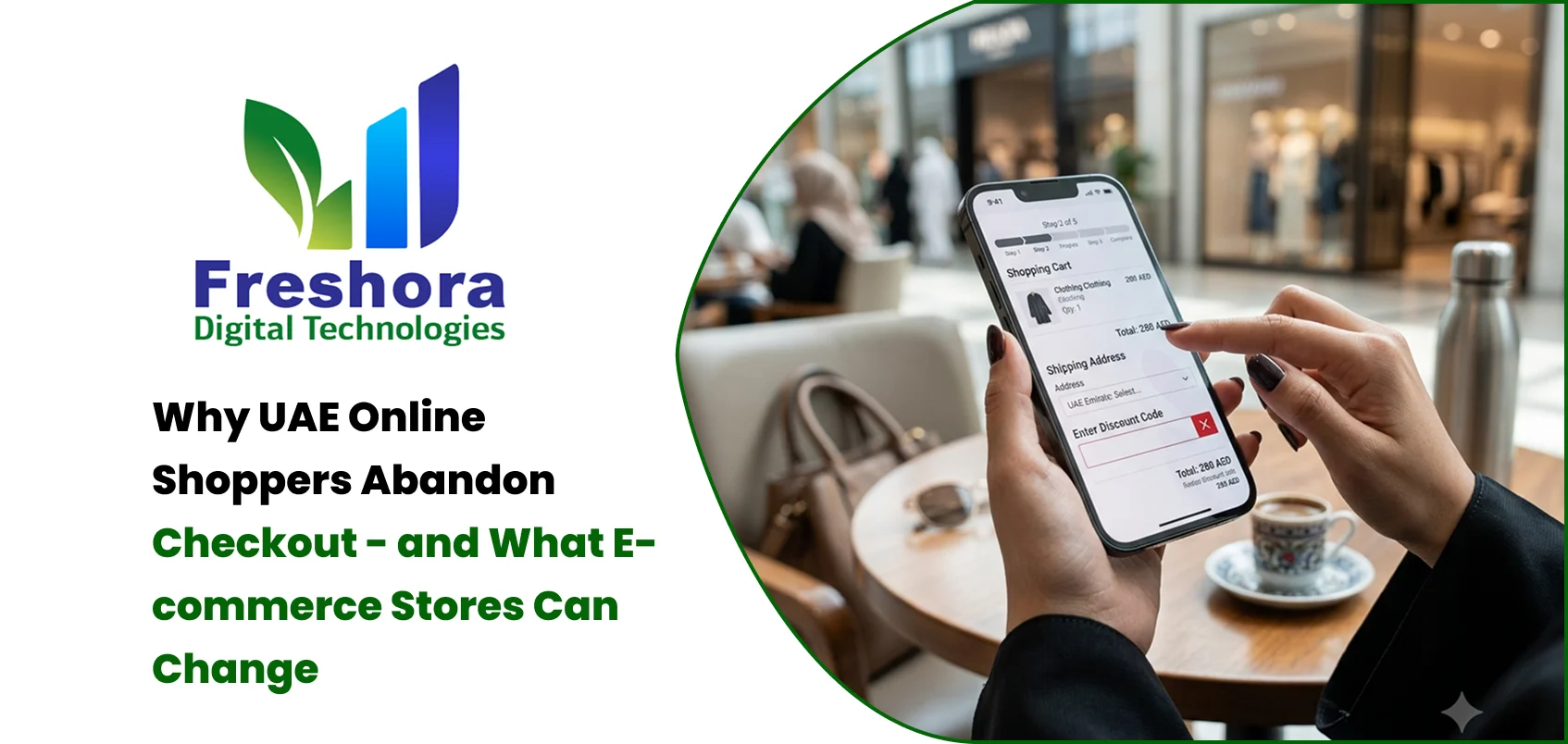
A customer can browse products, compare prices, add items to a cart, and still leave without placing an order. For an e-commerce business, this gap between purchase intent and completed payment can represent a missed opportunity, but the reason is not always a lack of interest in the product. The checkout experience itself may introduce uncertainty through unexpected delivery charges, unclear return conditions, lengthy forms, unfamiliar payment methods, or errors that prevent an order from going through. In the UAE, online stores may serve customers with different language preferences, delivery expectations, devices, and payment habits, making a single checkout design unsuitable for every audience. Improving E-commerce Checkout UAE experiences requires businesses to understand where confidence breaks down and remove friction without weakening payment security or collecting insufficient order information. By making costs clear, simplifying essential steps, supporting suitable payment methods, and testing the complete purchase journey, retailers can create a smoother path from cart to confirmation.
Checkout abandonment happens when a shopper starts the purchase process but does not complete the order. Some exits are intentional: customers may compare prices, reconsider their budget, or save items for later. Others occur because the checkout creates obstacles that could have been avoided.
Common causes include:
Unexpected charges: Delivery fees, taxes, service charges, or other costs appear late in the process.
Complicated forms: Shoppers must enter information that is unnecessary or difficult to provide on their device.
Limited payment choices: The available methods do not suit the customer's preference or circumstances.
Forced account creation: Customers are asked to register before they can complete a purchase.
Unclear delivery details: The store does not explain delivery coverage, estimated timing, or fulfilment conditions clearly enough.
Trust concerns: Shoppers cannot easily find contact details, return policies, or information about how payment and personal data are handled.
Technical problems: A payment fails, a page loads slowly, or the checkout loses information.
Poor mobile usability: Buttons, fields, and payment controls are difficult to use on a small screen.
The first step is to distinguish between customers who simply change their minds and those who encounter avoidable friction. Store analytics, payment logs, customer enquiries, and usability tests can help reveal the difference.
Unexpected costs are among the most preventable sources of checkout frustration. A shopper may accept the product price but reconsider the order when delivery fees or other charges suddenly increase the total.
Retailers should communicate costs as early as practical.
Show delivery charges clearly. If delivery fees depend on the customer's location, explain how they are calculated and show the applicable charge once the necessary details are available.
Explain additional charges. Any applicable taxes, service fees, customisation costs, or other charges should be disclosed before the customer commits to the purchase.
Display the order summary. Keep product prices, quantities, discounts, delivery charges, and the final payable amount easy to review.
Explain promotional conditions. If a discount requires a minimum spend or applies only to selected products, state the conditions clearly rather than revealing them after the shopper has entered several checkout details.
Avoid misleading urgency. Countdown timers, discount claims, and stock messages should reflect genuine conditions. Artificial pressure can damage trust, particularly when the final price differs from what shoppers expected.
For example, a customer ordering household products should be able to understand the expected total before entering payment details. If the delivery fee depends on the postcode or service area, the checkout should explain this dependency and provide the amount as soon as possible.
A transparent checkout helps shoppers make informed decisions, even when they decide not to purchase.
Every unnecessary step adds effort between the customer's decision to buy and the completed order. A streamlined checkout should collect the information required to fulfil the purchase while avoiding questions that do not serve the transaction.
Allow customers to purchase without creating an account when registration is not essential. Account creation can be offered after the order is placed, when it may be easier to explain the benefits.
Do not request the same information more than once unless it serves a genuine purpose. If the billing address is the same as the delivery address, provide an option to reuse the information.
Email, telephone, postcode, and address fields should use suitable input types and autocomplete support where appropriate. These features can reduce typing and help prevent mistakes.
Arrange fields in a logical order, group related information, and make the next action obvious. Avoid sending customers back and forth between unrelated screens.
If a validation error occurs, keep the information the shopper has already entered whenever possible. Losing a completed address or order detail can create frustration and unnecessary repetition.
Some transactions require identity checks or additional information. Explain why these steps are necessary instead of removing safeguards merely to shorten the journey.
Checkout Optimisation Dubai initiatives should focus on removing unnecessary effort, not eliminating steps that protect customers or enable successful fulfilment.
A mobile-friendly product page does not automatically produce a mobile-friendly checkout. The purchase process may still become difficult when the keyboard covers important controls, the address form is crowded, or payment redirects interrupt the journey.
Mobile Checkout Dubai improvements should address the entire transaction, from reviewing the cart to receiving confirmation.
Use readable field labels and text. Customers should not need to zoom repeatedly to understand instructions or correct an error.
Provide appropriately sized controls. Buttons, checkboxes, and payment options should be easy to select without accidentally activating neighbouring elements.
Choose mobile-friendly input types. A telephone field should make number entry convenient, while email fields should support efficient address entry.
Keep the order total visible. Customers should be able to review the amount payable without repeatedly navigating away from the current step.
Avoid unnecessary pop-ups. Promotional overlays and newsletter requests can interrupt a purchase when shoppers are ready to pay.
Handle redirects clearly. If a payment provider opens another page or application, explain what is happening and help customers return to the store safely.
Test on real devices. Check common browsers, screen sizes, keyboard behaviour, and network conditions rather than relying only on desktop previews.
A useful test is to complete a purchase on a phone without assistance. Note every moment when the process becomes confusing, requires repeated typing, or hides essential information.
Payment availability can influence whether a shopper completes an order. However, adding every possible payment option is not necessarily the right solution. The useful question is whether the methods offered match the needs of the store's customers and the economics of the transaction.
UAE retailers can evaluate suitable options such as:
Debit and credit cards: Clearly communicate which card types are supported and handle rejected transactions with helpful instructions.
Digital wallets: Consider relevant wallet options based on the devices and payment preferences of the target audience.
Buy now, pay later services: Where appropriate, offer eligible instalment options with clear terms, fees, repayment information, and eligibility requirements.
Bank or payment-provider options: Use methods that integrate reliably with the store's payment infrastructure and fulfilment workflow.
Before adding a method, assess its availability in the UAE, provider fees, settlement arrangements, refund handling, customer support requirements, and security responsibilities.
The checkout should also show payment options in a clear, neutral way. Do not preselect a financing product or obscure important terms simply to encourage its use.
Payment friction UAE businesses encounter can come from failed transactions, unclear authentication instructions, expired sessions, or customers being uncertain about whether their payment succeeded.
Some friction is necessary. Payment authentication and fraud controls can protect customers and merchants. The goal is to remove confusing or avoidable obstacles while preserving appropriate safeguards.
If a transaction requires a one-time password, banking approval, or another verification step, explain what the customer should expect and how to proceed.
Instead of displaying only “Payment failed,” provide an appropriate next action, such as checking the payment details or trying another supported method. Avoid exposing sensitive fraud-detection information.
If a payment is pending, make the status clear and discourage customers from submitting the same transaction repeatedly. Use appropriate transaction handling to prevent accidental duplicate orders.
When possible, retain the customer's items and valid checkout details so the purchase can be retried without starting again.
The amount displayed before payment should match the amount submitted for authorisation, except for clearly explained and legitimate adjustments.
After a successful transaction, display an order confirmation with a reference number and relevant next steps. Send a confirmation through the appropriate channel where supported.
Review payment failures by provider, device, error category, and transaction stage. A pattern of failures with one method may indicate an integration issue rather than a problem with customer behaviour.
Trust should not depend on a single payment icon or a security badge near the checkout button. Customers need enough information to understand who they are buying from, what they will receive, and what happens if something goes wrong.
A trustworthy checkout should include:
Clear business contact information and customer support channels.
Accessible delivery, cancellation, return, and refund policies.
Accurate product details, prices, and stock information.
A clear explanation of any required personal information.
Appropriate privacy information and responsible handling of customer data.
Familiar and secure payment flows with clear feedback.
An order confirmation that identifies the purchase and explains what happens next.
For stores serving customers in the UAE, explain delivery coverage and any relevant conditions before payment. If some areas require additional delivery time or fees, communicate this clearly once the customer's location is known.
If Arabic and English are supported, make the language switch easy to find and ensure that switching languages does not erase the cart or reset completed fields unnecessarily. Arabic layouts should be tested for right-to-left direction, readable text, and correctly positioned controls.
These details can reduce uncertainty without relying on exaggerated claims about security or service quality.
Customers evaluate more than the product price before deciding whether to complete a purchase. Delivery timing, availability, return conditions, and the process for resolving problems can all affect the decision.
Show delivery estimates clearly. Provide a realistic range when an exact delivery date cannot be guaranteed. Explain whether the estimate changes according to location, product availability, or fulfilment method.
Clarify delivery coverage. If the store serves only certain locations or has restrictions for particular products, make those limits easy to discover before the final payment step.
Explain return eligibility. State the relevant conditions, timelines, and process for returning or exchanging an item. Avoid forcing customers to search through unrelated pages to find the policy.
Provide order tracking information. Explain how customers will receive updates and where they can check the status of an order.
Set realistic expectations. Do not promise delivery times or refund periods that the business cannot reliably meet.
For products with different fulfilment conditions, show the relevant details at product or cart level instead of presenting every customer with a generic statement.
A clear Online Shopping Experience UAE should help customers understand both the purchase and the commitments that follow it.
A store cannot fix checkout problems reliably if it measures only overall sales. It needs to understand where shoppers leave and what happens immediately before they do.
Create an event sequence that reflects the actual purchase journey. Depending on the platform, useful events may include:
Product added to cart.
Checkout started.
Delivery information entered.
Delivery option selected.
Payment method selected.
Payment attempted.
Payment authorised or rejected.
Order confirmation displayed.
Use these events to calculate completion rates between stages and identify where the largest losses occur.
Important metrics include:
Checkout completion rate: The proportion of checkout starters who complete an order.
Cart-to-checkout rate: The proportion of shoppers with items in their cart who begin checkout.
Payment failure rate: The share of payment attempts that fail, interpreted alongside provider and transaction data.
Form error rate: The frequency of validation problems in delivery, contact, and billing fields.
Mobile checkout completion: The proportion of mobile checkout starters who successfully purchase.
Average time to complete checkout: How long users take to complete the process, while accounting for legitimate differences between order types.
Refund and cancellation rates: These help ensure that conversion improvements are not creating lower-quality purchases.
Segment the data by device, traffic source, payment method, language, and relevant customer groups where data collection and privacy requirements permit.
A high exit rate at payment may suggest a technical issue, an unsuitable payment method, or customer hesitation. The metric identifies where to investigate, but additional evidence is needed to determine the cause.
Checkout changes should be based on observed problems and tested against meaningful outcomes. A redesign that looks cleaner may not improve completed purchases, and a change that increases conversion may also create more errors or cancellations.
A structured test starts with a specific hypothesis.
For example: “Showing the delivery charge before customers enter their full address will reduce exits during the delivery stage because shoppers can understand the expected total earlier.”
A practical experiment should include:
A clearly defined checkout problem.
One main change that can be evaluated.
A primary metric, such as successful order completion.
Guardrail metrics, such as payment failures, refunds, cancellations, or customer support contacts.
A suitable test period and sufficient data to interpret the results.
A record of what was changed and what the team learned.
Avoid testing too many unrelated changes simultaneously if the results need to identify which adjustment made the difference. Where traffic is limited, usability testing and carefully reviewed customer feedback may be more useful than an inconclusive A/B test.
The purpose of testing is to improve the complete purchase experience, not simply increase button clicks.
Retailers can improve the checkout process in stages rather than attempting a complete redesign immediately.
Document the path from adding an item to receiving order confirmation. Include redirects, authentication, address entry, delivery selection, and any third-party payment service.
Review the journey on desktop and mobile. Check field requirements, pricing visibility, payment errors, accessibility, delivery information, and recovery from interrupted transactions.
Use analytics, customer support feedback, payment-provider reports, and usability tests to find the issues with the greatest effect on successful purchases.
Resolve broken payment flows, unclear pricing, lost form data, and blocked mobile interactions before spending time on minor cosmetic changes.
Confirm that checkout improvements preserve required payment authentication, accurate order information, privacy practices, and fulfilment requirements.
Compare completion, payment failures, cancellations, and other relevant metrics before and after the change. Check whether the improvement is consistent across important user journeys.
Reassess the checkout after changes to products, payment providers, delivery arrangements, promotions, or website functionality.
For e-commerce businesses planning a new store or improving an existing one, Freshora Digital Technologies can incorporate checkout usability, mobile interaction design, and conversion measurement into website development planning.
Some conversion problems persist because businesses optimise for convenience in one area while overlooking the overall purchase journey.
Hiding delivery charges until the final step: This can make the total feel unexpected and weaken confidence in the store.
Forcing account creation: Mandatory registration can interrupt customers who want to complete a straightforward purchase.
Offering too many distracting promotions: Coupon pop-ups and unrelated recommendations can pull shoppers away from checkout.
Displaying vague payment errors: Customers may repeatedly retry a failed transaction without understanding what happened.
Removing useful information to shorten the page: Essential delivery, return, or payment details should not disappear simply to make the interface look minimal.
Assuming desktop and mobile behave identically: Small screens and mobile payment flows require dedicated testing.
Treating every abandoned cart as a lost sale: Some shoppers are comparing options, checking delivery costs, or saving products for later.
Measuring conversion without quality: Higher order completion should be considered alongside cancellations, returns, support issues, and customer satisfaction.
A strong checkout helps customers make informed decisions and complete purchases without avoidable friction. It should not pressure every visitor into buying.
Checkout abandonment can result from unexpected costs, complicated forms, unsuitable payment options, unclear delivery policies, or technical issues that interrupt the purchase journey. For UAE e-commerce businesses, addressing these problems begins with understanding how customers move from the cart to payment confirmation and identifying the barriers that prevent successful completion. Transparent pricing, mobile-friendly layouts, relevant payment methods, accessible forms, clear authentication steps, and dependable error recovery can make the process easier to navigate. However, improvements should be evaluated through real checkout data rather than assumptions about customer behaviour. By monitoring each stage, testing focused changes, and balancing convenience with security and fulfilment requirements, online stores can build a more reliable shopping experience. The objective is not simply to push more visitors through checkout, but to help customers who want to buy complete their orders with clarity, confidence, and minimal unnecessary effort.



Quick Answer Dubai businesses can replace spreadsheets with internal web applications when shared f... Read More

Quick Answer A Dubai business needs a web application instead of a standard website when customers,... Read More

Quick Answer E-commerce integration connects an online store with the business systems that manage... Read More
Our expert will call you shortly to understand your needs and help grow your business.
Get exclusive digital marketing tips, SEO insights, web & app updates, and job opportunities delivered straight to your inbox.
Join our WhatsApp channel for instant digital marketing tips, SEO insights, web & app updates, and latest job opportunities.
Join NowFreshora Digital Technologies proudly serves businesses across Tiruchirappalli (Trichy), including Cantonment, Puthur, Thillai Nagar, Palakarai, Subramaniyapuram, Mela Chinthamani, Woraiyur, KK Nagar, Karumandapam, Crawford, Edamalaipatti Pudur (EMP), Kattur, Airport Area, Ariyamangalam, Panjappur, Thuvakudi, Tiruverumbur, BHEL Township, Srirangam, Thiruvanaikaval, Samayapuram, No.1 Tollgate, Central Bus Stand Area, and Chathiram Bus Stand Area.
We also serve clients across Tamil Nadu, India, and globally in Singapore, the UAE, Saudi Arabia, Canada, Australia, the United Kingdom, and the United States, delivering innovative Website Development, Mobile App Development, Software Development, SEO, Google Business Profile Management, and Digital Marketing solutions that help businesses grow and succeed in the digital world.

