
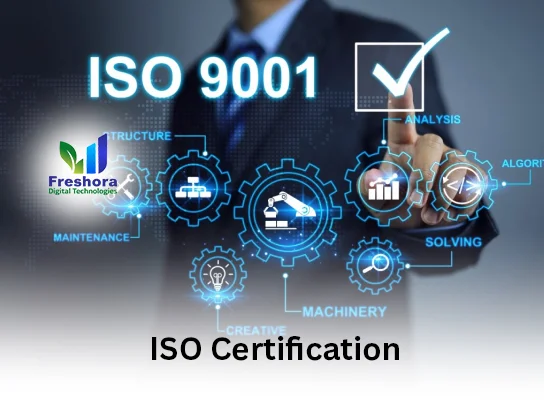
Contact our team for professional guidance and solutions.
ISO Certification has become an important consideration for businesses seeking stronger quality systems, customer confidence, process consistency and market credibility. ISO standards are not limited to large corporations; organizations of different sizes and sectors can use management system standards to structure and continually improve their operations. ISO states that more than 1 million ISO 9001 certificates have been issued to organizations in 189 countries, making ISO 9001 one of the world's most widely used quality management standards. The year 2026 is particularly important because ISO 9001 is moving toward a new edition, with ISO indicating publication of ISO 9001:2026 in September 2026. For businesses considering ISO Certification for Businesses, this makes it an appropriate time to understand quality management, certification requirements, transition considerations and how certification can support long-term business performance rather than treating the certificate as simply a marketing document.
ISO Certification is an independent assessment that confirms an organization's management system conforms to the requirements of a specified ISO standard.
For businesses, ISO certification can support:
● Process consistency
● Customer confidence
● Risk management
● Continuous improvement
● Supplier credibility
● Tender participation
● International business opportunities
● Internal accountability
● Structured documentation
ISO itself does not certify organizations. Certification is carried out by independent certification bodies, which may be accredited by an appropriate accreditation body.
● More than 1 million ISO 9001 certificates have been issued across 189 countries.
● ISO 9001:2015 remains the current published edition while the revised ISO 9001:2026 edition is under publication.
● ISO expects the new ISO 9001 edition to be published in September 2026.
● ISO 9001 certification is voluntary unless a customer, contract, regulation or other business requirement makes it necessary.
● Certification is different from simply implementing an ISO management system.
● ISO certification can strengthen process discipline, customer confidence and continuous improvement.
● The 2024 climate-action amendments added climate-change considerations to a range of ISO management-system standards.
● ISO 9001:2026 places stronger emphasis on leadership, quality culture, accountability and risks and opportunities.
● Businesses should choose an ISO standard according to their actual operational needs rather than selecting a certificate only for promotional purposes.
● ISO Certification Services in Trichy can help local businesses understand implementation, documentation, readiness and certification requirements.
In 2026, customers, suppliers, investors, procurement teams and business partners increasingly expect organizations to demonstrate that their operations are reliable, controlled and capable of delivering consistent results, making ISO Certification more relevant for businesses that want to strengthen credibility while improving the way they operate. ISO certification is not simply a framed certificate placed on an office wall; it is connected to a management system that defines how an organization establishes processes, manages responsibilities, evaluates performance, addresses risks and continually improves its operations. ISO reports that more than 1 million ISO 9001 certificates have been issued to organizations in 189 countries, demonstrating the international reach of quality management certification. The year 2026 is especially significant because ISO 9001 is undergoing its major revision since the 2015 edition, with the new ISO 9001:2026 expected to be published in September 2026. The upcoming edition places greater emphasis on leadership, quality culture, accountability, risks and opportunities, and clearer requirements. At the same time, ISO management-system standards have incorporated climate-change considerations following amendments published in 2024. For organizations considering ISO Certification for Businesses, these developments make 2026 a useful point to review existing processes, understand the relevant ISO Standards for Companies, prepare for applicable changes and build a quality system that contributes to actual business performance rather than pursuing certification merely as a promotional symbol.
ISO certification demonstrates that an organization's management system has been independently assessed against the requirements of a particular ISO standard.
For example:
ISO 9001 → Quality Management
ISO 14001 → Environmental Management
ISO 45001 → Occupational Health and Safety
ISO/IEC 27001 → Information Security Management
ISO 22000 → Food Safety Management
ISO 13485 → Medical Devices Quality Management
ISO identifies these and other standards across areas such as quality, information security, environmental sustainability, health and safety, food and agriculture, energy and risk management.
The important point is that there is no single ISO certificate suitable for every business.
These terms are often confused.
The organization develops and operates a management system that meets the applicable standard's requirements.
An independent certification body assesses the management system and, when conformity is demonstrated, issues the certification.
ISO explains that organizations can implement ISO 9001 without necessarily going through third-party certification.
Therefore:
Implementation = Building the System
Certification = Independent Confirmation of Conformity
The business environment is changing rapidly.
Companies increasingly deal with:
● Digital operations
● International customers
● Supply-chain requirements
● Sustainability expectations
● Data-driven decision-making
● Regulatory requirements
● Competitive procurement
A structured management system can help businesses respond more systematically.
The 2026 revision of ISO 9001 is designed to improve clarity and relevance while strengthening focus on leadership, quality culture and risk and opportunity management.
This means businesses considering certification should think beyond documentation.
The bigger question is:
How can quality management become part of everyday business performance?
A business becomes easier to manage when important activities follow defined processes.
For example:
Customer Enquiry → Quotation → Order → Production → Quality Check → Delivery
A structured process makes responsibilities clearer and can reduce variation.
Customers want evidence that suppliers can deliver consistently.
ISO 9001 is designed to help organizations improve customer satisfaction and demonstrate their commitment to quality.
Certification can therefore strengthen credibility during:
● Vendor evaluations
● Supplier onboarding
● Procurement processes
● International partnerships
Modern businesses face risks related to:
● Quality
● Suppliers
● Operations
● Technology
● Compliance
● Business continuity
A structured management system encourages organizations to identify and address risks instead of waiting for problems to become expensive failures.
ISO management systems are built around continual improvement.
This encourages businesses to ask:
● What went wrong?
● Why did it happen?
● How can it be prevented?
● Can the process be improved?
● What evidence shows improvement?
This creates a culture where operational improvement becomes an ongoing activity.
ISO systems can clarify:
● Responsibilities
● Authorities
● Procedures
● Documentation
This can make it easier to determine who owns a process and who is responsible for improvement.
For companies competing with numerous suppliers, certification can provide an additional credibility signal.
This can be particularly relevant for businesses pursuing:
● Corporate clients
● Export opportunities
● Vendor registrations
● Institutional contracts
● Government tenders
However, certification should never be presented as an automatic guarantee of winning contracts.
ISO certification encourages businesses to move from informal processes toward controlled and repeatable systems.
That can help reduce dependence on individual employees' personal working methods.
Instead of:
"This is how one employee usually does it."
the organization can move toward:
"This is the defined process, and performance is monitored."
ISO 9001 is the most widely recognized quality management standard.
It provides a framework for organizations to:
● Establish a Quality Management System
● Meet customer expectations
● Improve processes
● Manage quality risks
● Monitor performance
● Improve customer satisfaction
ISO states that ISO 9001 can be used by organizations of different sizes and sectors, including manufacturing, services, healthcare, education, construction and technology.
This is one of the most important considerations for businesses this year.
ISO indicates that ISO 9001:2026 is expected to replace ISO 9001:2015 in September 2026.
The new edition is intended to provide:
● Clearer wording
● Stronger leadership focus
● Greater emphasis on quality culture
● More clarity around risks and opportunities
● Stronger accountability
● Better alignment with other management-system standards
Organizations already certified to ISO 9001:2015 will receive a transition period to move to the new edition.
Therefore, businesses should avoid panic-driven changes before understanding the final requirements and transition arrangements applicable to their certification.
Another important development began in 2024.
ISO and the International Accreditation Forum introduced climate-action amendments to management-system standards, adding consideration of climate change within the context of the organization and relevant interested-party requirements.
This does not mean every business must suddenly become a climate-focused organization.
It means businesses should consider whether climate change is a relevant issue affecting their management system and intended outcomes.
For some organizations, this may influence:
● Supply chains
● Raw materials
● Energy
● Infrastructure
● Business continuity
A typical certification journey can be understood through 7 stages.
Determine whether the business needs ISO 9001, ISO 14001, ISO 45001, ISO/IEC 27001 or another standard.
Compare current business practices against the applicable requirements.
Create or improve relevant processes, responsibilities and controls.
The system must operate in practice rather than exist only in documents.
Internal audits help identify gaps and improvement opportunities.
Leadership evaluates whether the management system is effective and suitable.
An independent certification body assesses conformity with the relevant standard.
If conformity is demonstrated, certification can be issued.
There is no universal certification timeline.
It depends on:
● Company size
● Number of locations
● Scope
● Standard
● Existing processes
● Documentation
● Employee involvement
● Operational complexity
● Readiness for audit
A small organization with established processes may require significantly less preparation than a large company operating across multiple locations.
Therefore, businesses should avoid providers promising a universal certification timeline without first assessing the organization's scope.
Before certification, organizations should consider:
● Organizational structure
● Process documentation
● Quality objectives
● Responsibilities
● Risk assessment
● Operational controls
● Training records
● Supplier management
● Customer feedback
● Internal audits
● Corrective actions
● Management review
The exact requirements depend on the chosen standard.
Small businesses sometimes assume ISO certification is only suitable for large organizations.
That is incorrect.
ISO 9001 can be used by organizations of any size and sector.
For a small business, certification can help create:
● Defined processes
● Better documentation
● Consistent service
● Customer confidence
● Improved internal accountability
● More structured growth
The system should be scaled to the organization's actual size rather than creating unnecessary bureaucracy.
Certification itself does not automatically increase revenue.
Instead, it can create conditions that support better business performance.
For example:
Defined Processes
→ Consistent Delivery
→ Fewer Avoidable Errors
→ Better Customer Experience
→ Higher Trust
→ Stronger Business Opportunities
This is why businesses should view ISO certification as a management-system investment rather than a standalone marketing activity.
Digital companies can also benefit from ISO standards.
For example, technology businesses may consider:
ISO/IEC 27001
for information security management.
Organizations working with artificial intelligence may also examine:
ISO/IEC 42001
for AI management systems. ISO lists ISO/IEC 42001:2023 among its management-system standards.
This demonstrates how ISO standards are expanding alongside modern technology and business risks.
For Freshora Digital Technologies, the role in an ISO-focused business journey is primarily connected to digital infrastructure, documentation support systems, process technology and business visibility, rather than acting as the independent certification body.
Freshora can help businesses strengthen areas such as:
Build a professional website that communicates:
● ISO certification
● Quality commitments
● Services
● Products
● Business capabilities
● Certifications
● Contact information
Improve organic visibility when customers search for products, services or certified suppliers.
Where appropriate, digital tools can help businesses organize information, workflows and records more efficiently.
Automation can support:
● Approval workflows
● Customer enquiries
● Notifications
● Task assignments
● Follow-ups
● Reporting
For businesses with complex operations, ERP systems can help connect:
● Sales
● Inventory
● Purchasing
● Customer records
● Accounts
● Employees
● Operational workflows
Once certification is achieved, digital marketing can communicate the organization's quality positioning to relevant audiences.
Freshora does not replace an independent ISO certification body. Certification must be performed by an appropriate independent certification body.
Freshora's role is to help businesses strengthen the digital and technology layer around their operational growth.
For a business working toward certification, the overall journey can be structured as:
Business Assessment
↓
ISO Standard Selection
↓
Gap Identification
↓
Process Improvement
↓
Documentation & Implementation
↓
Certification Audit
↓
Digital Visibility
↓
SEO & Marketing
↓
Freshora can contribute particularly to the final digital and technology stages while supporting appropriate business-process digitisation throughout the journey.
A business should select a standard based on actual operational needs.
ISO is about how the organization operates, not simply how many documents it has.
Employees need to understand the processes they are expected to follow.
A management system should operate continuously.
The business should first identify the operational value.
Certification demonstrates conformity with the applicable standard; it does not guarantee that every product or service will always be perfect.
Businesses looking for ISO Certification Services in Trichy should evaluate providers carefully.
Important questions include:
● Which ISO standard is appropriate?
● What is the certification scope?
● Is a gap assessment included?
● What documentation support is provided?
● How are employees prepared?
● Which certification body will conduct the audit?
● Is the certification body appropriately accredited?
● What happens after certification?
● How will transition requirements be handled for ISO 9001:2026?
Businesses should also distinguish between:
Consultancy
Implementation Support
and
Certification
These are not necessarily the same service.
Before beginning an ISO journey, a business can review:
● Relevant ISO standard identified
● Certification scope defined
● Existing processes reviewed
● Gap assessment completed
● Responsibilities assigned
● Required documentation established
● Employees trained
● Internal audit conducted
● Corrective actions completed
● Management review completed
● Independent certification body selected
● Certification audit planned
Do not begin with the certificate. Begin with the problem you want the management system to solve.
ISO 9001 is not automatically the right standard for every organization.
Organizations using ISO 9001:2015 should monitor the official transition information as ISO 9001:2026 approaches publication.
The system should be used by employees rather than maintained only for audit purposes.
Digital systems can make records, approvals, workflows and reporting easier to manage.
Track indicators such as:
● Customer complaints
● Process errors
● Delivery performance
● Rework
● Supplier issues
● Corrective actions
ISO does not itself certify organizations. Independent certification bodies perform certification.
Use the correct standard name and certification claims rather than suggesting that ISO itself has certified the company.
ISO Certification is an independent confirmation that an organization's management system conforms to the requirements of a specified ISO standard.
ISO certification is generally voluntary. However, customers, contracts, procurement requirements or sector-specific conditions may make certification practically necessary in certain situations.
ISO 9001 is the world's most widely used quality management standard, with more than 1 million certificates issued to organizations in 189 countries according to ISO.
ISO 9001:2026 is expected to be published in September 2026, with clearer wording and stronger emphasis on leadership, quality culture, accountability and risks and opportunities.
Freshora can support the digital, technology and business-infrastructure side of an ISO journey, but the actual certification is performed by an independent certification body.
ISO Certification provides independent confirmation that an organization's management system conforms to the requirements of a specified ISO standard. It can improve process consistency, customer confidence, risk management and continual improvement.
The appropriate standard depends on the organization's industry and objectives. ISO 9001 focuses on quality management, ISO 14001 on environmental management, ISO 45001 on occupational health and safety, and ISO/IEC 27001 on information security.
ISO 9001 is undergoing revision, with ISO 9001:2026 expected to be published in September 2026. The new edition emphasizes clearer requirements, leadership, quality culture, accountability and risks and opportunities.
Common benefits include improved process consistency, stronger customer confidence, structured risk management, continual improvement, better accountability and increased credibility with business partners.
Freshora Digital Technologies can help certified businesses strengthen their website, SEO, digital marketing, automation, ERP and online visibility so that their quality credentials are communicated effectively to potential customers.
● ISO Certification is about demonstrating conformity with a specific management-system standard.
● ISO 9001 has more than 1 million certificates across 189 countries.
● ISO 9001:2026 is expected to be published in September 2026.
● The new edition emphasizes leadership, quality culture, accountability and risks and opportunities.
● Climate-change considerations were incorporated into relevant ISO management-system standards through amendments published in 2024.
● ISO certification is different from ISO implementation.
● ISO itself does not certify organizations.
● Businesses should select standards according to their actual operational requirements.
● Certification can support credibility, process consistency and continuous improvement.
● Digital systems can make quality-related processes, records and workflows easier to manage.
● ISO Certification Services in Trichy should be evaluated based on implementation quality, certification-body arrangements and post-certification support.
● Freshora Digital Technologies can complement ISO-oriented growth through websites, SEO, digital marketing, automation and ERP solutions.
ISO Certification in 2026 should be viewed as a strategic management decision rather than simply another business credential, because organizations increasingly need reliable processes, measurable quality, clear accountability and stronger confidence from customers, suppliers and business partners. ISO 9001 alone has more than 1 million certificates across 189 countries, demonstrating the global relevance of structured quality management. The timing is particularly important because ISO 9001:2026 is expected to be published in September 2026, introducing clearer requirements and stronger emphasis on leadership, quality culture, accountability and the management of risks and opportunities. Businesses certified to ISO 9001:2015 will have a transition period to move to the revised edition, making 2026 an appropriate time to review existing quality-management practices and understand the upcoming requirements. At the same time, the 2024 climate-action amendments demonstrate that management systems are evolving to address wider business risks and changing stakeholder expectations. For organizations considering ISO Certification for Businesses, the strongest approach is therefore to identify the business objective first, select the relevant standard, implement the required system properly, involve employees, measure performance and use certification as evidence of an operating management system rather than treating the certificate itself as the final goal.
For businesses in Trichy and across India, Business Quality can become particularly valuable when it is connected to measurable improvements in how the organization works. A manufacturer can use quality systems to improve consistency, a service company can establish clearer delivery processes, an IT business can strengthen information-security practices, and a growing organization can use structured management systems to reduce dependence on informal processes. However, businesses should clearly distinguish between implementation support, consultancy and certification. ISO itself does not certify organizations; independent certification bodies perform conformity assessments and issue certificates where requirements are demonstrated. This distinction matters because businesses should select appropriate implementation partners and certification bodies rather than assuming that every provider offering an "ISO certificate" performs the same role. For companies searching for ISO Certification Services in Trichy, important evaluation factors include the applicable standard, scope, gap assessment, documentation support, employee preparation, internal audits, certification-body arrangements and transition support for the 2026 edition. A quality management system should ultimately become part of everyday operations, helping the business identify issues, improve processes, manage risks and create more consistent customer outcomes.
Freshora Digital Technologies can complement this journey by strengthening the digital and technology infrastructure surrounding an ISO-focused business. Freshora does not act as the independent certification body; instead, its role can include website development, SEO, digital marketing, ERP, workflow automation and digital process solutions that help businesses operate and communicate more effectively. Once an organization achieves certification, for example, a professional website can communicate its quality credentials, SEO can improve visibility among potential customers searching for certified suppliers, digital marketing can promote its capabilities to relevant audiences, and automation or ERP systems can support structured workflows and information management. This creates a broader growth model in which ISO Certification + Process Improvement + Digital Technology + Market Visibility work together. The ultimate value of ISO is therefore not the certificate alone but the discipline, consistency, credibility and improvement culture that can emerge when the standard is genuinely integrated into the organization. For businesses preparing for the changing expectations of 2026, ISO can become a foundation for stronger operations, while Freshora's digital capabilities can help transform that operational strength into greater visibility, customer confidence and sustainable business growth.
In today's competitive furniture market, having premium products alone is not enough to attract cust... Read More
In the thriving beauty and wellness industry of Trichy, competition is stronger than ever. New salon... Read More
Blog Summary: In 2026, a university portal is the digital heart of an efficient campus. By integrati... Read More
Our expert will call you shortly to understand your needs and help grow your business.
Get exclusive digital marketing tips, SEO insights, web & app updates, and job opportunities delivered straight to your inbox.
Join our WhatsApp channel for instant digital marketing tips, SEO insights, web & app updates, and latest job opportunities.
Join NowFreshora Digital Technologies proudly serves businesses across Tiruchirappalli (Trichy), including Cantonment, Puthur, Thillai Nagar, Palakarai, Subramaniyapuram, Mela Chinthamani, Woraiyur, KK Nagar, Karumandapam, Crawford, Edamalaipatti Pudur (EMP), Kattur, Airport Area, Ariyamangalam, Panjappur, Thuvakudi, Tiruverumbur, BHEL Township, Srirangam, Thiruvanaikaval, Samayapuram, No.1 Tollgate, Central Bus Stand Area, and Chathiram Bus Stand Area.
We also serve clients across Tamil Nadu, India, and globally in Singapore, the UAE, Saudi Arabia, Canada, Australia, the United Kingdom, and the United States, delivering innovative Website Development, Mobile App Development, Software Development, SEO, Google Business Profile Management, and Digital Marketing solutions that help businesses grow and succeed in the digital world.
