
Contact our team for professional guidance and solutions.
Blog Summary
Businesses today operate across multiple departments, systems, and processes. Managing finance, inventory, sales, customer information, employee activities, and operations manually can create delays, errors, and unnecessary workload.
Enterprise Resource Planning (ERP) automation helps businesses connect different operations into one intelligent system. By automating repetitive tasks and improving data flow, ERP solutions allow companies to reduce manual work, improve accuracy, and make faster business decisions.
For startups, SMEs, and growing businesses in Tiruchirappalli (Trichy) and across Tamil Nadu, ERP automation provides a structured approach to improving productivity, reducing operational complexity, and supporting long-term digital transformation.
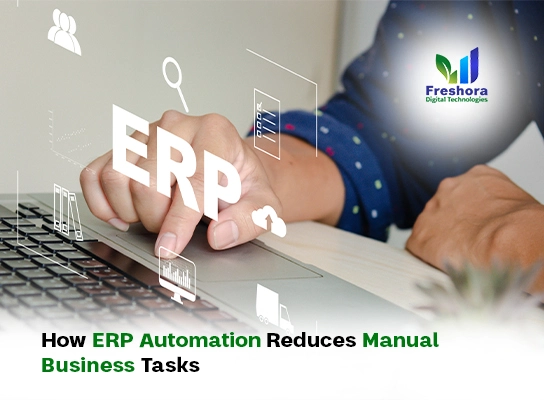
ERP automation is the use of ERP software to automate business processes that are traditionally handled manually.
An ERP system integrates different business functions such as:
Instead of using separate systems and manual spreadsheets, businesses can manage operations through a centralized platform.
Manual business processes often create challenges such as:
According to Gartner research, organizations increasingly adopt enterprise technologies to improve efficiency, automation, and decision-making capabilities.
Research from Deloitte Digital also highlights that digital transformation initiatives help businesses improve operational performance through better technology adoption.
ERP automation helps businesses move from reactive management to proactive decision-making.
One of the biggest benefits of ERP automation is reducing repetitive data entry.
In traditional systems, employees may manually enter:
ERP systems automatically synchronize information across departments, reducing duplicate work and improving accuracy.
For example, when a sales order is created, inventory levels and financial records can update automatically without separate manual entries.
Financial operations often involve large amounts of repetitive work.
ERP automation helps manage:
Automation reduces calculation errors and gives businesses better visibility into financial performance.
This allows finance teams to spend more time analyzing business growth instead of managing repetitive administrative tasks.
Inventory problems can affect customer satisfaction and business profitability.
ERP automation helps businesses monitor:
Real-time inventory information helps prevent:
For businesses managing products and supply chains, this creates better operational control.
HR and employee-related processes often require significant administrative effort.
ERP systems can automate:
Automation improves efficiency and allows HR teams to focus on employee development and organizational improvement.
Customer data is valuable for business growth.
ERP automation helps businesses manage:
A centralized customer view allows teams to provide faster and more personalized service.
Better customer management improves trust and long-term relationships.
Many businesses experience delays because approvals depend on manual communication.
ERP automation creates structured workflows for:
Automated workflows improve transparency and reduce unnecessary waiting time.
Before implementing ERP, businesses should analyze existing processes.
Identify:
Understanding current problems helps select the right ERP approach.
Businesses should evaluate ERP systems based on:
The right solution should support current operations and future growth.
ERP creates a connected environment where departments can share information.
Integration improves:
Successful ERP adoption depends on user understanding.
Businesses should provide:
Technology delivers value when employees can use it effectively.
ERP implementation is not the final step.
Businesses should continuously analyze:
Regular improvements ensure maximum ERP value.
|
Manual Business Process |
ERP Automation Approach |
|
Separate department systems |
Integrated business platform |
|
Repeated data entry |
Automated information flow |
|
Higher chance of errors |
Improved accuracy |
|
Slow reporting |
Real-time insights |
|
Manual approvals |
Automated workflows |
|
Limited visibility |
Centralized control |
ERP automation supports business growth by improving:
Employees spend less time on repetitive administrative work.
Automated systems reduce human errors and improve data consistency.
Real-time reports help leaders make informed decisions.
ERP systems help businesses manage increasing complexity as they grow.
Reducing manual processes lowers operational effort and improves resource utilization.
Small and medium businesses often face challenges managing growth with traditional systems.
As operations expand, businesses need better control over:
ERP automation provides the foundation for organized growth.
For businesses in Trichy and Tamil Nadu, adopting technology solutions such as ERP can support digital transformation and improve competitiveness in changing markets.
Freshora Digital Technologies helps businesses implement technology-driven solutions that improve efficiency, digital performance, and long-term growth.
ERP automation is transforming how businesses manage daily operations. By reducing manual tasks, improving accuracy, and connecting business functions, ERP helps organizations become more efficient and prepared for growth.
In a competitive digital environment, businesses need more than traditional processes. They need intelligent systems that support better decisions and faster operations.
Adopting ERP automation strategically can help businesses reduce complexity, improve productivity, and build a stronger foundation for sustainable digital growth.


In the fast-paced logistics landscape of Tiruchirappalli, efficiency is the difference between profi... Read More

In the heart of Tamil Nadu’s thriving commercial landscape, Trichy’s fashion industry is... Read More

Blog Summary Many business consultants build their reputation through referrals, networking, and lo... Read More
Our expert will call you shortly to understand your needs and help grow your business.
Get exclusive digital marketing tips, SEO insights, web & app updates, and job opportunities delivered straight to your inbox.
Join our WhatsApp channel for instant digital marketing tips, SEO insights, web & app updates, and latest job opportunities.
Join NowFreshora Digital Technologies proudly serves businesses across Tiruchirappalli (Trichy), including Cantonment, Puthur, Thillai Nagar, Palakarai, Subramaniyapuram, Mela Chinthamani, Woraiyur, KK Nagar, Karumandapam, Crawford, Edamalaipatti Pudur (EMP), Kattur, Airport Area, Ariyamangalam, Panjappur, Thuvakudi, Tiruverumbur, BHEL Township, Srirangam, Thiruvanaikaval, Samayapuram, No.1 Tollgate, Central Bus Stand Area, and Chathiram Bus Stand Area.
We also serve clients across Tamil Nadu, India, and globally in Singapore, the UAE, Saudi Arabia, Canada, Australia, the United Kingdom, and the United States, delivering innovative Website Development, Mobile App Development, Software Development, SEO, Google Business Profile Management, and Digital Marketing solutions that help businesses grow and succeed in the digital world.


