Contact our team for professional guidance and solutions.
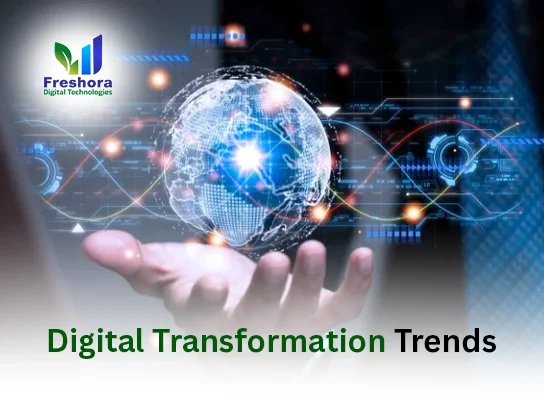
Digital transformation is no longer optional it’s essential for businesses that want to stay competitive in 2025. From small startups to large enterprises, companies are leveraging technology to improve efficiency, enhance customer experiences, and drive growth.
But what exactly are the digital transformation trends in 2025, and how can your business adopt them effectively? In this article, we explore the top trends shaping the future of business and technology.
1. Artificial Intelligence and Machine Learning Adoption
AI and machine learning continue to revolutionize business operations. In 2025, companies are increasingly using AI for predictive analytics, customer personalization, chatbots, and automated decision-making.
Example:
Retailers are using AI to predict buying behavior, recommend products, and optimize inventory, leading to improved customer satisfaction and increased revenue.
Businesses are moving away from traditional IT infrastructure and embracing cloud-native and multi-cloud solutions. This trend enables scalability, cost efficiency, and faster deployment of digital services.
Tip:
Consider migrating critical applications to a multi-cloud environment to improve resilience and avoid vendor lock-in.
To speed up digital transformation, companies are adopting low-code and no-code platforms. These tools allow employees without programming knowledge to build apps, automate workflows, and solve business challenges quickly.
Example:
A marketing team can use a no-code platform to automate lead capture and follow-ups without waiting for IT support.
As digital transformation accelerates, so do cybersecurity threats. Businesses are prioritizing security by implementing AI-driven threat detection, zero-trust architecture, and advanced encryption techniques.
Tip:
Regularly update security protocols and conduct employee training to reduce the risk of data breaches.
IoT adoption is growing across industries in 2025. Smart devices, sensors, and connected equipment are helping businesses gather real-time data, optimize operations, and deliver better customer experiences.
Example:
Manufacturing companies use IoT sensors to monitor machinery performance and prevent downtime.
Customers expect personalized experiences across digital channels. Businesses are leveraging AI, big data, and analytics to tailor offers, recommendations, and services to individual customer needs.
Tip:
Use customer data to create hyper-personalized marketing campaigns that drive engagement and loyalty.
RPA is transforming repetitive tasks such as invoice processing, data entry, and customer onboarding. By automating manual processes, businesses save time, reduce errors, and allow employees to focus on strategic work.
AR and VR are increasingly used for training, product visualization, and immersive customer experiences. Companies are integrating these technologies into their marketing, e-commerce, and internal operations.
Example:
Furniture brands use AR apps to let customers visualize how a product will look in their home before purchase.
In 2025, sustainability is a core part of digital transformation. Businesses are adopting green IT practices, energy-efficient cloud solutions, and eco-friendly digital workflows to reduce their carbon footprint.
Tip:
Highlight your sustainability efforts online it builds brand trust and attracts conscious consumers.
Data remains the backbone of digital transformation. Businesses are investing in analytics platforms, real-time dashboards, and AI insights to make smarter decisions and gain a competitive advantage.
Digital transformation in 2025 is about more than just adopting technology it’s about strategically using digital tools to drive growth, efficiency, and customer satisfaction.
From AI and cloud solutions to IoT, RPA, and AR/VR, these trends are reshaping how businesses operate. By staying ahead and embracing these innovations, your company can remain competitive, agile, and ready for the future.
Even small steps like adopting AI analytics, automating workflows, or enhancing cybersecurity can make a significant impact on your business.
Start your digital transformation journey today to stay relevant in 2025 and beyond.

Summary: Endpoint protection improves IT system reliability by securing devices such as compute... Read More

Summary:Reels help businesses stay relevant online by supporting trend-driven storytelling, consiste... Read More
Summary:Mobile apps improve customer engagement by enabling direct communication, personalised exper... Read More
Our expert will call you shortly to understand your needs and help grow your business.
Get exclusive digital marketing tips, SEO insights, web & app updates, and job opportunities delivered straight to your inbox.
Join our WhatsApp channel for instant digital marketing tips, SEO insights, web & app updates, and latest job opportunities.
Join NowFreshora Digital Technologies proudly serves businesses across Tiruchirappalli (Trichy), including Cantonment, Puthur, Thillai Nagar, Palakarai, Subramaniyapuram, Mela Chinthamani, Woraiyur, KK Nagar, Karumandapam, Crawford, Edamalaipatti Pudur (EMP), Kattur, Airport Area, Ariyamangalam, Panjappur, Thuvakudi, Tiruverumbur, BHEL Township, Srirangam, Thiruvanaikaval, Samayapuram, No.1 Tollgate, Central Bus Stand Area, and Chathiram Bus Stand Area.
We also serve clients across Tamil Nadu, India, and globally in Singapore, the UAE, Saudi Arabia, Canada, Australia, the United Kingdom, and the United States, delivering innovative Website Development, Mobile App Development, Software Development, SEO, Google Business Profile Management, and Digital Marketing solutions that help businesses grow and succeed in the digital world.


