Professional Services
Service descriptions, team information, case studies and enquiry forms that help prospective clients assess the business.

Websites planned around your Chennai customers, business goals and day-to-day operations
Your website is often where potential customers first evaluate your business. It should explain what you offer, answer important questions and make it straightforward for visitors to call, enquire, book or buy.
Freshora Digital Technologies develops websites for businesses in Chennai and across Tamil Nadu. Our work brings together information architecture, UI/UX, frontend and backend development, responsive layouts and search-friendly technical foundations.
We work on business and corporate websites, WordPress websites, online stores and custom website requirements. Depending on the agreed scope, a project can include Tamil and English content, enquiry forms, WhatsApp contact options, payment facilities or connections to existing business systems. Features are selected around the customer journey and the way your team will manage the website.
From our Adyar branch and through online collaboration, we keep project discussions, approvals and updates organised from initial planning to launch. The scope, deliverables and support arrangements are clarified before development begins.
We combine a local point of contact with website planning shaped around the way Chennai businesses attract and serve customers.
A service company, established organisation and online retailer need different website structures. The page hierarchy, content, calls to action and functionality should reflect what customers need to understand or complete.
We begin with the purpose of the website, the information customers need and the actions they should be able to take. This helps determine the right platform, page structure and features without adding unnecessary complexity.
Depending on the project, website functionality can also include responsive page layouts, landing pages, Tamil and English content, enquiry and booking forms, WhatsApp contact options, payment gateway connections and selected third-party integrations. More complex portals, APIs and application workflows should be scoped as separate technical requirements rather than treated as standard features of every business website.
For industry-specific considerations, our guides to restaurant website development in Chennai and logistics website development in Chennai show how functionality changes with the customer journey. The right technology is not the same for every business. Depending on your requirements, we can plan the website around a suitable CMS, custom development approach, e-commerce platform or web application architecture. The goal is to build something that is practical to manage today and able to support your business as it grows in Chennai and across Tamil Nadu.
The agreed scope guides the sitemap, interface, development work and testing. This keeps the build focused on the required customer experience and the practical needs of the team managing the website.
Before design begins, we establish the purpose of the website, the people it needs to serve and the tasks it must support. This early definition helps keep the project aligned with business priorities and prevents features from being added without a clear reason.
We clarify the required pages, content ownership, languages, enquiry or purchase journey, integrations and content-management needs. For Chennai businesses, this may also include local service information and the option to present content in Tamil and English.
The result is a defined project scope that can guide design, development, testing and launch. Platform and technology choices follow the requirements, not the other way around.
What must the website help the business do?
We review the business model, audience, services, existing website (if any) and the questions customers are likely to ask before making contact or purchasing.
This establishes the primary purpose and the actions the website should support.
Which pages and journeys are required?
We map the sitemap, navigation, page hierarchy, content requirements and calls to action. Where needed, we identify forms, product journeys, language versions and system connections.
The agreed structure gives the design and development stages a clear reference point.
Which platform and features fit the scope?
We implement the approved layouts and required functionality using a suitable CMS or development approach. Responsive behaviour, navigation, forms and agreed integrations are built into the implementation.
The build is checked across the screen sizes and devices relevant to the intended audience.
Does the website work as intended?
We test important pages, links, forms, navigation, responsive layouts and agreed integrations. We also review content presentation and key customer journeys before the website is approved for launch.
Any corrections are prioritised against the agreed scope and launch requirements.
A clear scope should identify the pages, content responsibilities, design requirements, functionality, integrations and launch tasks included in the project.
It should also clarify what the client needs to provide, who approves the design and content, how feedback will be handled and what post-launch support is included.
Agreeing these points early gives both teams a shared reference for progress and helps avoid assumptions about features or responsibilities.
Chennai businesses compete across a varied local market: professional services in Adyar and Nungambakkam, technology and B2B firms along OMR and Guindy, retailers in T. Nagar and Velachery, and healthcare and education providers across the city. A useful website should make services, location coverage, language options and contact routes clear without repeating the same location keywords on every page.
A Chennai-focused website should make the business location, service coverage, contact details and relevant service information easy to verify. These details should reflect the areas the business genuinely serves rather than repeating neighbourhood names without useful context.
Place the information customers need near the relevant service or product: what is offered, who it is for, how the process works and how to make an enquiry or purchase.
For a local service provider, this may include service coverage and contact options. For a retailer, it may mean product details, delivery information and checkout support. The content should match the actual customer journey.
Clear navigation, relevant page links and consistent business information help visitors move between those details without having to search repeatedly.
This approach keeps the website useful to customers while making its content easier for the business to maintain.

For established businesses, a website is an important part of their professional identity.
Our corporate website development in Chennai can present company information, services, expertise, industries, leadership, projects, certifications, achievements, locations and contact information.
The website can also be structured for future growth, making it easier to add services, industries, resources, case studies and multilingual content later.
E-commerce websites need to support the customer journey from product discovery through checkout and order management.
E-commerce architecture can be planned around the products, customers, operational workflow and target market.
A custom website is not necessary simply because a business wants a more professional design. For many companies, a well-configured CMS can handle everything they need. Custom development becomes more useful when the website has to support a business process that cannot be handled cleanly with standard themes, plugins or pre-built functionality.
For a Chennai business, this might mean customers need to follow different booking rules, employees need different levels of access, enquiries need to move into a CRM, prices need to be calculated from multiple conditions, or information needs to move between the website and another business system.
When a customer journey does not follow a simple enquiry or checkout process, the website can be built around the actual steps your business follows rather than forcing the process into a standard template.
Give customers, staff or administrators access to different information and actions through dashboards designed around their specific roles and responsibilities.
Connect website enquiries, customer information and other activities with CRM, ERP or internal systems when manually moving information between platforms becomes inefficient.
Integrate external services when the website needs to exchange live information with payment systems, software platforms, databases, logistics services or other business tools.
Build booking experiences around availability, locations, staff, services, schedules, pricing rules or other conditions that standard booking plugins may not handle comfortably.
Provide logged-in customers with access to information or actions such as requests, documents, bookings, account details, quotations or service updates.
Handle forms that require conditional questions, calculations, eligibility rules, quotations or different outcomes depending on the information a customer provides.
Control what different users can view or manage when customers, employees, managers, partners or administrators require different permissions within the same system.
If a business mainly needs company information, service pages, a blog, enquiry forms and straightforward content management, a CMS such as WordPress may provide a practical solution without the additional development involved in building everything from scratch.
Custom development becomes worth considering when standard functionality starts creating workarounds, unnecessary manual processes, limitations between systems or an experience that does not properly fit the way the business operates.
The right question is therefore not “Should we build custom?” but “What does the business actually need the website to do?” From there, the technology can be chosen around the requirement rather than the other way around.
SEO should not begin only after a website launches. Its architecture can affect how search engines understand pages, services and relationships between topics.
That is why Freshora considers SEO during website planning and development.
Local relevance comes from useful, accurate information—not from repeating the city name across every heading. We plan location references around the business's real address, service coverage, customer needs and relevant pages.
Clear page structure also helps people and search systems understand the information on a website. Useful headings, direct explanations and accurate business details are a sound foundation for traditional search and newer answer experiences.
Where relevant to the project, we consider Answer Engine Optimization (AEO) and Generative Engine Optimization (GEO) principles as part of content organisation—not as a guarantee of visibility in any particular AI platform.
No development company can guarantee a particular Google ranking or AI search result. Clear, useful and well-structured information simply gives search and answer systems better material to understand.
Chennai businesses may need to serve customers who prefer Tamil or English. Where needed, Freshora can plan Tamil and English website structures around the project requirements, including readable typography, clear language switching and translated navigation.
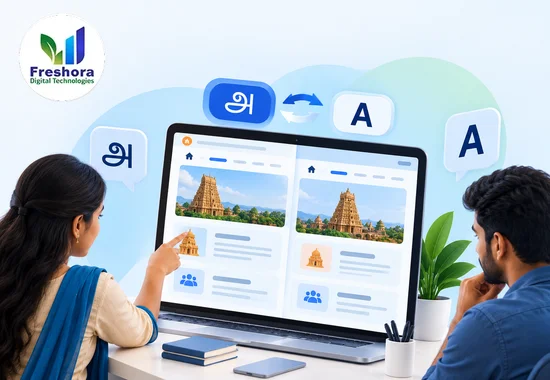
Many customers research businesses on smartphones, so websites need to work smoothly across mobile, tablet and desktop devices.
A visitor should be able to understand the business and take the next step without struggling with the website.
The examples below show common website requirements across different business types. The final page structure and functionality are defined by each client's products, services, audience and operating process.
Service descriptions, team information, case studies and enquiry forms that help prospective clients assess the business.
Property information, listing categories, search filters and enquiry journeys for buyers or tenants.
Service pages, genuine service-area details, quote requests and clear contact options.
Product categories, product details, search, checkout and order-related customer journeys.
Course and programme information, admission details, enquiry forms and downloadable resources.
Practice information, doctor or department profiles, treatment details and appointment enquiries.
Service information, shipment-related enquiries, quotation requests and business contact paths.
Product and capability information, industry applications, technical resources and B2B enquiries.
If you already have a website, redevelopment does not always mean starting from zero. First, we identify what is working and what needs improvement.
Before redevelopment, Freshora can review:
During redevelopment, valuable URLs and existing search signals should be considered. Where URLs change, redirects and other technical configurations should be planned carefully.
A website project involves more than designing pages and putting them online. Each stage builds on the previous one so that the final website reflects the agreed business requirements and provides a practical experience for customers.
We review the business requirements, target audience, services, content, functionality and technical considerations to establish what the website needs to achieve.
We organise the sitemap, navigation, page hierarchy, content requirements and key customer journeys. Competitor and search-intent research can inform the structure where it is part of the agreed scope.
We create the visual direction and page layouts around the brand, content and intended user experience, with responsive behaviour considered from the beginning.
The approved design and planned functionality are developed into the working website, including required CMS features, forms, integrations and custom functionality.
Before launch, we check important pages, forms, links, responsive layouts, integrations and key user journeys. After approval and the required technical configuration, the website is deployed and the agreed access, handover information and support arrangements are shared.
Freshora has a branch in Adyar, Chennai. We combine local discussions where useful with online collaboration, documented requirements, design reviews and development updates so project decisions remain clear throughout delivery.
Depending on the project, communication can include:
The working arrangement is agreed at the start of the project so the client knows how reviews, approvals and communication will be handled.
These are Freshora-wide company figures across our digital services and project work. They represent the broader organisation, not website projects completed exclusively for Chennai businesses.
We work with businesses to understand their requirements and develop digital solutions suited to their goals.
Our project delivery experience helps us approach different requirements with a focus on planning, functionality and execution.
We understand that each industry has different customer expectations, workflows and technical requirements.
Our team brings together skills across development, design and digital technologies to support different project requirements.
We serve clients across multiple countries, adapting our work to different business needs and markets.
We deliver digital solutions to businesses across cities, helping them strengthen their digital presence and support their growth.
The cost depends on the number of pages, design requirements, content, CMS, e-commerce features and integrations. A simple business website and a custom portal have very different scopes. Share your requirements or use our website cost calculator to estimate a starting budget.
A small business website usually takes less time than a large corporate website, online store or custom web application. The timeline depends on the agreed scope, content readiness, integrations and how quickly feedback is provided. We confirm the schedule after understanding the requirements.
We plan responsive layouts, readable content, mobile-friendly navigation, clean URLs, page titles, meta descriptions, heading structure and crawlable pages. Technical setup helps search engines understand the website, but rankings depend on competition, content quality, authority and many other factors.
We first review existing URLs, valuable pages, search traffic, metadata and internal links. If URLs or page content need to change, we plan relevant redirects and technical checks before launch. No redesign can guarantee that rankings will remain exactly the same, but careful migration reduces avoidable risks.
Yes. We can plan Tamil and English content, language switching, readable Tamil typography, translated navigation and language-specific metadata. The right setup depends on whether both languages need the same pages and how your team will maintain translations.
Yes. Depending on your workflow, we can plan WhatsApp enquiry options, CRM connections, booking forms, payment gateways, analytics and third-party APIs. We identify the required systems and any subscription or provider charges during planning.
We can arrange ongoing updates and technical support based on the platform, security needs, content changes and agreed scope. Before launch, we clarify what is included, who manages hosting and domain renewals, and how future changes will be handled.
Whether you are launching a business website, improving an existing site, selling products online or planning a more advanced website experience, the right starting point is understanding what your business and customers actually need.
Freshora can help define the website structure, required functionality and technical approach around those needs, with clear communication through planning, development, testing and launch.
Tell us what you are planning, what you want to improve or what your current website is not doing well. We can discuss the requirements and identify a practical way forward.
Get exclusive digital marketing tips, SEO insights, web & app updates, and job opportunities delivered straight to your inbox.
Join our WhatsApp channel for instant digital marketing tips, SEO insights, web & app updates, and latest job opportunities.
Join NowFreshora Digital Technologies proudly serves businesses across Chennai, including T. Nagar, Anna Nagar, Adyar, Velachery, Guindy, Nungambakkam, Mylapore, Alwarpet, Egmore, Kilpauk, Perambur, Porur, Ambattur, Avadi, Mogappair, Arumbakkam, Vadapalani, Ashok Nagar, KK Nagar, Saidapet, Tharamani, OMR, Sholinganallur, Perungudi, Medavakkam, Pallikaranai, Tambaram, Chromepet, Pallavaram, Guindy Industrial Estate, Ekkatuthangal, Mount Poonamallee Road, Thoraipakkam, Navalur, Siruseri, Kelambakkam, Poonamallee, Kundrathur, Madhuravoyal, Kolathur, Ayanavaram, Royapettah, Triplicane, George Town, Royapuram, Washermanpet, Thiruvanmiyur, Besant Nagar, Neelankarai, Injambakkam, and ECR.
We also serve clients across Tamil Nadu, India, and globally in Singapore, the UAE, Saudi Arabia, Canada, Australia, the United Kingdom, and the United States, delivering innovative Website Development, Mobile App Development, Software Development, SEO, Google Business Profile Management, and Digital Marketing solutions that help businesses grow and succeed in the digital world.

