Listen to Ria Hi everyone, This is Ria... Ria's Message Hey everyone! I'm Ria... Your Business Dreams Every business has a dream... For Business Owners Hello business owners, naan Ria... Brand Building Hi enoda peru Ria! For Your Website Vanakkam everyone! Naan Ria... Start Your Digital Journey Hey everyone! Unga business-ku... Listen to Ria Hi everyone, This is Ria... Ria's Message Hey everyone! I'm Ria... Your Business Dreams Every business has a dream... For Business Owners Hello business owners, naan Ria... Brand Building Hi enoda peru Ria! For Your Website Vanakkam everyone! Naan Ria... Start Your Digital Journey Hey everyone! Unga business-ku...

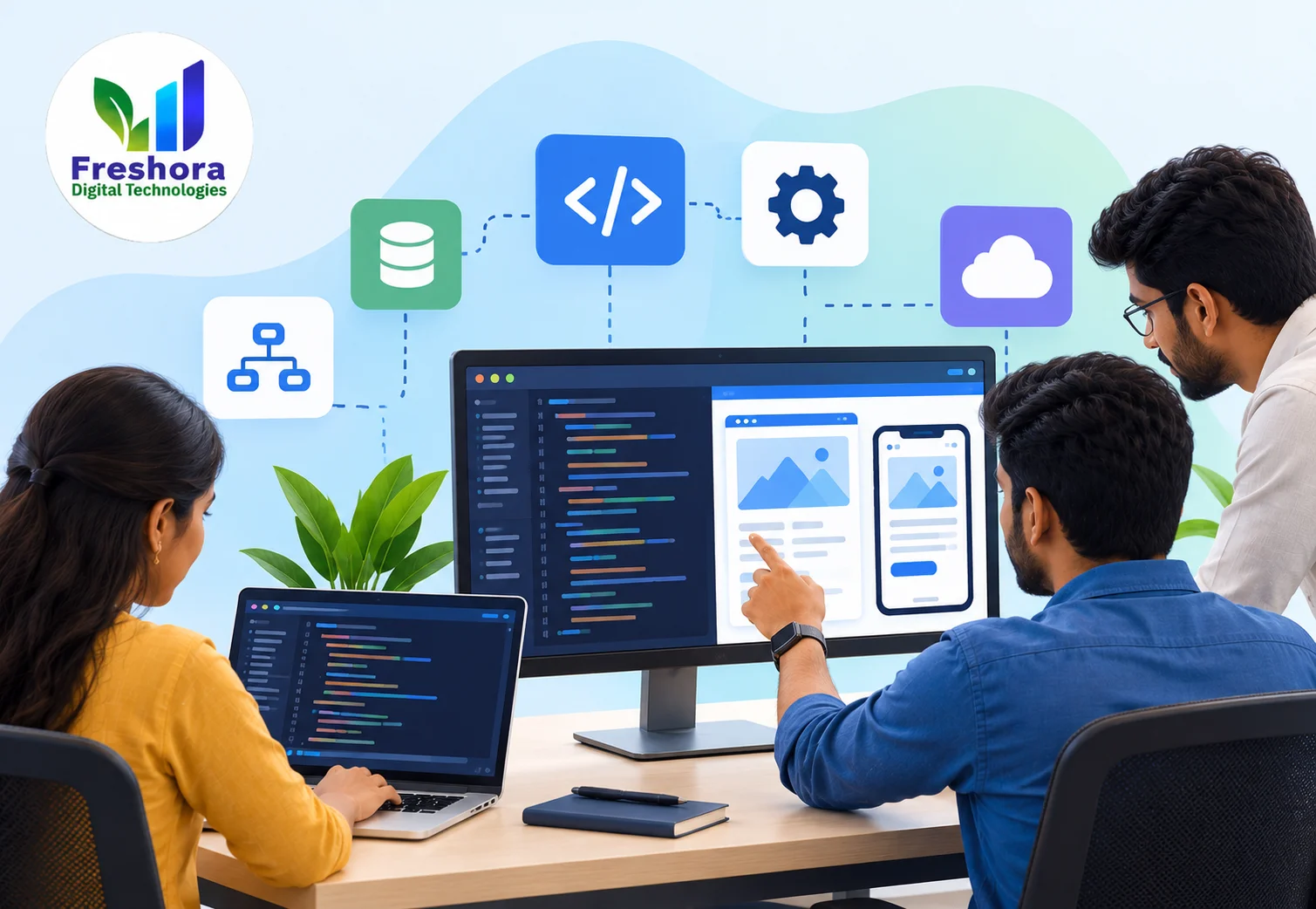
Software Development
Custom Software for Chennai Businesses

Software Development Company in Chennai

Custom business software built around your workflows, teams and operational requirements

Freshora Digital Technologies provides software development services in Chennai for businesses that need more control over daily operations, connected information and repeatable processes. We plan each solution around the work your team needs to complete, the data it uses and the decisions the system should support.

Our work can include custom business applications, enterprise systems, CRM and ERP-connected workflows, inventory and order management, reporting dashboards and SaaS products. We begin by understanding your users, existing tools and business rules rather than starting with a fixed feature list.

From requirement mapping and interface design to databases, permissions, integrations and reporting, we plan the parts that make the software useful in everyday work. The agreed scope also defines testing, deployment, documentation, handover and any continuing support.

For a SaaS team around OMR, a manufacturer near Ambattur or a service business operating across Chennai, purpose-built software should reduce avoidable data entry, clarify responsibilities and make important information easier to access. We prioritise practical functionality, maintainable implementation and a first release that fits the agreed requirements and budget.

Custom and enterprise software development for Chennai businesses

What Is Custom Software Development?

Software Designed Around a Specific Business Need

Custom software is designed around an organisation’s specific workflows, business rules and data. It can support sales, inventory, purchasing, production, finance, service delivery, staff administration or reporting when existing tools cannot handle the required process efficiently.

For example, a distributor may manage stock in one system, orders in spreadsheets and customer updates through calls or messages. A suitable application can bring selected steps into one workflow, reduce repeated entry and show the current order status. A larger organisation may also need approval limits, branch-level reporting and connections to existing ERP or accounting tools.

Software development differs from a standard business website. The central work is defining data relationships, calculations, permissions, validations and integrations so people can complete operational tasks consistently. A website mainly presents information or services; business software supports internal or customer-facing processes.

We separate essential requirements from optional features and choose the simplest maintainable approach that meets the need. Depending on the situation, that may mean configuring an existing platform, integrating systems or building custom software for workflows that genuinely require it.

Custom and Enterprise Software Development Services

Our software development services in Chennai cover practical tools for daily operations as well as larger systems that support multiple teams. We agree the business outcome and the first-release scope before deciding which features should be built.

Custom Business Software

Bring selected operational tasks into one application, from job tracking and quotations to records, reports and approvals. The modules are defined around the process your team needs to manage.

CRM and Sales Operations

Manage enquiries, follow-ups, customer history, quotations and sales stages in a shared workflow. User permissions and reminders can be scoped around how your sales team works.

Enterprise Software Systems

Connect selected departments and branches through shared records, defined workflows and role-based access. Reporting requirements are agreed around the information managers need to review.

Inventory and Order Management

Manage product records, stock movements, purchase requests, orders and fulfilment steps with business rules that reflect the way stock is received, transferred and issued.

SaaS and Product Development

Plan a first product release around a defined user problem, core features and access roles. A phased roadmap can help validate the product before additional modules are considered.

Management Dashboards and Reporting

Bring selected operational data into reports and dashboards with agreed definitions, filters and date ranges, so managers can review performance using consistent information.

Workflow and Approval Automation

Define owners, validation rules, due dates and approval steps for processes such as purchasing, service requests and internal reviews. Automation should follow documented business rules.

Integrations and Legacy Modernisation

Connect systems that need to exchange information and modernise only the parts that no longer meet operational needs. A staged approach may be more practical than replacing every system at once.

Software Architecture and Technical Planning

Choose an Approach That Fits the Work, Data and Future Maintenance

We plan the application around its purpose, expected users, data structure, permissions, reporting needs and systems that must exchange information. The aim is to meet the current requirement without introducing technical complexity the business does not need.

Depending on scope, the solution may include user interfaces, backend processing, database design, APIs, authentication, activity history, notifications and reporting. Each component should have a clear role and be documented sufficiently for future maintenance.

Maintainability is considered alongside delivery through readable implementation, documented decisions, appropriate access controls and a deployment approach that can be supported. Third-party services, licence requirements and integration dependencies should be identified during planning.

✓ User Interface
Screens, forms, dashboards and navigation shaped around the people who use the software and the actions they need to complete.
✓ Business Logic
Rules, validations, calculations, permissions and workflow steps that keep software behaviour consistent.
✓ Data Model
Clearly structured records for customers, products, orders, tasks and history, with data quality considered from the start.
✓ Integration Layer
Defined connections to approved third-party tools, accounting platforms, payment services and existing business systems.
✓ Permissions and Audit
Access controls and activity history based on each user’s role and the sensitivity of the information.
✓ Modular Design
Functional areas separated sensibly so new reports, workflows or departments can be added with less disruption.
Custom and enterprise software development for Chennai businesses

Business Roles, Permissions and Accountability

Keep Data Access Aligned With Each Person’s Responsibility

Business software rarely serves just one type of user. A sales executive may update a lead, a supervisor may approve a quotation, an accounts user may reconcile an invoice and an administrator may manage settings. Those roles should not all receive the same access.

We map access to job responsibilities, data sensitivity and the actual approval path. This helps reduce accidental changes and makes it clearer who can view, create, approve or export important records.

  • Customer access
  • Employee access
  • Manager permissions
  • Administrator controls
  • Department-level access
  • Branch-level access
  • Module permissions
  • Approval permissions

Where required, we also consider branch-specific records, activity logs and handover procedures so your team can administer the system after launch.

Integrating Software With Your Existing Tools

Reduce Duplicate Entry Without Replacing Every System

Many projects do not start from zero: a business may already use accounting software, a CRM, payment services or a warehouse system. We check what each platform can reliably share and where integration is more practical than rebuilding an existing function.

Integration scope is agreed before development, including which system is the source of truth for each record, how errors are handled and whether information moves instantly or on a schedule.

For example, a sales enquiry can create a CRM record, an approved order can pass to accounting, or a management dashboard can combine information from agreed sources. We test these flows against real scenarios, not just a successful demo.

✓ CRM integrations
✓ ERP integrations
✓ Payment gateway connections
✓ Email and communication services
✓ Third-party application APIs
✓ Database connections
✓ Business system data exchange
✓ Webhook-based integrations

Security, Performance and Scalability

Software has to remain dependable as records, users and business rules increase. We plan security, performance, error handling and maintainability as part of delivery, with controls matched to the type of data and the risk involved.

Authentication and Access Control

Apply authentication and least-privilege access so users can reach the modules and records their work requires.

Data Protection

Identify sensitive records, limit unnecessary access and define how data is stored, exported, backed up and exchanged with connected services.

Performance

Review slow queries, repeated processing, large reports and integration delays so they can be addressed at the right layer.

Scalable Structure

Choose an architecture that can accommodate realistic growth without paying for needless complexity at the start.

Application Monitoring

Use appropriate logging and monitoring to help the team investigate errors and understand important failures after release.

Testing

Test role permissions, data validation, calculations, failure cases, backups and integrations—not only the ideal user journey.

When Does Custom Software Make Business Sense?

Build Around a Real Bottleneck, Not Just a Desire for New Technology

Custom software makes sense when an important process is difficult to manage with existing tools, when the same information is repeatedly entered, or when off-the-shelf systems cannot represent your business rules without fragile workarounds.

Before building, list the problem, who experiences it, how often it happens and what a better process would change. If a simple configuration or integration solves the issue, that may be the more sensible investment. Custom development is most useful when the workflow genuinely needs it.

Repeated Manual Work

The same data is copied between sheets, emails and systems, creating avoidable rework or mistakes.

Rules That Off-the-Shelf Tools Cannot Fit

Your pricing, approvals, assignment or reporting rules require repeated workarounds in standard software.

Unclear Ownership or Handoffs

Requests get delayed because no one can see who owns the next step or whether an approval is still pending.

Fragmented Reporting

Managers spend too long merging reports or cannot trace a number back to its source.

Systems That Do Not Share Data

Teams re-enter the same customer, order or transaction information in multiple products.

A Product or Process You Own

Your service model or product relies on a workflow that is central to how the business competes.

A practical starting point is a focused first release: automate the most costly or error-prone part of the process, measure what changes and expand only when users and results justify the next phase. When comparing a software development agency in Chennai, ask for clear deliverables, acceptance criteria, integration responsibilities, source-code and data ownership terms, and a post-launch support plan—not just a list of technologies.

Software Development for Chennai Businesses

Plan Around the Operational Needs of Chennai Businesses

Chennai businesses work across technology, manufacturing, logistics, healthcare, education, retail and professional services. Their software requirements can differ significantly: one team may need enquiry and customer records, while another needs stock control, purchase approvals, service scheduling or management reporting. The system should reflect the operation rather than rely on a generic industry template.

For example, a SaaS team around OMR or Taramani may need subscription and customer workflows; a manufacturer in Ambattur or Guindy may prioritise production, stock and purchasing; a distributor may need order visibility across sales and accounts. These are starting points for requirements discovery, not fixed solutions for every business in an industry.

When evaluating an enterprise software development company in Chennai, look beyond coding capability. A project may need to reconcile legacy data, standardise processes between departments and connect systems introduced at different times. These dependencies should be mapped before deciding whether to integrate, improve or replace existing tools.

Freshora has a Chennai branch in Adyar for local business discussions. We can work with teams across Chennai through agreed consultations and online project reviews. The scope is defined around the existing process, data and systems the business relies on.

✓ Branch and Location Requirements
Plan the data and permissions needed when staff, warehouses, branches or customer groups work across locations.
✓ Team-Specific Permissions
Separate the information and actions available to sales, operations, finance, managers and administrators.
✓ Customer and Supplier Journeys
Support the different records, approvals and communication steps required for customers, vendors and internal teams.
✓ Operational Reporting
Use clear definitions, filters and source records so managers can act on consistent information.
✓ Data Migration
Plan the transfer and checking of existing spreadsheet or system data before teams switch to the new workflow.
✓ Connected Business Systems
Connect CRM, ERP, accounting, payment and other approved tools when the integration is useful and supported.

Software Project Scope, Ownership and Handover

Know What Will Be Delivered Before Development Begins

A software proposal should explain more than the list of screens or modules. It should make the project responsibilities, acceptance conditions and handover expectations clear. The exact deliverables depend on the agreed project scope, but these are important areas to define before development.

✓ Requirements and Module Scope
Document the users, workflows, business rules, included modules and items reserved for a later release.
✓ Data and Migration Plan
Identify source systems, required fields, data quality checks, sample imports and reconciliation responsibilities.
✓ User Access and Security
Define roles, permissions, authentication requirements and how sensitive records should be accessed.
✓ Integrations and Dependencies
Record the systems, APIs, subscriptions, credentials and third-party responsibilities required for the solution.
✓ Testing and Acceptance
Agree test scenarios, expected results, approval responsibilities and the conditions for accepting each release.
✓ Deployment and Handover
Clarify hosting, deployment access, documentation, source-code arrangements, backups and any user training included.
✓ Support and Maintenance
Define the support period, issue reporting process, update responsibilities and how future enhancements will be estimated.
✓ Ownership and Access
Confirm ownership and access arrangements for project code, data, domains, cloud accounts and third-party services in the contract.

Our Software Development Process

A Defined Path From Requirements to Release and Ongoing Support

We keep the project tied to agreed business requirements, with deliverables and review points at each stage. This helps identify assumptions early and avoid adding features without understanding their impact on cost or delivery.

1

Discovery

We document the current process, pain points, users, data sources and success criteria. The output is an agreed problem statement and a list of requirements to validate with your team.

2

Software Structure

We map modules, permissions, data fields, reports, integration points and the minimum scope for the first release. This becomes the reference for design, estimates and acceptance criteria.

3

Interface Design

We design key screens and task flows with the people who will use them. Your team can review navigation, forms and workflow decisions before full development begins.

4

Development

We develop the agreed features in stages, checking business rules, data handling and integrations as the system takes shape. Working reviews help identify requirement gaps early.

5

Testing and Launch

We test typical tasks, permissions, validation, edge cases and data accuracy, then prepare deployment and handover against the agreed acceptance criteria.

6

Support and Improvement

After launch, we can address agreed support needs, investigate issues, collect user feedback and plan improvements based on operational priorities. The support arrangement is defined before release.

Why Choose Freshora for Software Development in Chennai

Business Requirements, Maintainable Development and Clear Delivery Responsibilities

We start with the process the software must improve, then define the modules, business rules, integrations and acceptance criteria. Project reviews, testing and handover are planned around the agreed scope so your team understands what has been delivered and how it should be maintained.

As a software development company serving Chennai businesses, we consider interface usability, data, integrations, reporting and ongoing administration together. We also discuss when an existing product, integration or smaller first release may be more sensible than a large custom build.

275+ Businesses Trust Us

We work with businesses across different growth stages and focus each engagement on the operational problem, user needs and agreed outcome.

575+ Successful Project Deliveries

Our delivery experience helps us treat implementation, testing and handover as connected parts of a project rather than isolated tasks.

35+ Industries Served

Experience across different industries helps us ask better questions about sector-specific workflows without assuming two businesses operate alike.

42+ Skilled Professionals

Our multidisciplinary team brings development, interface experience, integrations and digital requirements together when the project calls for them.

Serving Clients Across 8+ Countries

Our international client work has helped us structure project communication, reviews and deliverables for teams working across different markets.

Digital Projects Across 15+ Cities

Our wider digital project work spans multiple cities, with communication and review arrangements planned around each engagement.

These figures describe Freshora-wide company experience across its digital services and project delivery; they are not a count of software-only projects. For software engagements, we recommend comparing providers on requirements discovery, technical decisions, data migration, testing, ownership, documentation and post-launch support.

Software Development Questions

Frequently Asked Questions

Can you replace spreadsheets and manual processes with custom software?

Yes. We can map how your team handles records, approvals and hand-offs, then scope a system to centralise the steps that matter. We recommend automating a process only after its rules and exceptions are understood.

Should we customise existing software or build a new system?

We compare your workflow with what existing products can already do, including configuration, integration, licence cost, data access and future flexibility. If a product can meet the need with sensible changes, a new build may not be necessary.

Can you migrate data from our current software or spreadsheets?

Data migration can be scoped for supported databases, spreadsheets and existing systems. We identify fields, check duplicates, validate sample imports and reconcile the final transfer. The source format and data quality determine the work involved.

How do you estimate the cost of a software project?

We estimate after reviewing users, modules, business rules, reports, integrations, migration and security requirements. The proposal should state what the first release includes and separate optional future features, making the scope and investment easier to assess.

Can the software grow as our team and operations expand?

We can plan modules, permissions, data structures and integrations so the system can evolve as requirements change. The architecture should match realistic growth and the project budget rather than adding complexity the business does not currently need.

What support is available after the software goes live?

Support can cover updates, issue investigation, agreed defect fixes, user feedback and future improvements. We define the handover materials, support scope and responsibilities before launch so your team knows how the system will be maintained.

Discuss Your Custom Software Requirements

Freshora Digital Technologies develops custom business software for Chennai companies that need to improve workflows, connect operational data or replace manual processes with a system planned around their requirements.

We work with you to define the problem, prioritise the first release and document the data, user roles, integrations and reports required. The aim is to deliver software that supports the people doing the work and can be maintained by the responsible team.

Tell us where work is slowing down, what information is difficult to track and which systems your team already uses. These details help establish whether custom development, integration or an existing platform is the most practical next step.

Join Our WhatsApp Channel 💬

Join our WhatsApp channel for instant digital marketing tips, SEO insights, web & app updates, and latest job opportunities.

Join Now
Areas We Serve

Serving Businesses Across Chennai, India & Worldwide

Freshora Digital Technologies proudly serves businesses across Chennai, including T. Nagar, Anna Nagar, Adyar, Velachery, Guindy, Nungambakkam, Mylapore, Alwarpet, Egmore, Kilpauk, Perambur, Porur, Ambattur, Avadi, Mogappair, Arumbakkam, Vadapalani, Ashok Nagar, KK Nagar, Saidapet, Tharamani, OMR, Sholinganallur, Perungudi, Medavakkam, Pallikaranai, Tambaram, Chromepet, Pallavaram, Guindy Industrial Estate, Ekkatuthangal, Mount Poonamallee Road, Thoraipakkam, Navalur, Siruseri, Kelambakkam, Poonamallee, Kundrathur, Madhuravoyal, Kolathur, Ayanavaram, Royapettah, Triplicane, George Town, Royapuram, Washermanpet, Thiruvanmiyur, Besant Nagar, Neelankarai, Injambakkam, and ECR.

We also serve clients across Tamil Nadu, India, and globally in Singapore, the UAE, Saudi Arabia, Canada, Australia, the United Kingdom, and the United States, delivering innovative Website Development, Mobile App Development, Software Development, SEO, Google Business Profile Management, and Digital Marketing solutions that help businesses grow and succeed in the digital world.

WhatsApp Chat Button Call Button

Website Audit Free

F
R
E
E

A
U
D
I
T

R
E
P
O
R
T