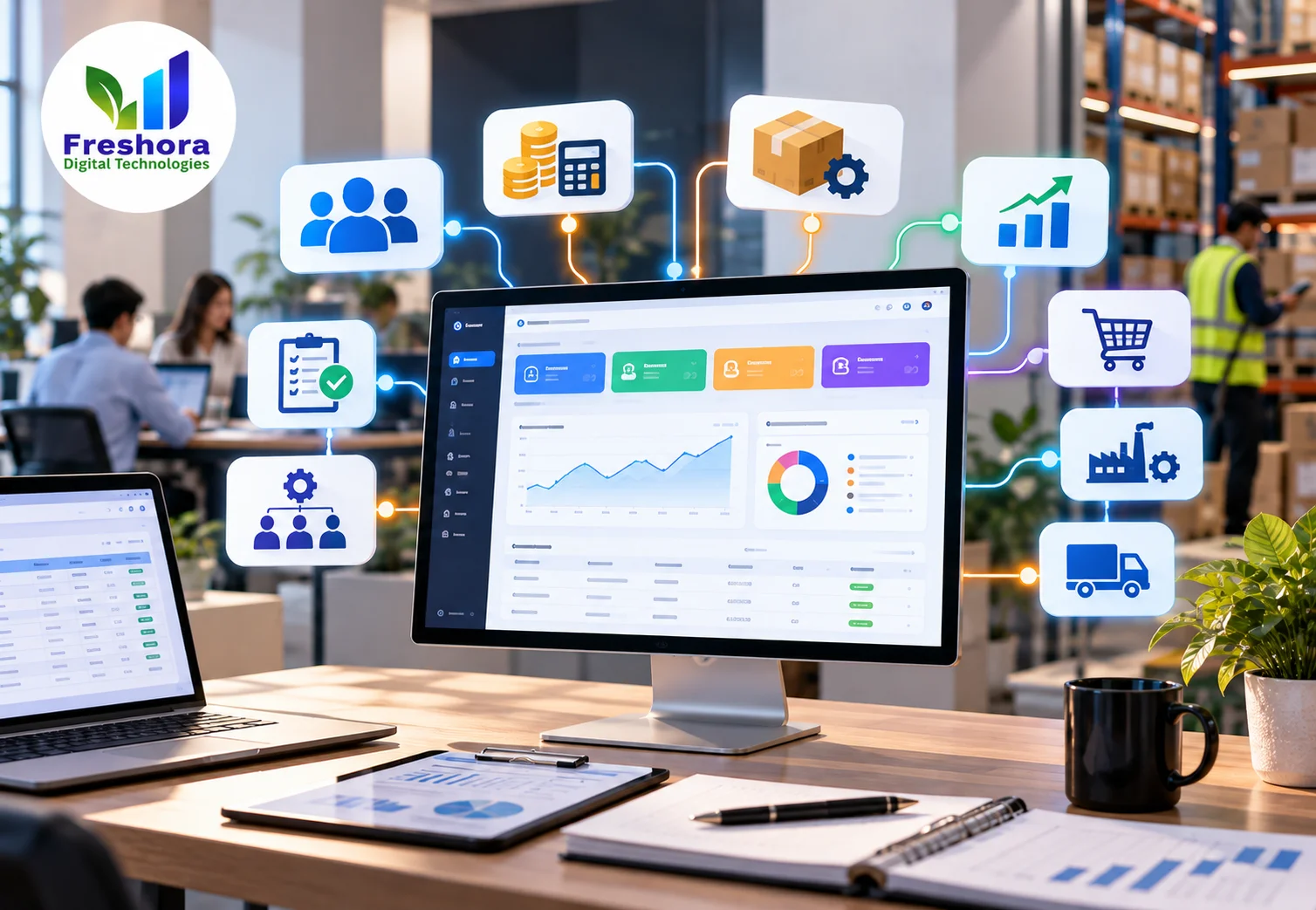
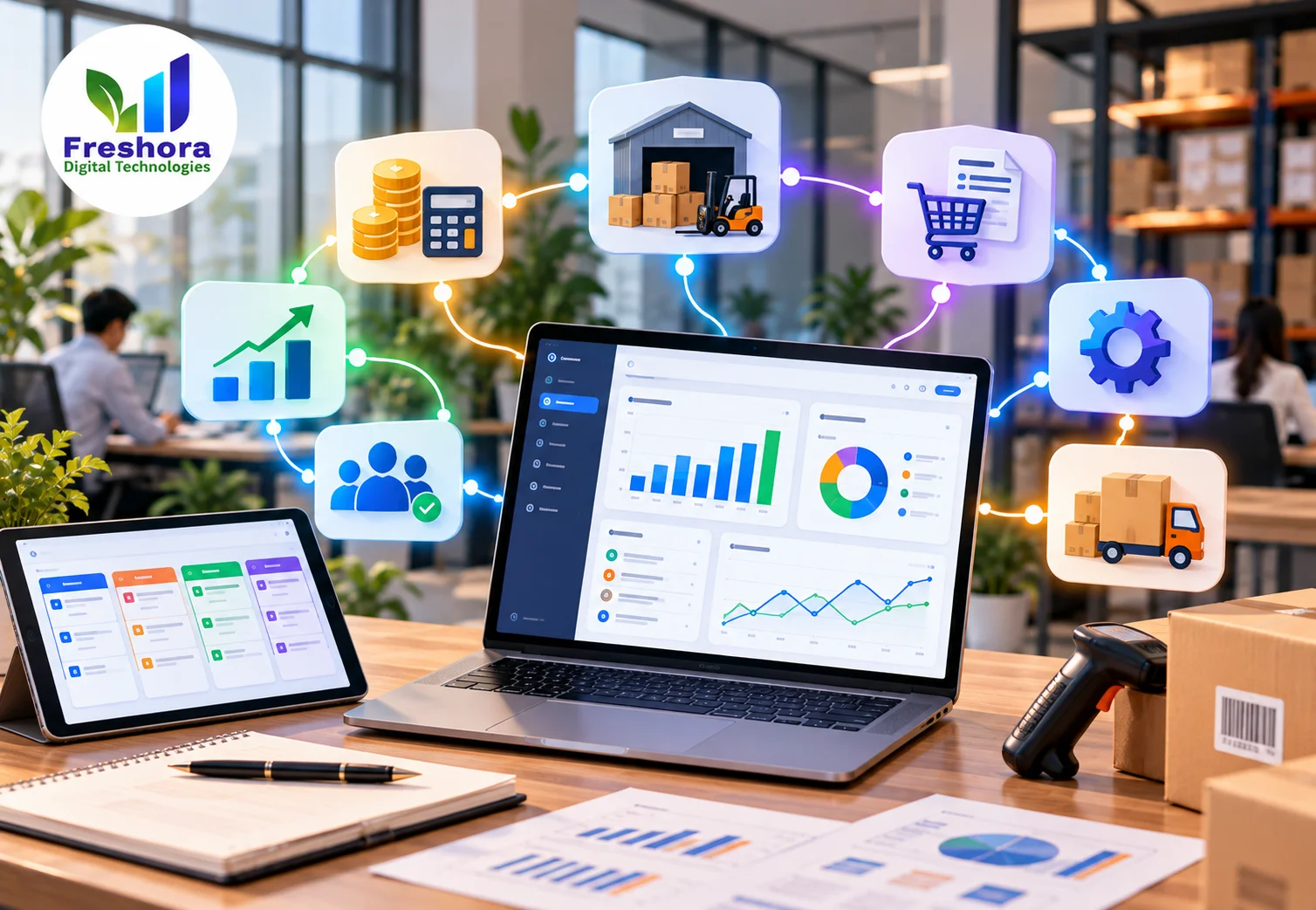
Connect the business. Simplify the work. Give your team one reliable view of operations.
Freshora develops ERP software for Singapore businesses that need finance, purchasing, inventory, sales, HR, approvals and reporting to work from connected data instead of separate spreadsheets and systems.
We design the ERP around the way your team actually works — whether that means a finance team in the CBD, a warehouse in Tuas, a distribution operation near Changi, or a multi-outlet retail or F&B business serving customers across Singapore.
Our software development services in Singapore give ERP projects the engineering foundation for secure workflows, integrations, role-based access and practical reporting. For genuinely business-specific processes, our custom software development team can extend the ERP around your requirements.
The best ERP is not the one with the longest feature list. It is the one that makes everyday work easier for the people using it. Freshora plans ERP software around the transactions, approvals, records and decisions your business depends on.
IMDA's Singapore solution guidance covers ERP capabilities such as sales, purchasing, accounting, inventory, distribution, customer relationship and workforce management. We use that operational view as a useful baseline, then shape the actual system around the client's workflow rather than forcing the business into a generic process.
ERP projects become expensive when companies start coding before agreeing on how information should move through the business. We start with the workflow, ownership and reporting needs first.
We map the current flow of sales, purchases, stock, finance, people, approvals and reporting.
We define modules, roles, records, permissions, approval states, integrations and the main business rules.
We develop the ERP in practical modules so teams can review real workflows instead of abstract screens.
We test the system with real scenarios, refine bottlenecks and prepare the platform for day-to-day use.
If a salesperson still copies an order into a spreadsheet, a warehouse still re-enters stock data, or management still waits for a manual report, the ERP is not solving the real problem.
We focus on connected workflows so an action in one part of the business can update the next step cleanly — with the right permissions, notifications and records.
Our article on how ERP streamlines business workflows and operations explains the same principle in practical terms.
Singapore businesses operate across compact but very different business environments. A single ERP may need to support office teams, outlets, warehouses, field staff, suppliers and management from one system.
IMDA reported that 95.1% of Singapore SMEs adopted at least one digital area in 2024, while the average SME adopted 2.3 digital areas. For ERP projects, that means integration matters as much as the ERP itself.
We therefore look at the systems around the ERP too: accounting, CRM, e-commerce, POS, payment tools, HR platforms and internal applications. The goal is a connected operational view without forcing every existing system to be discarded.
Finance needs clean transactions. Sales needs current pricing and customer records. Purchasing needs supplier and order visibility. Operations needs stock and delivery status. Management needs reliable reports.
An ERP brings those workflows together so information can move from quotation to order, purchase to receipt, stock to sale and transaction to report with less duplicate entry.
For deeper inventory planning, see our guide on how ERP improves inventory and resource management.
Standard ERP packages are useful for many businesses. Custom ERP becomes valuable when important processes do not fit standard screens, approval rules or data structures.
Build around unique operational steps instead of making teams create workarounds.
Route purchases, discounts, expenses or internal requests by role, value or department.
Give management one view while allowing outlets, warehouses or departments to see the information relevant to them.
Show the KPIs that matter to your business rather than forcing managers through generic reports.
Replace fragile manual processes or extend an existing ERP without rebuilding everything at once.
Give approved users access to orders, documents, status information or other controlled workflows.
We recommend custom development where it solves a real business need. Our aim is to keep the core system maintainable while adding the workflows that create measurable operational value.
For projects that sit between packaged ERP and fully bespoke software, our custom software development services provide a useful route for targeted modules and business-specific applications.
ERP should not become another isolated platform. Freshora plans integrations around the actual flow of information between systems, with clear ownership of each record and transaction.
Singapore's InvoiceNow network uses the Peppol standard, and IRAS is implementing GST InvoiceNow requirements in phases. We can plan ERP and accounting integrations around the selected InvoiceNow-ready solution and the business's applicable timeline rather than treating invoicing as an isolated feature.
For broader integration planning, see why ERP integration is essential for business automation.
ERP platforms hold important business information, so permissions and data handling need to be designed alongside the workflows. For Singapore operations, ERP data planning should take applicable PDPA obligations into account when personal data is processed.
Security is not a single checkbox. We consider access, data flow, application logic, integrations, hosting, backups and user roles together so the ERP remains manageable as the organisation grows.
Singapore's compact business landscape includes corporate offices, industrial parks, logistics hubs, retail locations and service businesses. ERP workflows should reflect the industry instead of treating every company the same.
Production planning, purchasing, inventory, job costing, quality and management reporting.
Sales orders, supplier management, stock control, fulfilment, pricing and delivery visibility.
Multi-outlet sales, stock movement, purchasing, expenses, staff workflows and consolidated reporting.
Jobs, customers, vehicles, documents, billing, operations and branch-level visibility.
Projects, timesheets, billing, expenses, approvals, clients and management dashboards.
Projects, procurement, workforce records, costs, approvals and operational tracking.
Controlled records, scheduling, billing, staff workflows and operational reporting.
Purchasing, supplier data, stock, sales, documents, currency and operational reporting.
Projects, subscriptions, finance, people, approvals, customers and connected reporting.
A full ERP replacement is not always the best first move. If the current platform contains valuable records or still handles part of the business well, we can review the gaps and plan a staged improvement.
This approach is especially useful for growing businesses that have outgrown spreadsheets but are not ready to disrupt the whole operation at once.
Our guide on choosing an ERP system for business processes covers the practical questions to ask before committing to a platform.
We keep ERP delivery structured so stakeholders can see how the system is taking shape and where decisions still need to be made.
Map departments, users, transactions, approval rules, reporting needs and existing systems.
Define modules, data relationships, roles, permissions, workflows and integration points.
Design practical screens, forms, dashboards and navigation for the people using the system every day.
Build the agreed modules, business logic, integrations, permissions and reporting capabilities.
Test real scenarios, validate calculations and permissions, and verify migrated or connected data.
Move into production with controlled rollout, user support and a clear path for future improvements.
We approach ERP as an operational system built around how your business actually works. With 106+ Singapore businesses supported, 75+ projects delivered, 35+ industries served and 42+ professionals across our wider team, we bring experience in software development, digital technology, integrations and business workflows into ERP projects. We first understand what the business needs to record, approve, calculate, track and report, then shape the system around those requirements.
Our Singapore-facing software work also covers CRM, AI, custom software and broader engineering, giving us a practical understanding of how different business systems need to connect. When customer-facing processes need to work alongside ERP operations, you can explore our CRM development services.
We start with business processes, not a pre-filled feature list.
We build around genuine business-specific requirements without unnecessary complexity.
We consider the systems around the ERP so information can move cleanly between them.
Operational software should be easy to understand for the people using it all day.
We plan roles, access, data handling and integration choices with the Singapore operating environment in mind.
ERP can evolve as the business adds outlets, users, products, departments or new workflows.
We do not recommend building a large ERP simply because a business can. We recommend the modules, integrations and level of customisation that make operational sense for the business.
Clear answers to common questions businesses ask before starting an ERP project.
We build ERP systems that connect business functions such as finance, purchasing, inventory, sales, HR, approvals and reporting around the actual workflow of the company.
Yes. Custom ERP development is suitable when the business has workflows, approval rules, data structures, dashboards or integrations that are not handled well by a standard package.
Yes. ERP integrations can connect accounting, CRM, e-commerce, POS, payment, websites and other business systems where the required APIs or integration access is available.
ERP and accounting architecture can be planned around InvoiceNow-ready solutions and the business's applicable IRAS implementation date. The exact integration depends on the accounting or ERP platform selected.
We can map existing master data, clean duplicate or outdated records, define field mappings, migrate agreed datasets and validate important records before go-live.
ERP timelines depend on the modules, user roles, business rules, integrations, data migration, reporting and testing involved. A focused ERP module is typically much smaller than a company-wide system.
Yes. We can assess the current ERP, identify workflow gaps and plan integrations, custom modules, dashboards or targeted improvements before considering a full replacement.
Tell us how your teams handle sales, finance, purchasing, stock, people, approvals and reporting today. We will help you identify the right ERP scope, modules, integrations and development approach.
Whether you need a focused ERP module, a custom ERP platform, an integration layer or a staged modernisation plan, we can start from the operational problem and work towards a practical system.
Get exclusive digital marketing tips, SEO insights, web & app updates, and job opportunities delivered straight to your inbox.
Join our WhatsApp channel for instant digital marketing tips, SEO insights, web & app updates, and latest job opportunities.
Join NowFreshora Digital Technologies proudly serves businesses across Singapore, including Central Business District (CBD), Marina Bay, Raffles Place, Marina Centre, Orchard Road, Bugis, Tanjong Pagar, Shenton Way, HarbourFront, Jurong East, Jurong West, Tuas, Woodlands, Sembawang, Yishun, Ang Mo Kio, Bishan, Toa Payoh, Serangoon, Hougang, Punggol, Sengkang, Tampines, Pasir Ris, Bedok, Changi, Changi Business Park, Kallang, Geylang, Paya Lebar, MacPherson, Tai Seng, One-North, Science Park, Buona Vista, Clementi, Queenstown, Bukit Merah, Bukit Batok, Bukit Panjang, Choa Chu Kang, and other major commercial, industrial, business, and residential areas across Singapore.
We also serve businesses across Asia and international markets, including India, Malaysia, Indonesia, Thailand, the Philippines, Vietnam, Hong Kong, Japan, and South Korea. Our global service reach extends to the United Arab Emirates, Saudi Arabia, Qatar, Kuwait, Bahrain, Oman, Canada, Australia, the United Kingdom, and the United States. Freshora Digital Technologies provides Website Development, Mobile App Development, Software Development, SEO, Google Business Profile Management, Digital Marketing, UI/UX Design, E-commerce Development, AI Solutions, and other digital technology services tailored to different industries and business requirements. We help businesses strengthen their online visibility, generate qualified enquiries, improve customer engagement, and support sustainable digital growth.