Real Estate
Lead capture, property enquiries, agent assignment, viewing follow-ups, pipeline stages and customer communication.
CRM systems built around your leads, customers, sales process and business workflows
A CRM should give your sales and customer teams one clear place to manage leads, customer records, opportunities, follow-ups, communication and the next action. Freshora develops CRM software for Singapore businesses around the way those teams actually work.
Singapore's digital adoption is already deep. IMDA reports that 95.1% of SMEs adopted at least one digital area in 2024, while SMEs adopted an average of 2.3 digital areas. CRM is one of the core business technology categories supported through Singapore's digitalisation programmes, covering leads, sales opportunities, customer data, campaigns and customer service.
We provide crm software development services in singapore for businesses that need a CRM adapted to their sales model, customer lifecycle, user roles, approval rules, reporting and existing systems. We build customer-management workflows without turning the CRM into a replacement for every other business system.
With 106+ Singapore businesses supported, 75+ projects delivered for Singapore businesses, 35+ industries served and 42+ professionals supporting our digital work, we bring software development, UI/UX, integrations and business-process understanding into CRM projects.
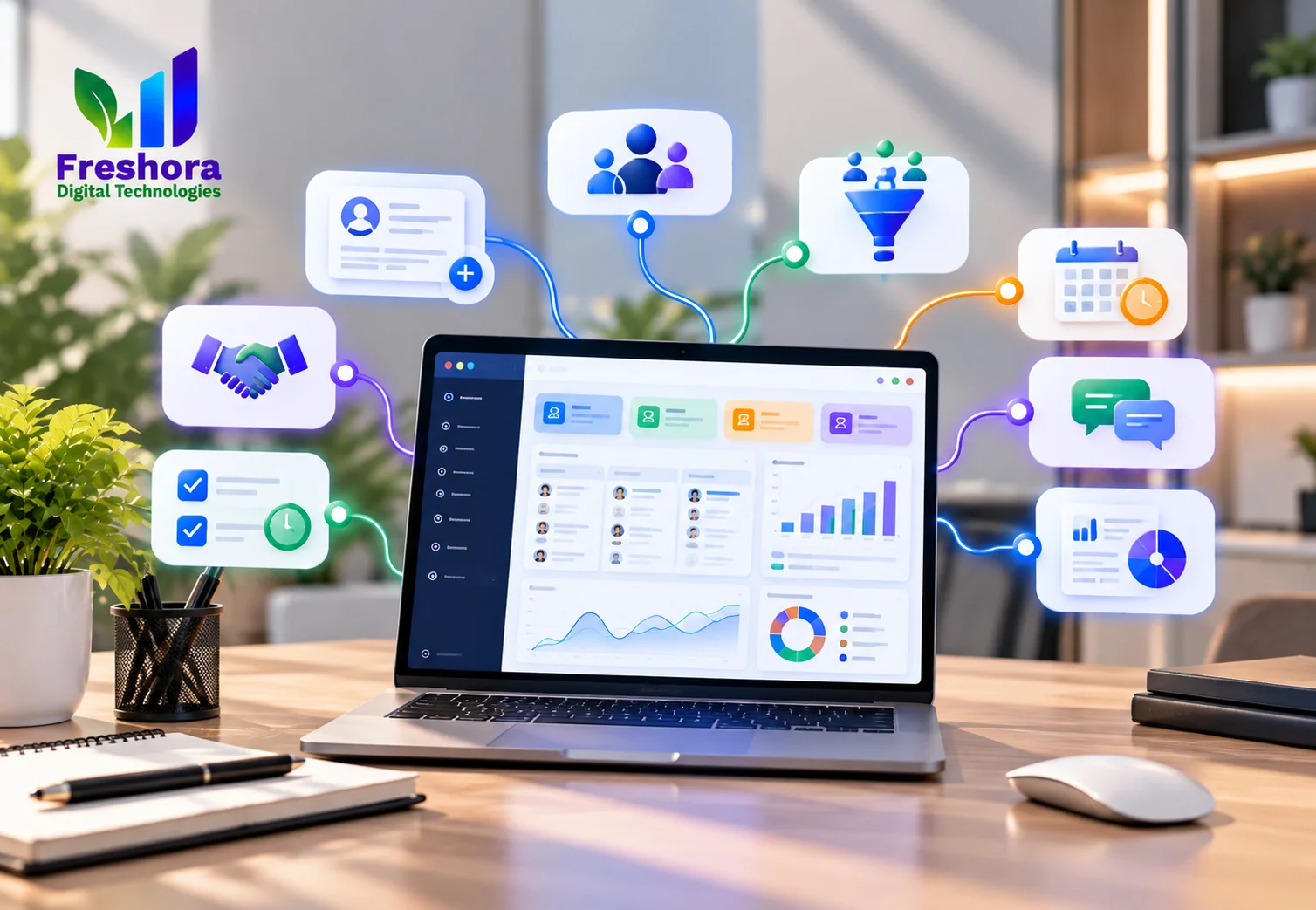
Our crm development services in singapore cover the customer-management functions that sales and service teams use every day. We structure the CRM around the information that needs to be captured, the actions teams need to take and the customer journey that follows each enquiry.
IMDA's CRM category highlights lead nurturing, customer relationships, shorter sales cycles, customer insights, role-based access, lead and opportunity tracking and marketing campaigns. We use those core requirements as a practical foundation and customise the system around the business process.
We keep the CRM focused on customer relationships, sales activity and customer-facing workflows. Finance, inventory, procurement and other operational functions can remain in the systems designed to manage them and connect to the CRM where the workflow requires it.
We start with the customer lifecycle rather than a list of CRM screens. Before development, we map where a lead comes from, who handles it, what information needs to be recorded, how the opportunity moves through sales and what happens after the deal.
That gives us a clearer basis for deciding what should be automated, what should remain a human action and what information should be connected to another system.
Our CRM work follows four stages: Understand, Structure, Build and Improve.
How do leads and customers move through the business today?
We review lead sources, sales stages, customer records, follow-ups, communication, user roles and the systems already involved in the process.
This shows us where the current process is losing information or creating unnecessary manual work.
What should the CRM capture and what should happen next?
We define customer records, pipeline stages, fields, workflows, activities, permissions, dashboards and integration points.
The result is a CRM structure that matches the actual sales and customer-management process.
How should the CRM work for sales and customer teams?
We develop the interface, workflows, data structure, business rules and integrations required by the approved scope.
We design the CRM so users can find information quickly and know what action is expected next.
Where can the CRM remove friction after launch?
We review user feedback, pipeline usage, recurring manual tasks, reporting requirements and workflow gaps.
We then improve the CRM around the work the business is actually doing.
A sales team should not have to search through spreadsheets, inboxes and disconnected notes to understand what happened with a lead. The CRM should show the customer record, recent activity, current stage, responsible user, next follow-up and relevant context in one place.
We use that principle when shaping the interface, workflow rules and dashboards so the CRM supports action rather than becoming another database that employees have to maintain manually.
Singapore's business environment combines strong digital adoption with a wide range of SMEs and larger organisations. IMDA's current CRM guidance identifies CRM as a business solution for managing customer data, leads, opportunities and campaigns, with cloud, mobile and web accessibility among the expected capabilities for pre-approved CRM solutions.
We use that practical environment to shape CRM projects around accessible customer information, sales visibility, follow-up discipline and integration with the digital systems the business already uses.
A professional-services firm may prioritise enquiries, proposals and client relationships. A retailer may need customer history and repeat-purchase visibility. A B2B distributor may need account-specific contacts, quotations and sales stages. A growing company may need the CRM to bring website enquiries, sales activity and management reporting together.
We build the CRM around those differences instead of assuming one fixed customer journey works for every business.
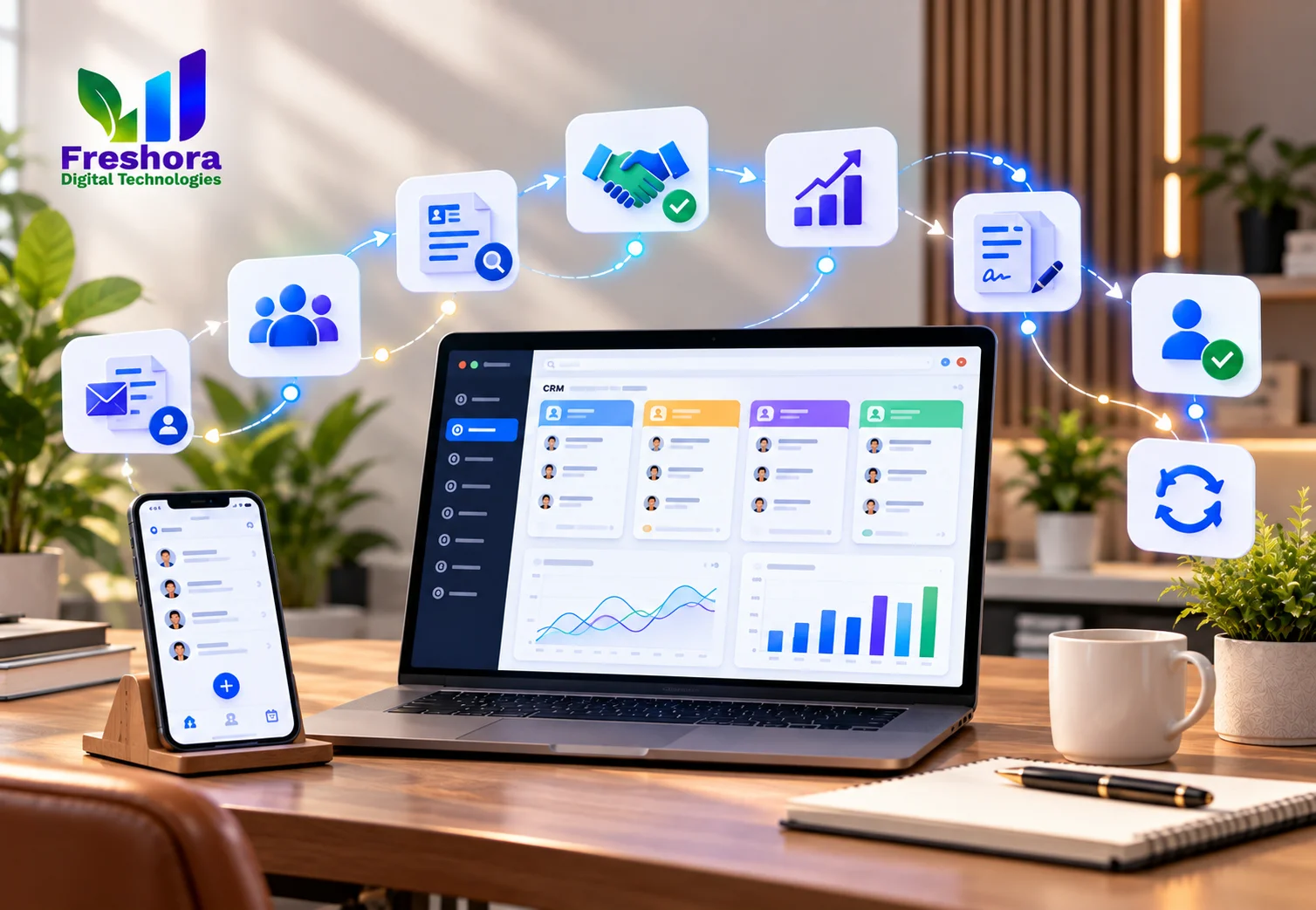
CRM software should give sales and customer teams a shared view of what is happening with each customer.
We structure CRM workflows around the stages that matter to your business, from the first enquiry to qualification, proposal, negotiation, conversion, onboarding, repeat business and ongoing customer communication.
We keep the customer journey visible from first contact to the next meaningful action. That helps teams reduce lost follow-ups and gives management a clearer view of the pipeline.
Packaged CRM platforms can handle many common sales and customer-management requirements. Custom CRM development becomes more useful when your process includes specific workflows, roles, integrations, data structures or customer experiences that need to fit together in a particular way.
We first identify the gap between the standard process and the actual way your team works. Then we decide where custom development creates enough value to justify it.
Build sales and customer flows around the specific stages, records and decision points used by your industry.
Assign leads based on location, service, product, sales team, customer type or other business rules.
Create stages, activities, approvals and reporting around the actual sales cycle rather than forcing every team into a generic pipeline.
Give customers access to approved account information, enquiries, documents, requests, quotations or service updates.
Control what sales users, managers, administrators, support teams and other roles can view or manage.
Build dashboards around the pipeline, sales activity, follow-ups, customer service and management metrics that matter to the organisation.
Automate reminders, assignments, notifications and defined actions that otherwise require repetitive manual work.
Model the customer, account, product, service and relationship information around the data your business actually needs.
We do not build a custom CRM simply to recreate features that already work well in established platforms. The strongest reason for custom CRM development is a workflow, integration or customer-management requirement that standard software does not fit efficiently.
That keeps the CRM investment focused on the business process instead of adding unnecessary complexity.
A CRM should not become another isolated database. Leads may arrive through the website, products may be managed through an e-commerce platform, financial information may sit in accounting software and operational information may be handled by an ERP.
We connect the CRM with the systems involved in the customer journey so the right information reaches the right team at the right stage.
We keep the CRM boundary clear. Customer profiles, leads, opportunities, sales activity, communication and follow-ups belong to the CRM layer. Finance, inventory, procurement and other operational functions can remain in their dedicated systems and exchange information through defined integrations.
This makes the architecture easier to understand and reduces unnecessary duplication of business data.
CRM systems often contain names, contact details, account information, communication history, sales activity and other customer-related information. In Singapore, organisations handling personal data have obligations under the PDPA covering areas such as notification, purpose limitation, protection, retention, transfer and access or correction.
We plan the CRM data model and user access around those requirements and the organisation's own data policies.
Give users access to the customer and sales information required for their roles.
Control which customer records, fields and activities different user groups can access or manage.
Build appropriate application and infrastructure controls around sensitive customer information.
Support processes for reviewing and removing customer data when it is no longer required for business or legal purposes.
Structure customer records so authorised teams can find and update information accurately.
Keep important customer and sales actions traceable where the business process requires it.
The exact controls depend on the CRM's data, users, integrations and industry. We treat data protection as part of the system design rather than as a feature added after the CRM is built.
Customer-management workflows vary by industry. We shape the CRM around how enquiries become customers, how teams communicate and what information management needs to see.
Lead capture, property enquiries, agent assignment, viewing follow-ups, pipeline stages and customer communication.
Enquiries, client records, proposals, follow-ups, meetings, relationship history and account management.
Course enquiries, admissions leads, follow-ups, applicant information and communication workflows.
Enquiry and appointment workflows, contact records, communication and controlled access around applicable systems.
Lead and customer records, sales activity, follow-ups, account relationships and role-based access.
Customer profiles, enquiries, purchase-related information, repeat engagement and customer service workflows.
B2B account management, quotation enquiries, sales pipelines, customer communication and follow-up workflows.
Distributor and account management, enquiries, sales opportunities, quotations and customer relationship tracking.
Project enquiries, business contacts, quotation follow-ups, client relationships and sales pipelines.
Enquiries, customer preferences, booking-related communication and repeat customer relationship management.
Lead qualification, product enquiries, account management, demos, sales pipelines and customer success workflows.
A central customer-management system that brings leads, sales activity, follow-ups and customer records together as the team expands.
Businesses often reach a point where their existing CRM, spreadsheets or multiple customer databases no longer provide a reliable view of the sales pipeline.
We review the current data structure, workflows and integrations before deciding whether the right next step is improvement, reconfiguration, migration or a new CRM application.
Before migration or redevelopment, Freshora can review:
Migration should not be treated as copying tables from one system to another. We map the information to the new structure, identify duplicates and gaps, validate important records and test the workflows that sales and customer teams rely on.
The objective is a cleaner customer-management process with a clearer path forward for the team.
A CRM project should move from business process to tested software in a clear sequence.
We review lead sources, customer types, sales stages, follow-ups, users, reporting needs, existing systems and business objectives.
We define customer records, fields, pipelines, activities, user roles, permissions, dashboards, workflow rules and integration points.
We design the CRM screens, navigation, forms, dashboards and user journeys around the tasks the sales and customer teams need to complete.
We develop the CRM application, business rules, workflows, user roles and approved integrations according to the agreed structure.
We test important workflows, permissions, forms, integrations, reports, customer records and edge cases before the CRM is introduced to users.
After launch, we can continue with technical maintenance, workflow improvements, integrations, reporting changes and CRM enhancements as the business evolves.
Singapore businesses can choose from established CRM platforms, platform implementation partners and custom software providers. The difference is often how closely the system can be fitted to the business process and how well it connects with the systems already in use.
Freshora focuses on the application layer around your customer lifecycle. We combine software development, UI/UX, integrations and business-process thinking so the CRM is built around how your team captures leads, manages opportunities, communicates with customers and follows up.
We support 106+ Singapore businesses, have delivered 75+ projects for Singapore businesses, served 35+ industries and have 42+ professionals working across technology, development, design, SEO and digital services.
Our broader technology capability also means CRM projects can connect naturally with software development services when the customer-management system needs to work with a wider business application.
We start with the customer journey, sales process and team responsibilities before designing CRM screens.
Build customer-management functionality around business-specific workflows, records, roles and rules.
Connect CRM data with websites, ERP, e-commerce, email, APIs and other approved systems involved in the customer journey.
Make customer information, pipeline stages, follow-ups and next actions easier for the team to understand and use.
We consider access, protection, retention and responsible handling of customer information within the CRM design.
Improve workflows, integrations, reports and customer-management features as the business changes.
A CRM software development company builds or customises systems used to manage leads, customers, sales pipelines, follow-ups, communication and customer-related workflows. Freshora develops CRM solutions around the processes and systems used by the business.
Freshora provides custom CRM development, lead and customer management, sales pipeline development, follow-up automation, dashboards, customer portals, CRM integrations, data migration, workflow automation and ongoing CRM improvement.
Yes. We can build custom CRM software around the business's sales process, customer lifecycle, user roles, data structure, workflow rules and integration requirements.
Yes. We can plan integrations with websites, forms, email systems, WhatsApp-based communication workflows, ERP systems, e-commerce platforms, APIs and other approved applications where the required technical access is available.
We design CRM access and workflows with data protection, permissions, security, retention and responsible handling in mind. Where personal data is involved, the CRM should be implemented in line with applicable Singapore requirements, including the PDPA.
Yes. We can plan CRM migration around the existing data structure, field mapping, duplicate handling, customer records, lead data, historical information, workflows and validation requirements.
The timeline depends on the CRM scope, number of users, modules, workflow complexity, integrations, data migration and testing requirements. A focused CRM application will usually have a smaller scope than a fully connected customer-management platform.
Your CRM should give your team a clear view of leads, customers, opportunities, follow-ups and the next action without forcing your sales process into a structure that does not fit.
Freshora develops custom CRM software for Singapore businesses, covering customer records, sales pipelines, workflow automation, communication, dashboards, integrations and CRM migration.
With 106+ Singapore businesses supported, 75+ projects delivered for Singapore businesses, 35+ industries served and 42+ professionals supporting our digital work, we bring software, design and integration capabilities into every CRM project.
Tell us how you capture leads, manage customers and track sales today. We can discuss the CRM structure and development approach around your actual workflow.
Get exclusive digital marketing tips, SEO insights, web & app updates, and job opportunities delivered straight to your inbox.
Join our WhatsApp channel for instant digital marketing tips, SEO insights, web & app updates, and latest job opportunities.
Join NowFreshora Digital Technologies proudly serves businesses across Singapore, including Central Business District (CBD), Marina Bay, Raffles Place, Marina Centre, Orchard Road, Bugis, Tanjong Pagar, Shenton Way, HarbourFront, Jurong East, Jurong West, Tuas, Woodlands, Sembawang, Yishun, Ang Mo Kio, Bishan, Toa Payoh, Serangoon, Hougang, Punggol, Sengkang, Tampines, Pasir Ris, Bedok, Changi, Changi Business Park, Kallang, Geylang, Paya Lebar, MacPherson, Tai Seng, One-North, Science Park, Buona Vista, Clementi, Queenstown, Bukit Merah, Bukit Batok, Bukit Panjang, Choa Chu Kang, and other major commercial, industrial, business, and residential areas across Singapore.
We also serve businesses across Asia and international markets, including India, Malaysia, Indonesia, Thailand, the Philippines, Vietnam, Hong Kong, Japan, and South Korea. Our global service reach extends to the United Arab Emirates, Saudi Arabia, Qatar, Kuwait, Bahrain, Oman, Canada, Australia, the United Kingdom, and the United States. Freshora Digital Technologies provides Website Development, Mobile App Development, Software Development, SEO, Google Business Profile Management, Digital Marketing, UI/UX Design, E-commerce Development, AI Solutions, and other digital technology services tailored to different industries and business requirements. We help businesses strengthen their online visibility, generate qualified enquiries, improve customer engagement, and support sustainable digital growth.

