
Contact our team for professional guidance and solutions.
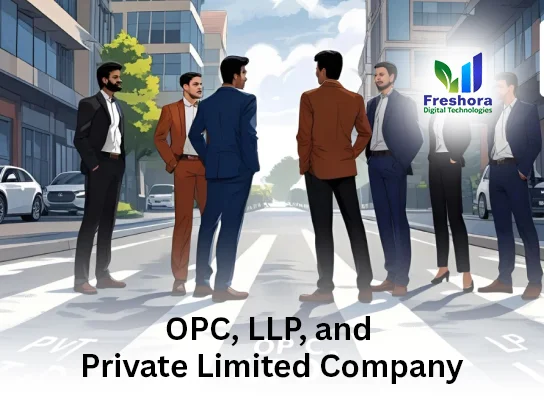
Choosing the right business structure is one of the most important decisions for any entrepreneur in India. The structure you choose impacts taxation, compliance, ownership, liability, fundraising capability, and long term growth. Among the most popular business structures in India are the One Person Company (OPC), Limited Liability Partnership (LLP), and Private Limited Company. Each structure has its own advantages, requirements, and ideal use cases. In 2025, with increasing entrepreneurship, digital registrations, and strong compliance frameworks, understanding the differences between OPC, LLP, and Private Limited Company is essential for setting up a legally compliant and scalable business.
Selecting the wrong structure can lead to unnecessary compliance costs, restrictions in growth, and operational challenges. On the other hand, choosing the right structure ensures smooth operations, better financial management, and long term stability. This comprehensive article explains the major differences between OPC, LLP, and Private Limited Company in 2025, helping business owners make informed decisions.
Before comparing, it is important to understand what each structure means.
An OPC is designed for single entrepreneurs who want full control of the business while enjoying limited liability protection. It is ideal for solo founders who want a simple corporate structure.
An LLP combines the benefits of limited liability with partnership style flexibility. It is suitable for professionals, consultants, and small businesses that require operational freedom with legal protection.
A Private Limited Company is a corporate structure with separate legal identity, limited liability, the ability to raise funds, and stronger compliance. It is ideal for startups and growing businesses.
In 2025, all three structures are widely used, but each fits different business needs and future plans.
Below are the major differences between these business structures based on ownership, compliance, liability, taxation, fundraising, and ideal suitability.
OPC:
Owned and managed by a single individual.
LLP:
Owned by partners. Minimum two designated partners required.
Private Limited Company:
Owned by shareholders. Minimum two shareholders required.
OPC provides single ownership, while LLP and Private Limited Company allow shared ownership.
OPC:
Owner enjoys limited liability similar to a company.
LLP:
Partners are protected from personal liability except in cases of fraud.
Private Limited Company:
Shareholders’ liability is limited to their shareholding.
All three structures offer limited liability, but companies have stronger legal protection.
OPC:
Has separate legal identity but limited in terms of ownership expansion.
LLP:
Full legal recognition with flexibility of partnership.
Private Limited Company:
Strong corporate identity, highly recognized by investors and institutions.
Private Limited Companies enjoy the strongest legal and corporate recognition.
OPC:
Moderate compliance. Less than a Private Limited Company.
LLP:
Lower compliance compared to companies. No mandatory audits unless turnover crosses a threshold.
Private Limited Company:
Highest compliance requirements. Mandatory annual filings, audits, and meetings.
Businesses that prefer lower compliance often choose LLP or OPC.
OPC:
Taxed as a Private Limited Company.
LLP:
Taxed as partnership firm with no dividend distribution tax.
Private Limited Company:
Corporate tax rates apply along with dividend tax rules.
LLPs often have simpler taxation compared to companies.
OPC:
Cannot raise equity funding.
LLP:
Limited fundraising options, generally not preferred by investors.
Private Limited Company:
Best structure for fundraising. Preferred by angel investors, VCs, and banks.
Startups aiming for funding must choose Private Limited Company.
OPC:
Can be converted into a Private Limited Company upon growth.
LLP:
Can be converted into a Private Limited Company with legal procedures.
Private Limited Company:
Easier to upgrade to Public Limited Company if required.
Private Limited Company offers the most growth flexibility.
OPC:
One director required, but can have more if needed.
LLP:
Minimum two partners.
Private Limited Company:
Minimum two directors required.
The choice depends on whether the business has multiple founders or a single owner.
OPC:
Solo entrepreneurs, freelancers, consultants.
LLP:
Professional firms, service companies, small businesses.
Private Limited Company:
Startups, growing enterprises, technology companies, funded businesses.
Each structure suits different business goals.
OPC:
Limited scalability due to ownership restrictions.
LLP:
Scalable but not ideal for large investor-driven businesses.
Private Limited Company:
Highly scalable with unlimited growth opportunities.
Private Limited Company is ideal for long term expansion.
· You are a solo entrepreneur
· You want complete control
· You prefer low compliance
· You need limited liability with simple structure
· You have multiple partners
· You prefer flexibility and low compliance
· You run a consultancy or service-based business
· You want limited liability without heavy maintenance
· You plan to raise investments
· You want strong corporate identity
· You want long term scalability
· You need strict legal protection and compliance
Understanding the differences between OPC, LLP, and Private Limited Company is essential for choosing the right business structure. Each structure offers unique advantages and limitations, depending on ownership, compliance needs, taxation, and growth goals. In 2025, with increasing digital compliance and stronger business regulations, selecting the correct business structure ensures long term stability, financial discipline, and professional growth. Whether a business chooses OPC for simplicity, LLP for flexibility, or Private Limited Company for scalability, the right foundation ensures smoother operations and a stronger market presence.
Freshora Digital Technologies follows all essential compliance guidelines and maintains proper documentation to operate responsibly in India. With a strong commitment to ethical governance, transparent business practices, and digital excellence, the company continues to support India’s economic development and contribute to the nation’s progress.

Executive Summary Trichy (Tiruchirappalli) is rapidly evolving into one of Tamil Nadu's most dynami... Read More
Executive Summary Tamil Nadu is home to one of India's largest and most dynamic small business ecos... Read More
Executive Summary Lead generation has become one of the most important priorities for businesses in... Read More
Our expert will call you shortly to understand your needs and help grow your business.
Get exclusive digital marketing tips, SEO insights, web & app updates, and job opportunities delivered straight to your inbox.
Join our WhatsApp channel for instant digital marketing tips, SEO insights, web & app updates, and latest job opportunities.
Join NowFreshora Digital Technologies proudly serves businesses across Tiruchirappalli (Trichy), including Cantonment, Puthur, Thillai Nagar, Palakarai, Subramaniyapuram, Mela Chinthamani, Woraiyur, KK Nagar, Karumandapam, Crawford, Edamalaipatti Pudur (EMP), Kattur, Airport Area, Ariyamangalam, Panjappur, Thuvakudi, Tiruverumbur, BHEL Township, Srirangam, Thiruvanaikaval, Samayapuram, No.1 Tollgate, Central Bus Stand Area, and Chathiram Bus Stand Area.
We also serve clients across Tamil Nadu, India, and globally in Singapore, the UAE, Saudi Arabia, Canada, Australia, the United Kingdom, and the United States, delivering innovative Website Development, Mobile App Development, Software Development, SEO, Google Business Profile Management, and Digital Marketing solutions that help businesses grow and succeed in the digital world.


