Corporate and Company Websites
We design websites for companies that need a professional public-facing presence with clear company information, services, expertise, industries and enquiry paths.

Websites Designed Around Your Business, Customers and Content
A business website needs to make important information easy to understand from the first visit. Visitors should know what the company does, which services are relevant to them, why the business is worth considering and where to go next.
We provide web design services in Singapore for businesses that need clear page structures, thoughtful visual presentation, responsive layouts and practical customer journeys.
Our work focuses on the design of the public-facing website: how pages are organised, how information is presented, how navigation works, where important actions appear and how the overall website experience feels across desktop, tablet and mobile devices.
Whether the requirement is a new corporate website, a service-based business website, a landing page or a redesign of an existing website, we build the design around the business and the people using it.
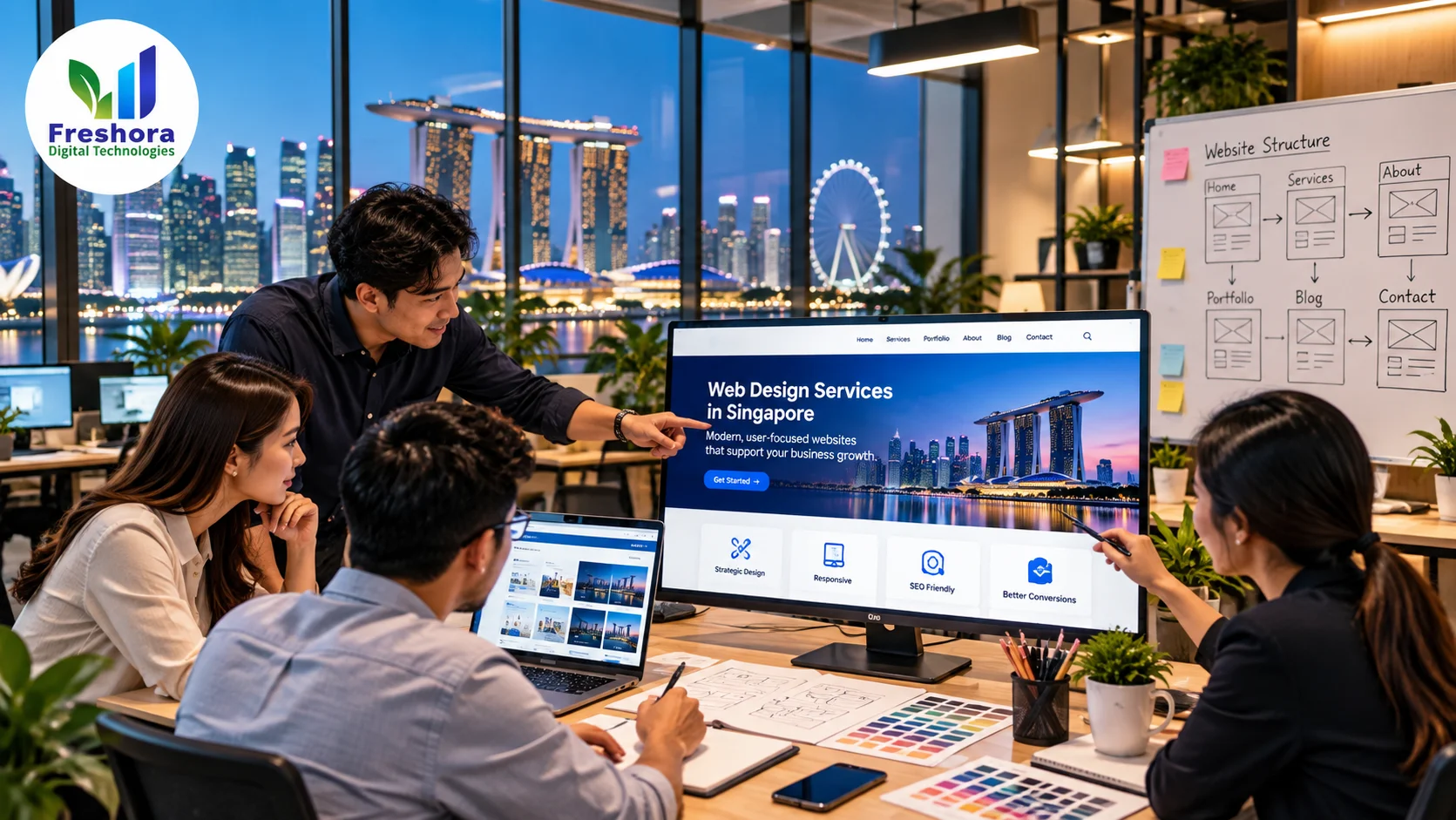
Website design involves more than choosing colours, images and fonts. The structure of every page influences how quickly visitors understand the business and how easily they move towards the information or action they need.
We approach website design by looking at the complete public-facing experience, from the homepage and navigation through to individual service pages, contact paths and supporting content.
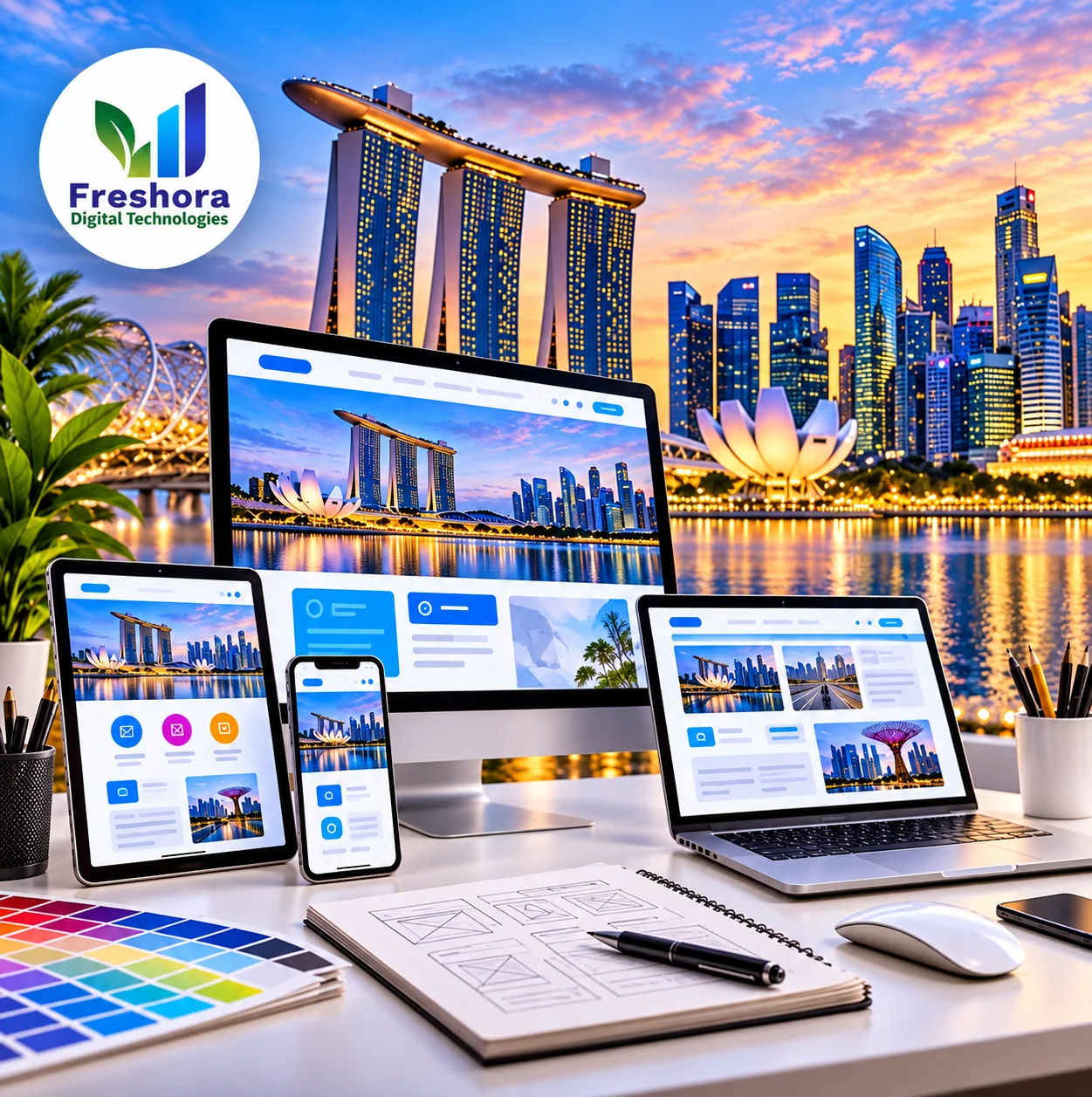
Corporate websites need to communicate a company clearly to different groups of visitors, including customers, business partners, prospective employees and other stakeholders. We design corporate websites with clear information structures, strong visual hierarchy and page layouts that make important company information easy to find. The design may include company overview pages, services, industries, case studies, leadership or team information, careers, contact pages and other sections relevant to the organisation.
B2B websites often contain detailed information that needs to be presented without overwhelming the visitor. We create page structures that separate services, capabilities, industries, solutions, supporting information and enquiry paths in a logical way. For Singapore-based B2B companies, the design needs to communicate expertise while making it easy for a prospective client to understand what the business actually offers.
Service businesses depend heavily on how quickly visitors understand their services. We design service websites with clear service navigation, focused page layouts, visible enquiry paths and supporting information that answers common customer questions before the visitor contacts the company. Each major service should have enough space to explain what is offered rather than forcing multiple services into a single crowded page.
An existing website may still contain useful content, search visibility and customer information even when its visual design no longer reflects the business. We redesign websites by first looking at the existing page structure, content organisation, navigation and visual presentation. The redesign process considers which parts of the existing website should remain, which areas need restructuring and how the new design should improve the visitor experience.
A landing page has a different purpose from a full business website. We design landing pages around a specific campaign, service, offer or customer action. The layout keeps the visitor focused on one objective while providing the information needed to make a decision. This may include a strong opening section, supporting proof, service details, key benefits, frequently asked questions and a clear enquiry or conversion path.
A website needs to work comfortably across different screen sizes. We design responsive layouts that adapt content, spacing, navigation, images, buttons and page sections for desktop, tablet and mobile use. The design is considered across screen sizes rather than treating the mobile version as a smaller copy of the desktop layout.
Different pages serve different purposes. A homepage introduces the business. A service page explains a specific offering. An industry page addresses a particular audience. A case study provides evidence. A contact page makes the next step clear. We design each page around its role within the website rather than applying one layout to every section.
Good design starts with understanding the information that needs to be presented. We work with headings, paragraphs, images, service descriptions, trust elements, FAQs, case studies and calls to action so the page remains easy to scan. The layout gives important information enough visual space without creating unnecessary sections simply to fill the page.
Navigation should make the website easier to explore. We structure menus around how visitors are likely to look for information, grouping related services and important business sections in a practical way. For companies with many services, the challenge is often not the number of pages but how those pages are organised so visitors know where to go.
Calls to action need to appear where the visitor has enough information to take the next step. We position enquiry buttons, contact options, forms and other actions according to the content and purpose of each page. The design avoids making every section compete for attention and gives important actions appropriate visual priority.
Different businesses require different website structures. The following project types represent the areas where web design needs a defined structure, clear visual presentation and practical customer journeys.
We design websites for companies that need a professional public-facing presence with clear company information, services, expertise, industries and enquiry paths.
Professional businesses often need to explain complex services without making the website difficult to navigate. We use structured page layouts to separate expertise, services, industries, case studies and useful supporting information.
Local businesses need visitors to understand the service, coverage, operating details and next step quickly. We design pages around practical customer questions and clear enquiry paths without filling the website with unnecessary information.
Property-related businesses often present multiple services, developments, locations and enquiry options. We structure the website so visitors can move between the information they are looking for without becoming lost in a large menu or crowded homepage.
Restaurants, cafes and F&B businesses need visual content to work alongside practical information. We design layouts that give appropriate attention to menus, locations, services, reservations, promotions, events and other business information.
Education and training websites usually serve several audiences at once. The design needs to make courses, programmes, schedules, admissions, facilities, frequently asked questions and contact information easy to locate.
Technology companies often have technically detailed offerings that require careful information hierarchy. We structure the website so visitors can understand the product or service at a general level first and then explore more detailed information where appropriate.
Campaign pages need a more focused structure than a full corporate website. We design dedicated landing pages around one campaign goal, service, product or audience, keeping the visitor's attention on the intended action.
For existing websites, we review the current structure before introducing a new visual direction. The redesign focuses on the areas that affect how customers experience the website, including navigation, page organisation, visual hierarchy, mobile layouts and conversion paths.
We Are Expertise In
Singapore businesses serve audiences that often expect information to be available quickly and clearly.
A visitor researching a professional service may want to understand the company's expertise before making contact. Someone looking for a local service may immediately look for service details, location information and enquiry options. A B2B buyer may spend more time reviewing capabilities, industries, case studies and company information.
The website design needs to reflect these differences.
For a Singapore professional-services firm, the homepage might need to establish credibility before directing visitors towards specialised services.
For a local service company, service navigation and contact actions may need to be much more prominent.
For a technology company, the design may need to introduce complex offerings gradually, allowing visitors to move from a simple explanation into detailed product or technical information.
For a retail or F&B business, imagery, product information and location-based actions may play a larger role.
We design around these practical differences instead of applying the same page structure to every industry.
Local relevance should appear through the way information is structured, not through repeatedly placing the word "Singapore" throughout the page.
For a business serving multiple areas in Singapore, the website may need clear service coverage information.
For a professional company, the design may need to present business expertise and supporting evidence in a straightforward way.
For a company with several services, the navigation should make it easy to move from a broad category into the specific service the visitor needs.
For businesses operating across multiple locations, the website structure should make location information accessible without creating unnecessary duplication.
The goal is to make the website feel relevant to the actual way the business operates in Singapore.
Visitors rarely read a business website from top to bottom.
They usually scan, compare, look for specific answers and decide whether to continue.
A strong web design therefore considers the sequence of decisions a visitor makes.
A homepage may answer:
What does this company do?
Who is it for?
Why should I continue exploring?
A service page may answer:
What exactly is offered?
Is this relevant to my situation?
What information should I know before enquiring?
A case study may answer:
Has this type of work been handled before?
A contact page may answer:
What is the easiest way to start a conversation?
We use this decision sequence when structuring page layouts so information appears where it is most useful.
Large service lists often create one of two problems.
Everything is placed into one long page, making it difficult to find a specific service.
Or each service exists separately without a clear relationship between the pages.
We structure service navigation so visitors understand the main categories and can reach individual services without unnecessary clicks.
The same principle applies to industries, solutions, locations and other larger website sections.
A larger website does not automatically need a more complicated interface. It needs clearer relationships between pages.
A redesign should begin with the existing website rather than ignoring everything that already exists.
We review the current navigation, important pages, content hierarchy, visual presentation and user journeys.
The redesign may involve:
The right approach depends on what the existing website is already doing well and which areas need to change.
A new website starts with a blank structure.
A redesign begins with an existing digital presence.
Businesses should consider a redesign when the existing content, page structure or business information remains valuable but the visual experience has become outdated or difficult to use.
A new design approach may be more appropriate when the business itself has changed significantly, the existing website structure no longer reflects its services or the information architecture needs to be rebuilt.
We review these situations before recommending the design direction.
We begin by understanding the business, its customers, services and the role the website needs to play. The design should reflect what the company actually needs visitors to understand.
We map important pages, service groups, navigation and information relationships. This creates a clear foundation before detailed visual design begins.
Not every page needs the same visual treatment. We identify the pages that carry the most important customer or business information and give them an appropriate structure.
Once the structure is clear, we work on typography, spacing, imagery, layout, buttons, content presentation and other visual elements. The design direction is applied consistently across the website.
The design is reviewed across desktop, tablet and mobile layouts. Content hierarchy and actions are adjusted where necessary so the experience remains practical at different screen sizes.
The final design needs to be understandable beyond the design file. We organise layouts, page patterns and design details so the design team and development team have a clear reference during implementation.
Before the design is finalised, we review the overall experience for consistency, clarity, navigation and page-level priorities. Changes are made where the structure or visual hierarchy needs improvement.
The design process becomes more productive when the business has a clear understanding of what the website needs to communicate.
Useful material includes:
Not every project starts with everything ready. We work with the available information and identify what needs to be prepared before each design stage.
The cost of web design depends on the size of the website, number of unique page types, design complexity, amount of content, responsive requirements and whether the project is a new website or a redesign.
A small business website with a few standard page types requires a different design scope from a large corporate website with multiple service categories, industry pages and custom layouts.
Other factors include:
We define the design scope around the actual website rather than treating every business as the same project.
A website should make the next step understandable.
Some visitors may want to call. Others may prefer a form, email, WhatsApp conversation, booking request or another route.
We design enquiry paths around the business model and the context of each page.
A visitor reading a high-value service page may need more information before contacting the company, while a campaign landing page may require a much shorter decision path.
The design gives each action the appropriate level of prominence.
A business website rarely stays the same after launch.
New services are added. New case studies are published. New locations may be introduced. Existing pages need updating.
A consistent design system makes these changes easier to manage.
We establish reusable patterns for headings, sections, buttons, cards, forms, spacing and other common elements while leaving room for pages that require a different structure.
This helps a growing website remain visually consistent without making every page look identical.
Corporate sites need a polished structure that communicates company information clearly while accommodating multiple stakeholders and business sections.
Service businesses need strong service navigation, detailed service pages and straightforward enquiry paths.
B2B websites require information structures that make detailed services, capabilities and proof easier to understand.
Local businesses often benefit from clear service information, coverage details, contact actions and easy-to-use mobile navigation.
E-commerce design focuses heavily on product discovery, categories, product presentation and the buying journey. Our focus on this page remains the public-facing design experience; platform development and store engineering belong to the dedicated e-commerce development service.
Campaign pages need focused structures built around a specific audience, offer or action rather than the broader information architecture of a corporate website.
We provide web design around the actual role a website needs to play in the business.
Our team works across page structure, visual hierarchy, navigation, responsive design, content presentation and customer journeys to create a public-facing website that is easier to understand and use.
We do not treat every website as the same type of project. A professional-services website, a local service website, a technology company website and a corporate website each require different information priorities.
Our broader digital work spans more than 275 businesses and 575 successful project deliveries across 35+ industries. A team of 42+ skilled professionals serves clients across 8+ countries and 15+ cities.
That experience gives us exposure to different business models, content structures and customer journeys.
For Singapore businesses, we apply that experience to the practical realities of local websites: clear service information, structured navigation, responsive layouts, easy enquiry paths and content that reflects the business rather than relying on generic page structures.
The design remains focused on the public-facing website experience while related specialist requirements are handled through the appropriate areas of the wider Freshora service portfolio.
The opening section should quickly communicate what the business does, who it serves and what the visitor should do next. The exact structure depends on the business. A service company may prioritise its main offering and enquiry action, while a corporate business may introduce its capabilities and key areas of expertise.
Services should be grouped into clear categories based on how visitors understand them. Important services should be easy to reach, while related pages should have logical relationships. A large menu is not necessarily a problem when the hierarchy is clear.
A redesign is often appropriate when the existing business information and useful pages remain relevant but the visual structure, navigation or presentation needs improvement. A new website structure may be more appropriate when the business, services or overall information architecture have changed substantially.
A corporate website provides a broader view of the company, its services, expertise and supporting information. A campaign landing page has a narrower purpose and is designed around one audience, offer or action.
They should appear where they support an important decision. A case study may strengthen a service page after the visitor understands the offering, while a testimonial may work near an enquiry action or alongside a relevant service.
We first work with the information that is available and identify the content required for each page. This allows the structure to develop around real business information rather than relying on placeholder text that later changes the layout.
A reusable design system helps maintain consistency. Common elements such as typography, spacing, buttons, cards, forms and content sections are defined so new pages follow the established visual language while still allowing different page types to have their own structure.
Your website should make your business easier to understand, easier to explore and easier to contact.
We provide web design services in Singapore focused on clear page structures, strong visual hierarchy, responsive layouts and practical customer journeys.
Build a website that presents your business clearly with Freshora Digital Technologies.
Get exclusive digital marketing tips, SEO insights, web & app updates, and job opportunities delivered straight to your inbox.
Join our WhatsApp channel for instant digital marketing tips, SEO insights, web & app updates, and latest job opportunities.
Join NowFreshora Digital Technologies proudly serves businesses across Singapore, including Central Business District (CBD), Marina Bay, Raffles Place, Marina Centre, Orchard Road, Bugis, Tanjong Pagar, Shenton Way, HarbourFront, Jurong East, Jurong West, Tuas, Woodlands, Sembawang, Yishun, Ang Mo Kio, Bishan, Toa Payoh, Serangoon, Hougang, Punggol, Sengkang, Tampines, Pasir Ris, Bedok, Changi, Changi Business Park, Kallang, Geylang, Paya Lebar, MacPherson, Tai Seng, One-North, Science Park, Buona Vista, Clementi, Queenstown, Bukit Merah, Bukit Batok, Bukit Panjang, Choa Chu Kang, and other major commercial, industrial, business, and residential areas across Singapore.
We also serve businesses across Asia and international markets, including India, Malaysia, Indonesia, Thailand, the Philippines, Vietnam, Hong Kong, Japan, and South Korea. Our global service reach extends to the United Arab Emirates, Saudi Arabia, Qatar, Kuwait, Bahrain, Oman, Canada, Australia, the United Kingdom, and the United States. Freshora Digital Technologies provides Website Development, Mobile App Development, Software Development, SEO, Google Business Profile Management, Digital Marketing, UI/UX Design, E-commerce Development, AI Solutions, and other digital technology services tailored to different industries and business requirements. We help businesses strengthen their online visibility, generate qualified enquiries, improve customer engagement, and support sustainable digital growth.

