Financial Services
Document analysis, knowledge assistants, customer-support workflows, risk-support tools and data-driven decision systems with appropriate controls.

Practical AI applications built around your business data, workflows and customers
Singapore businesses are moving from AI experiments to practical systems that support real work. Freshora helps businesses plan, build and integrate AI applications around the tasks that matter, from customer support and document processing to business intelligence, workflow automation and decision support.
Singapore's digital economy reached $128.1 billion in 2024, equal to 18.6% of GDP. IMDA also reported that AI adoption among SMEs more than tripled from 4.2% in 2023 to 14.5% in 2024, while non-SME adoption reached 62.5%. The opportunity is moving beyond trying AI tools to building AI into useful business processes.
We build custom AI development in Singapore around defined business outcomes. That can include generative AI applications, AI assistants, AI agents, machine learning, natural language processing, computer vision, predictive models and integrations with existing systems.
With 106+ Singapore businesses supported, 75+ projects delivered for Singapore businesses, 35+ industries served and 42+ professionals supporting our digital work, we bring development, design, data and technology capabilities together around the AI use case.
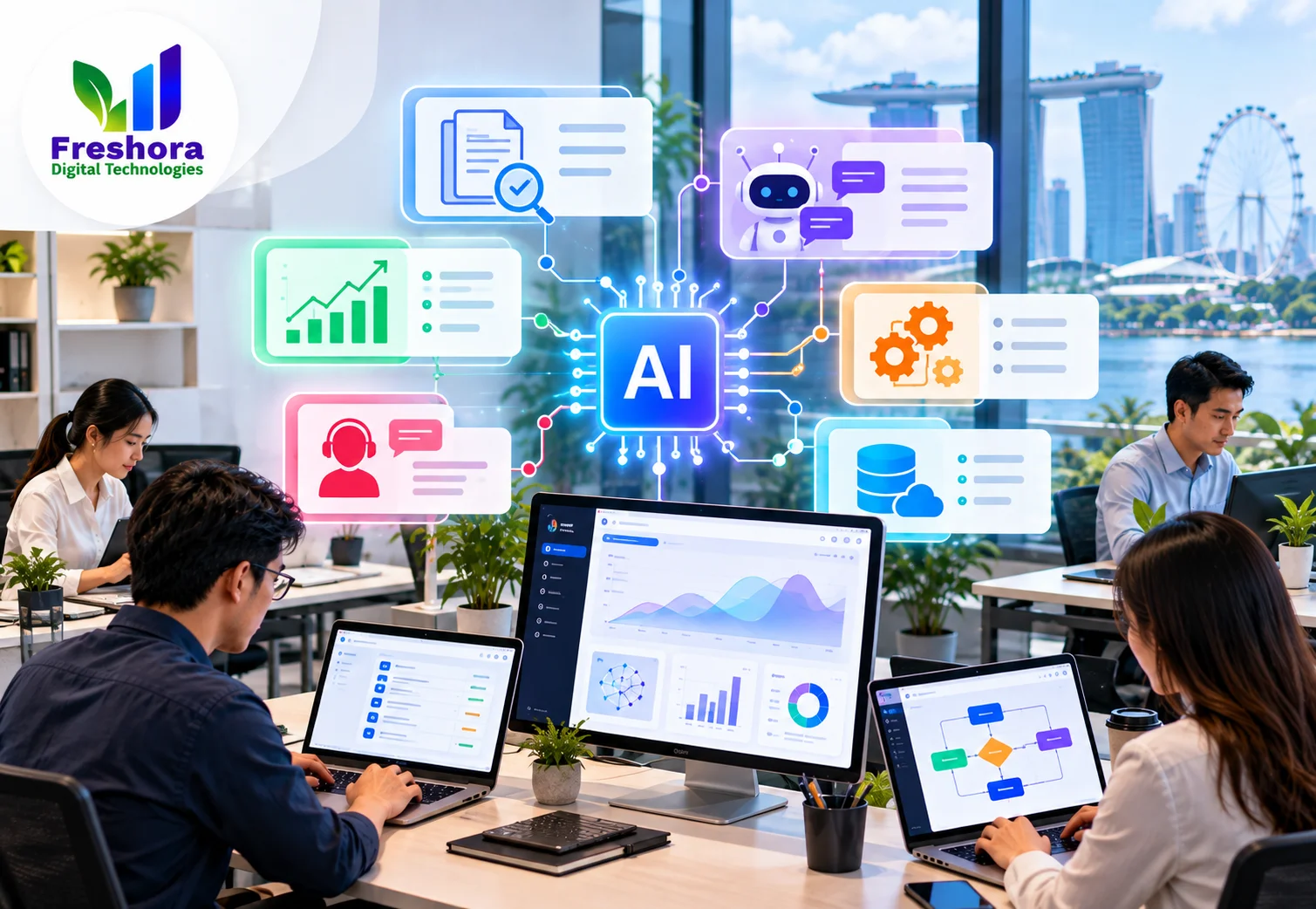
We focus on the application around the AI. The model is only one part of the solution. Data, user interaction, workflow, permissions, integrations, evaluation and monitoring all affect whether an AI system is useful in production.
Our ai development services in singapore cover practical AI use cases for customer-facing applications, internal operations, analytics and connected business systems.
We select the technical approach around the use case, data availability, accuracy requirements, user experience and systems that need to connect. This helps keep the AI solution useful after the initial demonstration.
A useful AI project starts with a clear problem. We first define what the AI should improve, who will use it, what information it needs and how the result fits into the business process.
Singapore has a high level of business digitalisation. IMDA reported that 95.1% of SMEs adopted at least one digital area in 2024, while 97% adopted at least one sector-specific digital solution. This means many AI projects need to work with existing digital systems rather than operate as isolated tools.
We therefore work through four stages: Understand, Design, Build and Improve.
What should the AI actually improve?
We examine the business process, users, information sources, repetitive tasks, decision points and existing technology.
This helps us identify a practical AI use case instead of starting with a model or trend.
How should the AI fit into the workflow?
We define the user journey, inputs, outputs, knowledge sources, system connections, approval points and expected behaviour.
For AI agents, we also define boundaries around actions, tools, data and human approval.
How should the solution work in production?
We develop the AI application, connect approved data sources and systems, create the interface and configure the required model or AI services.
We keep the application maintainable so the business can improve it as requirements change.
How will we know the AI is working well?
We evaluate important outputs, review failures, monitor behaviour and improve prompts, workflows, data or model choices where necessary.
The aim is a measurable and maintainable AI application rather than a one-time demonstration.
We keep the AI connected to the process around it. A customer-service assistant may need access to approved knowledge. A document system may need to extract information and send it into another application. A forecasting model may need regular data updates and a dashboard for the team using the result.
Where a broader software platform is involved, we keep the AI layer distinct from the underlying application so the roles of AI development and general software development remain clear.
Singapore is building a strong AI-enabled business environment. IMDA's 2025 report found that SMEs using AI under the Productivity Solutions Grant achieved average cost savings of 52% in 2024, while the country's National AI Impact Programme launched in 2026 is set to support 10,000 enterprises over three years.
For businesses, that creates a practical question: which process should AI improve first, and how should it connect to the systems already in use?
We do not treat AI adoption as a separate technology exercise. We look at the process around the proposed AI system: what information enters it, what decision or action follows, which systems it needs to access and where people need visibility or control.
That approach is especially useful for Singapore businesses that already have digital tools in place and now want to add intelligence, automation or decision support to those workflows.
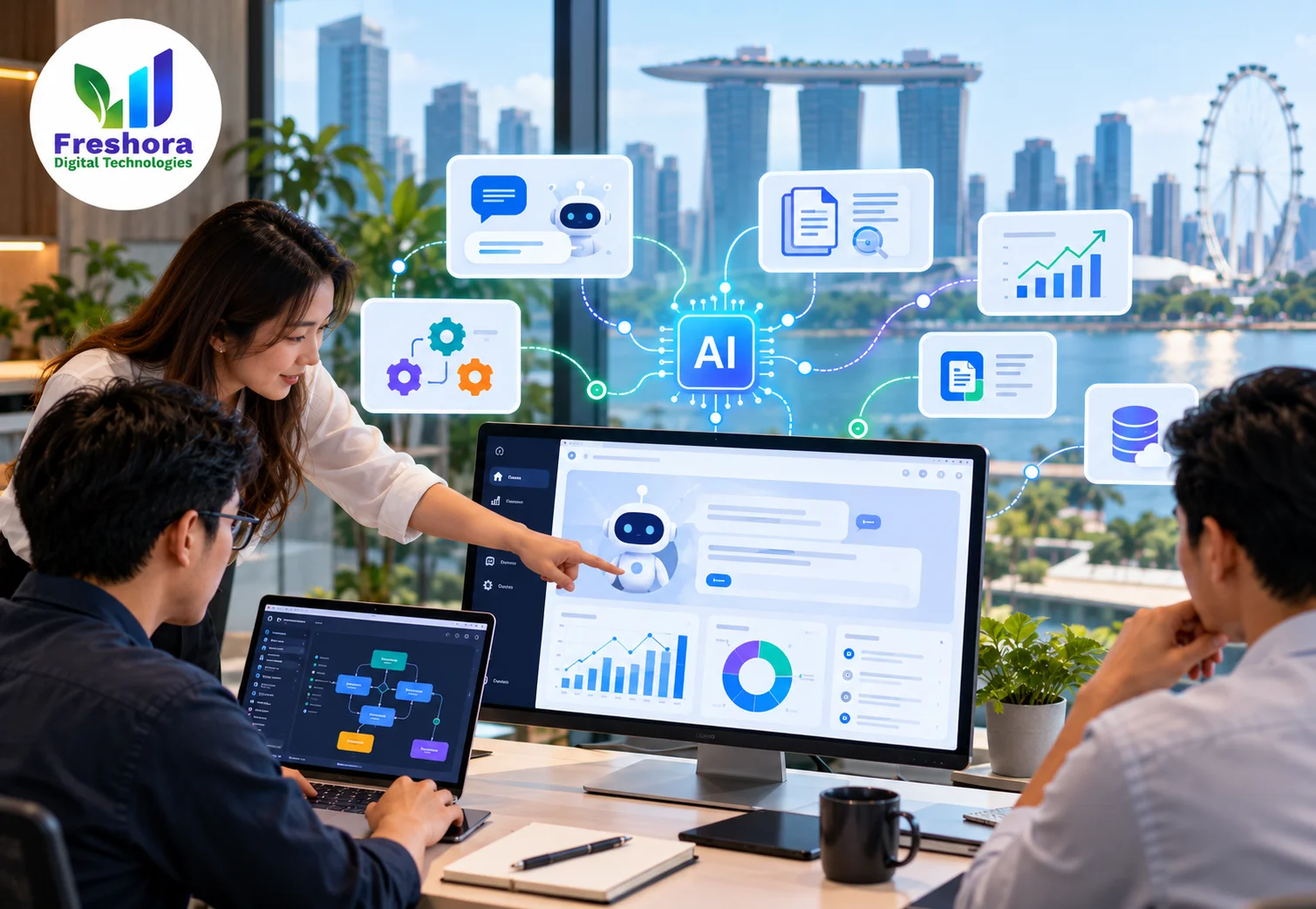
The same AI technology can support different functions when it is connected to the right data and workflow. We design the application around the job the user needs to complete.
Examples include AI systems that classify documents, answer questions from an approved knowledge base, summarise information, identify patterns, support customer conversations or help teams prioritise work.
We connect these applications to the surrounding business process so employees can act on the output instead of receiving another disconnected AI screen.
Off-the-shelf AI tools are useful for many tasks. Custom AI becomes more valuable when the business needs its own data, workflow, permissions, integrations, domain logic or user experience.
We look for a specific reason to build custom AI: a business process, customer experience, data environment or integration requirement that standard tools cannot handle cleanly.
Build an AI application around approved company documents, product information, policies, procedures and internal knowledge sources.
Connect AI to a defined workflow where information must be analysed, classified, summarised or routed before the next business action.
Connect AI with CRM, ERP, databases, web applications or other approved systems so the result becomes part of the existing process.
Develop machine learning or predictive models when the business has suitable data and a clear decision or forecasting problem.
Create different AI capabilities, access levels and actions for customers, employees, managers or administrators.
Automate repetitive information-processing tasks while keeping defined checkpoints for people when decisions or actions require review.
Build assistants, recommendations, search experiences or conversational interfaces around the products and services customers actually use.
Develop AI-enabled products where intelligence is part of the product experience rather than an external tool used by the team.
We do not recommend custom AI simply to add an AI label to a product. The business should be able to explain what the system will improve, what information it needs, how users will work with it and how success will be evaluated.
When the requirement is better suited to an existing tool, we can keep the architecture simpler. When the workflow genuinely requires a tailored AI layer, we build around that requirement.
An AI application's quality depends on more than the model. Data quality, retrieval, prompts, business rules, evaluation, user feedback and technical monitoring all influence the result.
We design the application so these parts can be reviewed and improved as the system is used.
A prototype can look impressive while failing on the cases that matter most to the business. We therefore focus evaluation on real tasks, known edge cases, expected outputs and the level of human review the workflow requires.
The evaluation approach depends on the application. A document extraction system may require field-level accuracy checks, while a conversational assistant may need tests for factuality, retrieval quality, refusal behaviour and response consistency.
Generative AI can create useful outputs from language, documents and other information. AI agents take this further by using approved tools and systems to perform defined actions.
Singapore's IMDA launched its Model AI Governance Framework for Agentic AI in January 2026 and updated it in May 2026 after feedback from 60+ organisations, adding more than 10 real-world case studies. The framework emphasises risk boundaries, meaningful human accountability, technical controls and end-user responsibility.
We apply those principles to the way we think about agentic solutions: define the job, limit the agent's authority, control the tools and data it can access, create approval points for higher-risk actions and test how it behaves before wider use.
Assist users with approved information, questions, summaries, search and routine knowledge tasks.
Retrieve relevant information from approved business documents and knowledge sources before generating a response.
Support bounded workflows where the agent may interpret information, call approved tools and complete defined actions.
Break a defined business task into controlled steps while keeping clear limits around what the system can execute.
Keep people involved at important checkpoints when actions are sensitive, difficult to reverse or likely to affect customers or business records.
Review actions, outputs, failures and usage patterns so the system can be improved as it operates.
AI becomes more useful when it can work with the information and systems already used by the business.
We can plan integrations with approved websites, web applications, CRM systems, ERP systems, databases, internal tools, communication platforms and analytics environments where the required technical access is available.
The integration is designed around the workflow rather than simply exposing an AI API.
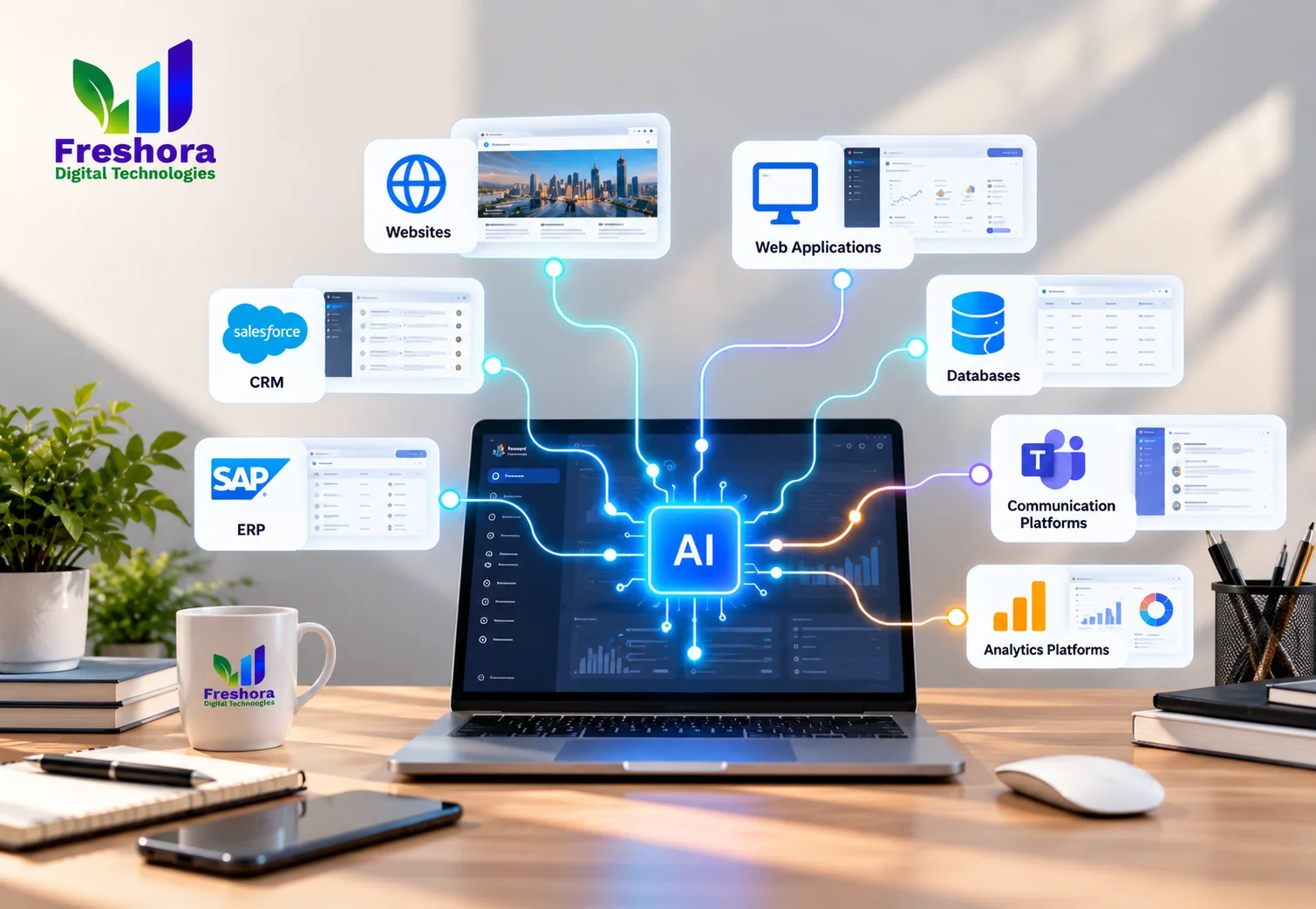
If employees still need to copy information between systems after an AI solution is introduced, much of the workflow remains manual. We therefore look at where data enters the process, where the AI adds value and where the result should go next.
This is where AI development connects naturally with Freshora's wider software development services in Singapore, while the AI page remains focused on the intelligence layer and its business use.
AI opportunities change with the data, decisions and workflows of each industry. We start with the business process and then choose the AI approach around it.
Document analysis, knowledge assistants, customer-support workflows, risk-support tools and data-driven decision systems with appropriate controls.
Product recommendations, conversational shopping, catalogue intelligence, customer support and demand forecasting.
Information retrieval, document processing, administrative assistance and other applications designed around approved data and workflows.
Knowledge assistants, learning support, content tools, document processing and administrative workflow automation.
Shipment information, document processing, operational alerts, forecasting and workflow support.
Quality inspection, predictive analysis, document intelligence and operational decision support.
Property information assistants, document processing, lead qualification and customer communication workflows.
Internal knowledge search, document analysis, summarisation, workflow automation and client-support tools.
Customer assistants, recommendations, knowledge systems and service workflow automation.
Document classification, project information search, reporting support and workflow assistance.
AI-native product features, knowledge systems, assistants, recommendation engines and intelligent workflow applications.
Focused AI applications and automation for teams that need to turn a specific workflow or product idea into a working system.
Businesses do not always need a new AI project. Sometimes an existing AI application has the right idea but needs better data, retrieval, user experience, evaluation, integrations or monitoring.
We can review the current application and identify where the AI system is creating friction, inaccurate outputs, manual work or unnecessary technical complexity.
AI systems evolve quickly. A solution built around one model, provider or workflow may need changes as the business grows or better technologies become available.
We review the existing architecture before changing it so the improvement work stays connected to the business objective and existing investment.
Our process keeps the AI use case, data, software integration and evaluation connected from the beginning.
We identify the business problem, users, existing process, expected outcome, available data and practical AI opportunity.
We review the data sources, system integrations, access requirements, model options and technical constraints that affect the solution.
We define the application architecture, user experience, AI workflow, knowledge sources, system connections and evaluation approach.
We build the AI application and connect the approved models, data sources, interfaces and business systems required by the use case.
We test important user journeys, AI outputs, edge cases, integrations, permissions and other behaviours that matter to the application.
After launch, we can continue with monitoring, technical maintenance, workflow improvements, evaluation and additional integrations.
Responsible AI is part of the engineering work. When an AI application uses business information or personal data, the design needs clear decisions about access, security, purpose, retention, testing, monitoring and human involvement.
Singapore's governance environment is practical and risk-based. IMDA's Model AI Governance Framework provides guidance for responsible AI, while the PDPC has specific guidance on the use of personal data in AI recommendation and decision systems. For financial institutions, MAS issued new AI Risk Management Guidelines on 7 October 2026; the guidelines cover all AI technologies and take effect from 7 October 2027.
We use these developments as engineering considerations rather than making a blanket claim that every AI project has the same compliance requirements.
Define which information the AI application can access and which users or systems can provide that information.
Keep meaningful human review where an AI output or action can materially affect customers, employees or business decisions.
Test important outputs, failure cases and application behaviour before the system is relied on in real workflows.
Review system performance and behaviour after launch so problems can be identified and addressed as usage changes.
Assess how external AI services fit into the architecture, data flow, security model and business requirements.
Define who owns the AI application, who reviews important results and who is responsible for business decisions around its use.
The Singapore AI market includes large technology services providers, enterprise AI specialists and focused AI studios. Many providers lead with large transformation programmes, AI platforms, agents, data engineering or specialist model capabilities.
Freshora takes a practical application-level approach. We bring AI into the business systems, customer experiences and workflows where the value needs to appear, while keeping the AI scope clearly defined.
Our Singapore work includes 30+ businesses supported, 75+ projects delivered, 35+ industries served and 42+ professionals working across technology, development, design, SEO and digital services.
We also work across the wider software environment, including UI/UX design in Singapore and software development, so AI applications can be considered as part of the product rather than as a disconnected add-on.
We begin with the business task, users and desired outcome before choosing the AI architecture.
We build the interface, workflow and integration around the AI so the result can be used inside the actual business process.
Our wider development and design capability supports integrations, product interfaces and surrounding software requirements.
We consider Singapore's digital adoption, user expectations, multilingual requirements and governance environment when they are relevant to the project.
We focus testing on the outputs and workflows that matter to the business rather than relying only on a successful prototype demonstration.
AI applications can be maintained and improved as models, data, workflows and business requirements change.
An AI development company builds and integrates AI systems that use data, models and software to support business tasks. Freshora develops custom AI applications, generative AI solutions, AI agents, machine learning systems, automation workflows and AI integrations for Singapore businesses.
Freshora provides custom AI application development, generative AI, AI assistants and agents, machine learning, natural language processing, computer vision, predictive analytics, AI automation, AI integrations, evaluation and ongoing improvement.
Yes. We can build an AI application around a defined business problem, user workflow, available data and integration requirements. The solution can be connected with existing web applications, databases, CRM, ERP or other approved systems.
Yes. We can integrate AI with existing applications and business systems where the required APIs, data access and technical interfaces are available. The integration is planned around the workflow the AI needs to support.
We plan AI systems with data access, purpose, permissions, security, retention and human oversight in mind. Where personal data is involved, the solution should be designed around applicable Singapore requirements, including obligations under the PDPA and relevant organisational policies.
Yes. We can develop AI agents for defined workflows where an agent needs to interpret information, use approved tools or systems and complete bounded actions. Agent autonomy, access, approval points, testing and monitoring are designed around the risk of the use case.
The timeline depends on the AI use case, data readiness, model requirements, integrations, interface, testing and deployment scope. A focused AI application can have a shorter build cycle than a connected enterprise system with multiple integrations and evaluation requirements.
AI works best when it is connected to a real business task, usable by the people responsible for that task and designed around the data and systems involved.
Freshora develops AI applications, generative AI solutions, AI agents, machine learning systems, automation workflows and AI integrations for businesses in Singapore.
With 106+ Singapore businesses supported, 75+ projects delivered for Singapore businesses, 35+ industries served and 42+ professionals supporting our digital work, we bring development, design and technology capabilities together around the AI project.
Tell us what you want the AI to improve, what systems it needs to work with and what outcome you want to achieve. We can discuss a practical development approach around the use case.
Get exclusive digital marketing tips, SEO insights, web & app updates, and job opportunities delivered straight to your inbox.
Join our WhatsApp channel for instant digital marketing tips, SEO insights, web & app updates, and latest job opportunities.
Join NowFreshora Digital Technologies proudly serves businesses across Singapore, including Central Business District (CBD), Marina Bay, Raffles Place, Marina Centre, Orchard Road, Bugis, Tanjong Pagar, Shenton Way, HarbourFront, Jurong East, Jurong West, Tuas, Woodlands, Sembawang, Yishun, Ang Mo Kio, Bishan, Toa Payoh, Serangoon, Hougang, Punggol, Sengkang, Tampines, Pasir Ris, Bedok, Changi, Changi Business Park, Kallang, Geylang, Paya Lebar, MacPherson, Tai Seng, One-North, Science Park, Buona Vista, Clementi, Queenstown, Bukit Merah, Bukit Batok, Bukit Panjang, Choa Chu Kang, and other major commercial, industrial, business, and residential areas across Singapore.
We also serve businesses across Asia and international markets, including India, Malaysia, Indonesia, Thailand, the Philippines, Vietnam, Hong Kong, Japan, and South Korea. Our global service reach extends to the United Arab Emirates, Saudi Arabia, Qatar, Kuwait, Bahrain, Oman, Canada, Australia, the United Kingdom, and the United States. Freshora Digital Technologies provides Website Development, Mobile App Development, Software Development, SEO, Google Business Profile Management, Digital Marketing, UI/UX Design, E-commerce Development, AI Solutions, and other digital technology services tailored to different industries and business requirements. We help businesses strengthen their online visibility, generate qualified enquiries, improve customer engagement, and support sustainable digital growth.

